Hard Drugs:
pp. 35-37 · Read in the full issue
the Crisis Now
Island nations face expanding drug trafficking, organised crime ... and a nudge toward self-help.
Beryl Cook reports.
“With young people going away to be educated and whatever, they sometimes come back with all these new ideas like discos and the habits that go with them.
So taking drugs could become a problem in the future, although there is always the question of whether they could afford them. People in the Pacific tend not to have the money so in a way that makes it less of a threat,” Simbolo said.
In Fiji, which lies on the main shipping routes and therefore trafficking routes, Director of the Fiji Council of Social Services Hassan Khan says grassroots social workers have been reporting the presence of cocaine and heroine in Fiji at least since last year. It has tended to be confined to the more elite, richer circles of society who can afford it, he said.
However, one source of funds for drugs could be the drug trade itself.
The experience of ex-senior Customs Officer in the Solomon Islands, Alfred Oti, is evidence that organised crime already has carved a path through the Pacific with the promise of large sums of fast, easy cash at least, Oti, who returned to the Solomons last month after serving a five-year jail sentence, was paid S5OOO a trip for
trafficking heroin from Asia to Australia. (See story page 37). Oti, an ex-Customs officer who is presumably more worldly than many islanders, seems not to differentiate between the potential effects of hard drugs like heroin and softer, legal options like cigarettes, alcohol and even kava.
“It is a narrowminded perception that (illegal) drugs are evil,” he said.
“Tobacco and alcohol are just as evil they are great human killers. Prohibition of narcotic drugs makes them go under ground and leads to activities like murder. Perhaps they should be legalised ... but it would have to be subject to
government-controlled supply.”
While Oti may have been referring more to the general affects of addiction and greed, there is no doubt most Pacific islanders are blissfully ignorant of the difference between drugs such as cocaine, heroine and even marijuana, particularly the actual physical effects of addiction to
particular drugs.
Pacific Islands Monthly’s efforts to ident ify centralised bodies solely responsible for drug education in the region were
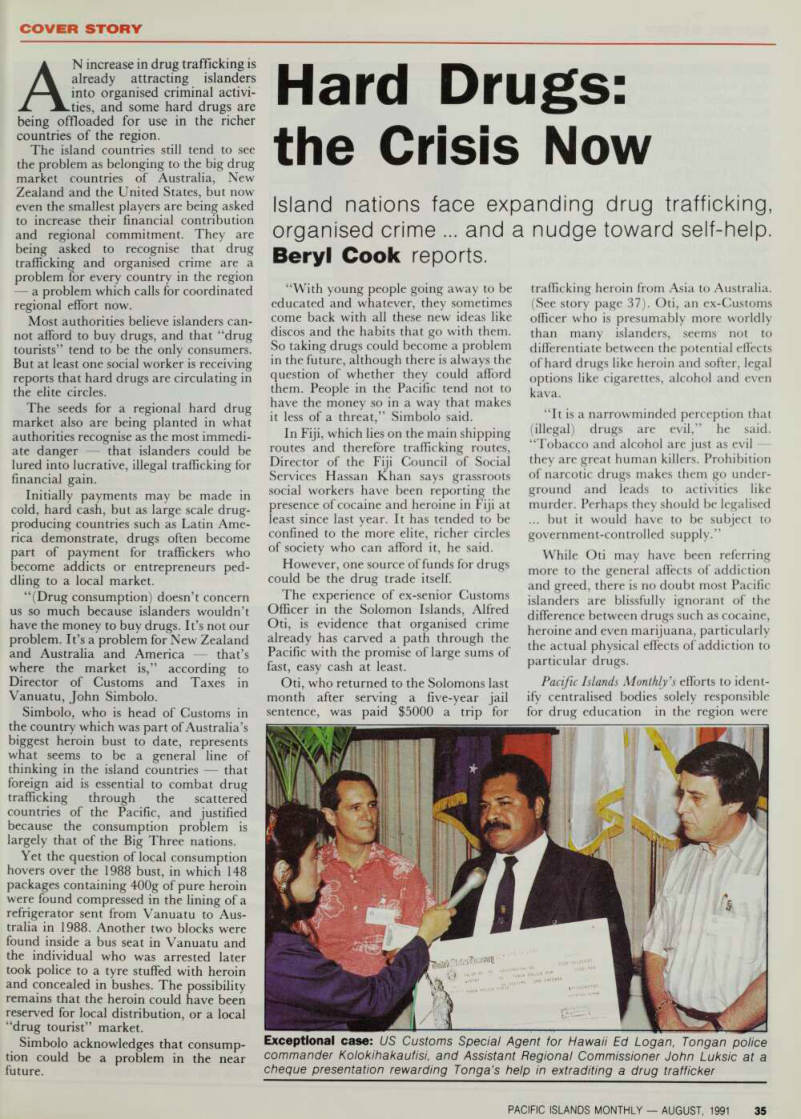
Exceptional case: US Customs Special Agent for Hawaii Ed Logan, Tongan police commander Kolokihakaufisi, and Assistant Regional Commissioner John Luksic at a cheque presentation rewarding Tonga’s help in extraditing a drug trafficker
largely fruitless the responsibility for drug education tends to fall on already overloaded education and general wel fare bodies, and on civic-minded individ uals who donate their time. No regional based, centralised education unit specifi cally for drugs has been formed.
The United States, Australia and New Zealand have contributed welcome but piecemeal assistance in preventive drug education and training customs officers.
But now, moves by these countries suggest it is time the Pacific islands play a greater part in the battle against drug trafficking.
The formal charter compiled at the last meeting of the Customs Heads of Administration Regional Meeting (CHARM) in Papua New Guinea noted that drug trafficking in the region is increasing. Yet funding for CHARM, which has come through Australian aid since 1986, has been scaled down and will finish in June, 1993. It had originally been scheduled to finish in June this year, but some additional aid has allowed it to continue as a partially funded event for another two years.
For the first time participating admin istrations will be required to fund a part, or all, of the costs associated with their attendance at the meeting.
On the positive side the Program Director, International Section, Austra lian Customs, Gerard McLinden, be lieves the Australian Customs Service (ACS) has provided an opportunity for
coordination and joint efforts on training and development in the region, a forum for joint approaches to organisations such as the United Nations Fund for Drug Abuse Control, the Economic and Social Commission for Asia and the
South Pacific, and the South Pacific Commission, and a forum for develop ment of operational Customs initiatives in the Intelligence field.
Drug trafficking, however, tends to be just a part of the general area covered by
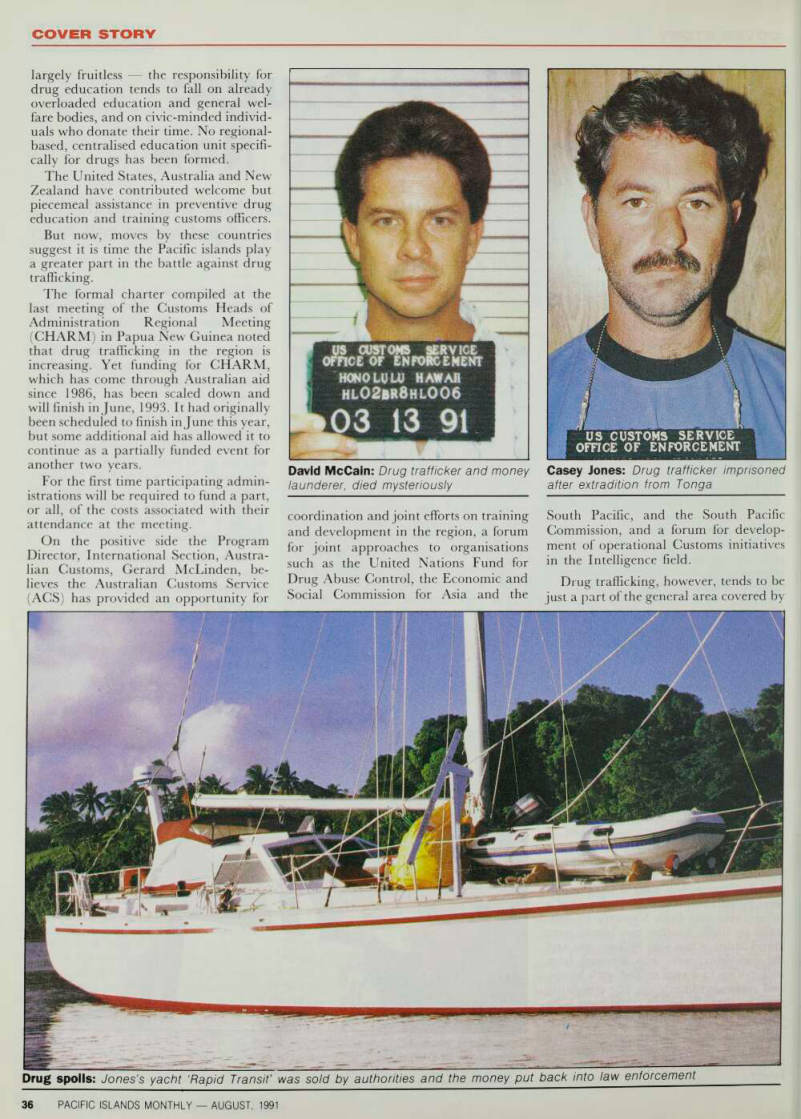
David McCain: Drug trafficker and money launderer, died mysteriously
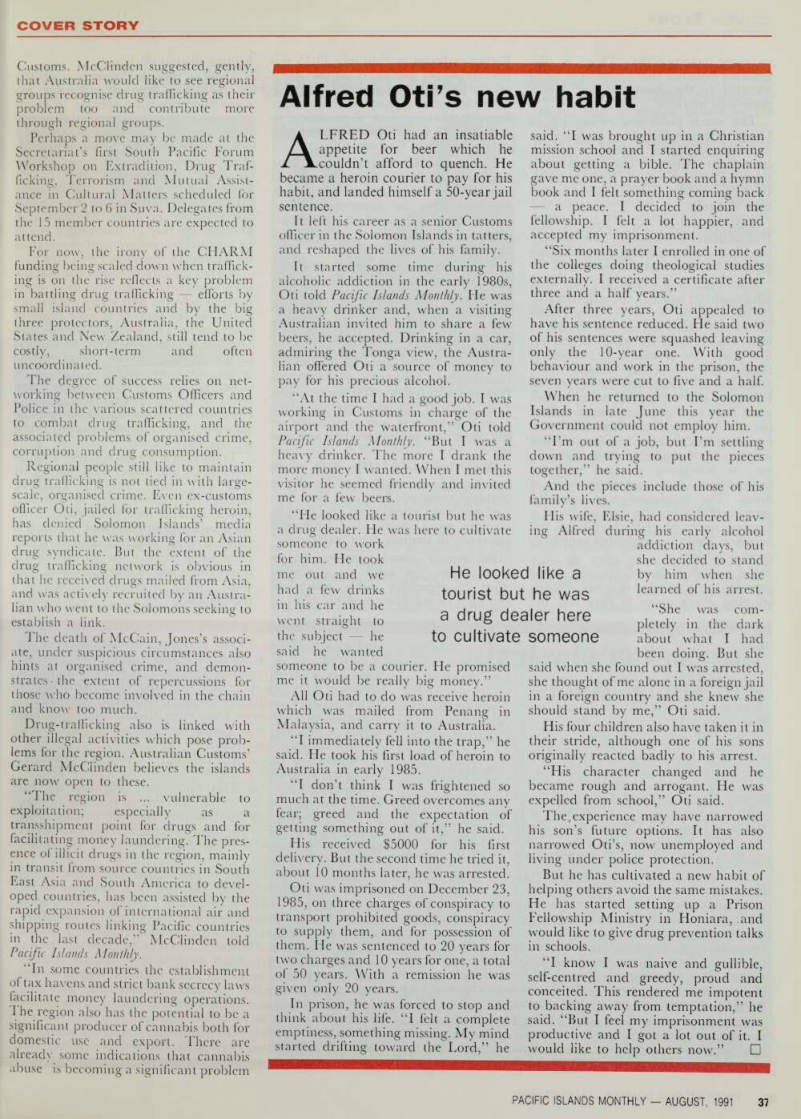
Casey Jones: Drug trafficker imprisoned after extradition from Tonga
Drug spoils: Jones’s yacht ‘Rapid Transit’ was sold by authorities and the money put back into law enforcement
Customs. McClindcn suggested, gently, that Australia would like to see regional groups recognise drug trafficking as their problem too and contribute more through regional groups.
Perhaps a move may be made at the Secretariat’s first South Pacific Forum Workshop on Extradition, Drug Traf ficking, Terrorism and Mutual Assist ance in Cultural Matters scheduled for September 2 to 6 in Suva. Delegates from the 15 member countries are expected to attend.
For now, the irony of the CFIARM funding being scaled down when traffick ing is on the rise reflects a key problem in battling drug trafficking efforts by small island countries and by the big three protectors, Australia, the United States and New Zealand, still tend to be costly, short-term and often uncoordinated.
The degree of success relies on net working between Customs Officers and Police in the various scattered countries to combat drug trafficking, and the associated problems of organised crime,
corruption and drug consumption.
Regional people still like to maintain drug trafficking is not tied in with large scale, organised crime. Even ex-customs officer Oti, jailed for trafficking heroin, has denied Solomon Islands’ media reports that he was working for an Asian drug syndicate. But the extent of the drug trafficking network is obvious in that he received drugs mailed from Asia, and was actively recruited by an Austra lian who went to the Solomons seeking to establish a link.
The death of McCain, Jones’s associ ate, under suspicious circumstances also hints at organised crime, and demon strates- the extent of repercussions for those who become involved in the chain and know too much.
Drug-trafficking also is linked with other illegal activities which pose prob lems for the region. Australian Customs’
Gerard McClinden believes the islands are now open to these.
“The region is ... vulnerable to exploitation; especially as a transshipment point for drugs and for facilitating money laundering. The pres ence of illicit drugs in the region, mainly in transit from source countries in South East Asia and South America to devel oped countries, has been assisted by the rapid expansion of international air and shipping routes linking Pacific countries in the last decade,” McClinden told Pacific Islands Monthly.
“In some countries the establishment of tax havens and strict bank secrecy laws facilitate money laundering operations.
The region also has the potential to be a significant producer of cannabis both for domestic use and export. There are already some indications that cannabis abuse is becoming a significant problem