Spirit
pp. 28-34 · Read in the full issue

Wrestling with White Spirit
Aboriginal art reflects the search for a new identity. Liz Thompson reports
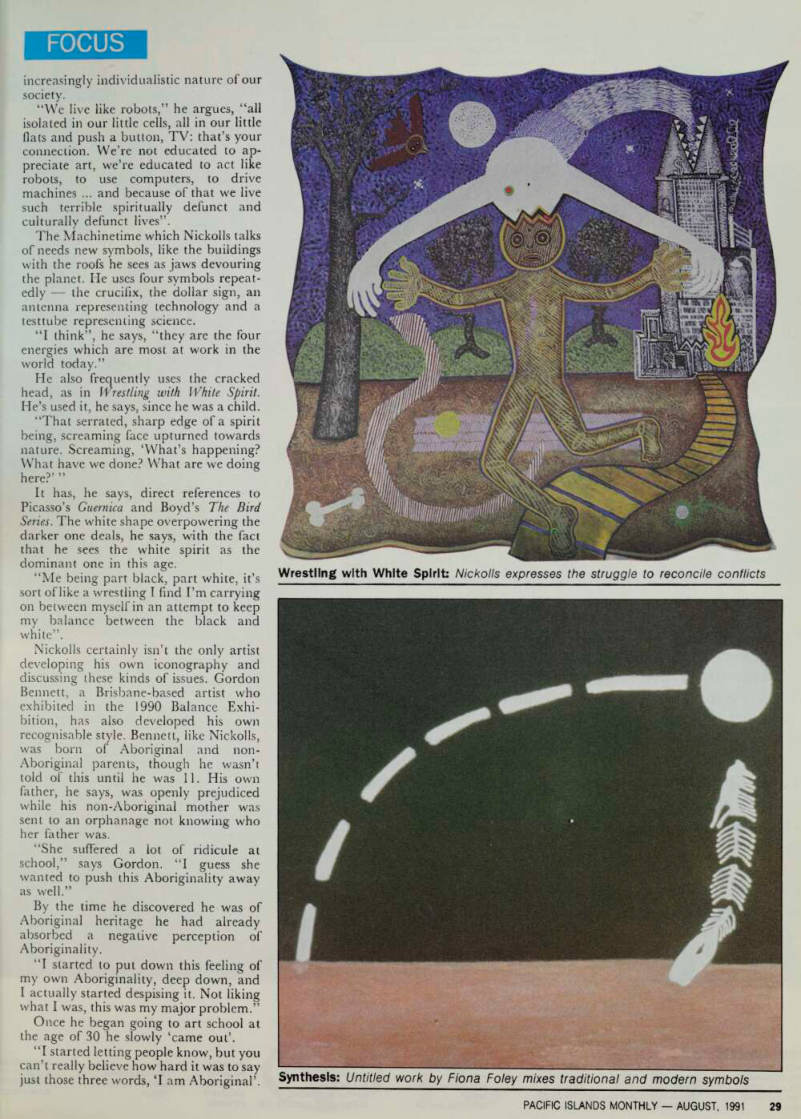
A LARGE canvas hangs on the wall, on it a brown male figure walks towards the viewer. His head is cracked and from it emerges a white form with arms and one eye. Its arms press down upon the
running brown figure with a heavy sense of oppression.
In the background a tall build ing, roof open like a mouth with serrated teeth, displays a dollar and crucifix symbol. A fire burns within it, a bird flies through the air.
The painting is called Wrestling with White Spirit and it is the work of artist Trevor Nickolls.
Nickolls and artist Rover Thomas were the first two Aborig inal artists to represent Australia at the Venice Biennale last year. This painting is typical of Nickolls’s work, recurring symbols become apparent and he pursues continu ing themes of his own personal struggles with a conflicting black and white heritage, and his broader view of the destruction of the environment.
His work, like many other con
temporary Aboriginal artists, is a far cry from what has most commonly been associated with contemporary Aborigi nal art over the last decade, the acrylic dot paintings of the Central Australian desert artists from Papunya.
The last two decades has seen an enormous increase in the production of contemporary Aboriginal art and a corresponding increase in public interest.
While the Central desert artists drew directly from traditional painting tra ditions, artists like Nickolls are develop ing new symbols and signs, new iconographies, to describe their own experiences. Often born and raised in
urban environments, artists like Nickolls are examining their lives in that context. Aboriginal culture, argues Nickolls, has evolved and art has evolved along with it.
His work, Wrestling with White Spirit reflects this. Nickolls’ catchphrase, “Dreamtime to Machinetime”, encapsulates his philosophy. Like many other artists he is acutely sensitive to the current environmental situ ation.
“In a lot of my paintings,” says Nickolls, “there’s birds because birds are the only thing we hear in this Machinetime.
Aboriginal society is based on its relationship with nature, and the white man has made a mockery of that”.
He is highly critical of the
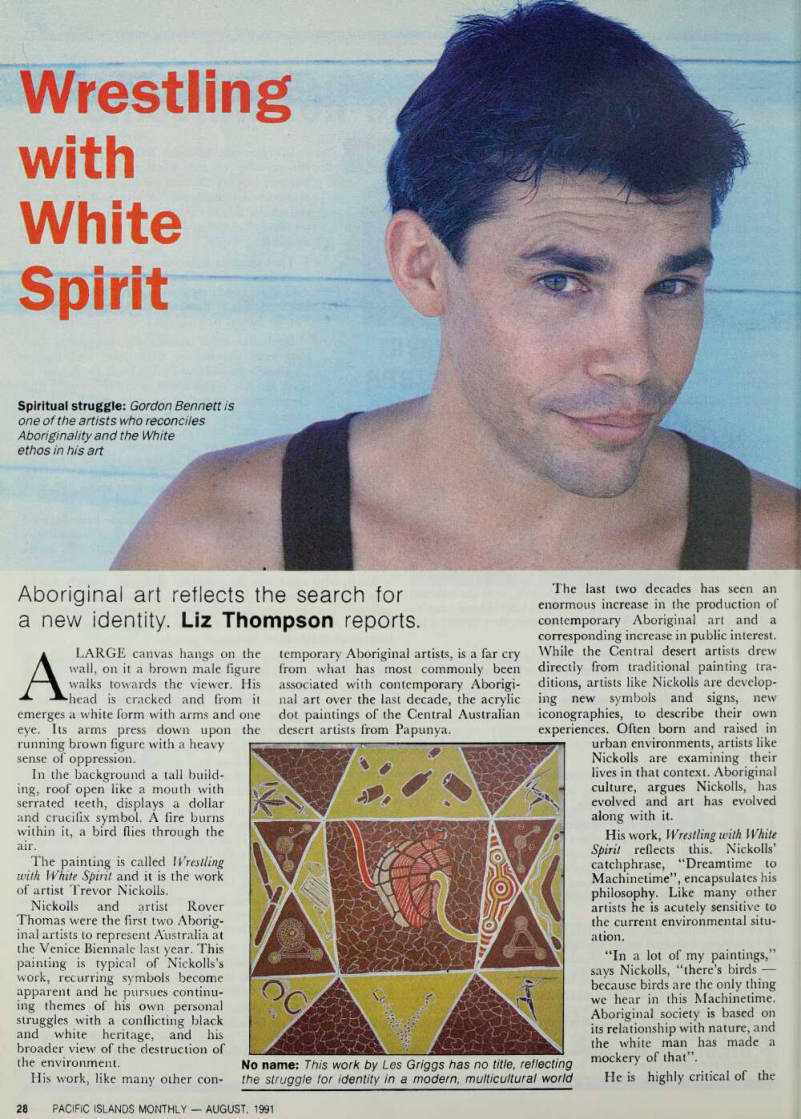
Spiritual struggle: Gordon Bennett is one of the artists who reconciles Aboriginality and the White ethos in his art
No name: This work by Les Griggs has no title, reflecting the struggle for identity in a modern, multicultural world
increasingly individualistic nature of our society.
“We live like robots,” he argues, “all isolated in our little cells, all in our little flats and push a button, TV: that’s your connection. We’re not educated to ap preciate art, we’re educated to act like robots, to use computers, to drive machines ... and because of that we live such terrible spiritually defunct and culturally defunct lives”.
The Machinetime which Nickolls talks of needs new symbols, like the buildings with the roofs he sees as jaws devouring the planet. He uses four symbols repeat edly the crucifix, the dollar sign, an antenna representing technology and a testtube representing science.
“I think”, he says, “they are the four energies which are most at work in the
world today.”
He also frequently uses the cracked head, as in Wrestling with White Spirit.
He’s used it, he says, since he was a child.
“That serrated, sharp edge of a spirit being, screaming face upturned towards
nature. Screaming, ‘What’s happening?
What have we done? What are we doing here?’ ”
It has, he says, direct references to Picasso’s Guernica and Boyd’s The Bird Series. The white shape overpowering the darker one deals, he says, with the fact that he sees the white spirit as the dominant one in this age.
“Me being part black, part white, it’s sort of like a wrestling I find I’m carrying on between myself in an attempt to keep my balance between the black and white”.
Nickolls certainly isn’t the only artist developing his own iconography and discussing these kinds of issues. Gordon Bennett, a Brisbane-based artist who exhibited in the 1990 Balance Exhi bition, has also developed his own recognisable style. Bennett, like Nickolls, was born of Aboriginal and non- Aboriginal parents, though he wasn’t told of this until he was 11. His own father, he says, was openly prejudiced while his non-Aboriginal mother was sent to an orphanage not knowing who her father was.
“She suffered a lot of ridicule at school,” says Gordon. “I guess she wanted to push this Aboriginality away as well.”
By the time he discovered he was of
Aboriginal heritage he had already
absorbed a negative perception of
Aboriginality.
“I started to put down this feeling of my own Aboriginality, deep down, and I actually started despising it. Not liking what I was, this was my major problem.”
Once he began going to art school at the age of 30 he slowly ‘came out’.
“I started letting people know, but you can’t really believe how hard it was to say just those three words, T am Aboriginal’.
Wrestling with White Spirit: Nickolls expresses the struggle to reconcile conflicts
Synthesis: Untitled work by Fiona Foley mixes traditional and modern symbols
It does affect you, people look at you differently.”
As a result Bennett is interested in looking at how people build up percep tions through his work.
A highly intellectual painter, he has developed his own complex system of symbols, often using children’s building blocks to spell out words in his images and a system of what look like Rennaisance perspective arches. In one painting the words, “Abo, Boong, Koon, Darkie, Heathen, Nigger” appear next to a figure hung from a roof. This painting, he says, is about the conditioning process of being categorised by these words.
“They have a lot of derogatory associations attached to them,” he says.
He points to language as central to how we construct our view of the world.
“The experience of these particular words,” he says, “of writing them up there, was very cathartic, so much so that I burst into tears as soon as I’d done them.”
Bennett questions the elements of our society which he believes are seen as natural. Nothing, he insists, is ‘God
given’.
He questions ideas of progress, ideas of mechanisation and modernism, “the idea of commercial profit and short-term gain and generation of wealth,” these con cerns reflect in many respects those of Nickolls while visually their work is quite different.
“I’m interested in how meaning can be manipulated using images, how myth ologies are built around the idea of the
Comfort in kind: Bronwyn Bancroft’s ‘Grandma Loves Me This I know' represents an Aboriginal perspective on life, love and security
New mediums: Traditional designs on silk by Tiwi Designs near Darwin
Artist at work: Bronwyn Bancroft makes a contemporary statement by applying traditional imagery to clothing and turning it into an saleable, artistic expression
bush in Western painting. For instance Hans Heysen romanticised the Austra lian bush men and farmers and made them into heroic figures but these same heroic figures were marauding around the countryside killing off whole tribes of my ancestors and then going to church on Sunday and praying.”
Bennett is fascinated with these con tradictions. He plays on the notions of false harmony, he says, by using con struction of receding arches designed to ‘construct’ a perspective, to convey the idea of a construction of a belief system.
Coming from a slightly different angle
in terms of his experience, but using a similar idea of signs and symbols is Melbourne-based artist Les Griggs.
Griggs’s work often depicts syringes,
nooses, handcuffs, prison bars inter
spersed with didgeridoos, boomerangs,
cross hatching and often umber, ochre colour schemes.
Griggs has spent most of his life in in-
New direction: Les Griggs spent most of his life in institutions but discovered a paintbrush was a better weapon than his fists
The old, and the new: Mosquito Man coil pot made by Thancoupie draws on the traditional and contemporary motifs as well as methods in art
stitutions and examines this experience through his work. He also looks at the environmental situation.
One work, called Dreaming in the Wrong Place, shows a bush animal, depicted in
traditional cross-hatching technique
walking across a crazy maze of black
strips of highway.
“Painting,” says Griggs, “helped me
to get rid of the anger and resentment that I had inside me. It was a way to open a valve and release it without getting violent. I got really violent growing up and I got bored with that.”
Griggs was let out of prison early to paint a mural and hasn’t been back since. Unlike the occasions on which he’d been let out, he had something which he
says he actually enjoyed.
“It gave me something to do,” he says, “it gave me a different direction to start fighting from. Rather than using my fists or clubs or guns or anything like that, I found I could fight with a paintbrush just as well and just as effectively and hit more people in the eye at the same time.”
Griggs examines his own plight but he is extremely concerned with those indi viduals who remain inside institutions.
He has a committed belief this is not the right way to deal with Aboriginal people trying to adapt to a new kind of
community and society.
There are still many contemporary artists who do draw quite directly from traditional imagery, for example Banduk Marika.
Based in Yirrkalla in the Northern Territory, Marika is a well-recognised artist and a member of the council at the National Gallery. She, unlike Nickolls, Bennett and Griggs, was born and grew up in her tribal homeland. Her father was a traditional painter and, through him, she has access to many traditional designs from her area, depicting tra ditional hunting grounds and tribal stories.
Nevertheless, the use of them has to be carefully monitored by guardians and custodians of particular images and she is fastidious about the mixing of colours, emphatic that each one has to be exactly right, to fit in with traditional demands.
Some of the elders, she says, find it hard to adapt to their designs being presented in these new forms but she believes that, just as it is important for Aboriginal culture to develop new lan guages to describe new experiences in the evolution of culture, it is important to use new mediums to maintain and transmit traditional designs and images.
Tiwi Designs also use traditional imagery on a range of new mediums.
Established on Bathurst Island, a one hour flight from Darwin, Tiwi Designs is the name of an Aboriginal fabric design
company. Starting off with silk screen, they now work with pottery, batik and
hand-painted silks.
Their fabrics incorporate designs
taken from traditional storytelling and legends of the Tiwi people and have proved to be a successful financial venture as well as a celebration and continuation of the people’s culture.
The work of both these individual artists and the Tiwi Design company is highly accomplished. Their creativity is a step in the continuing process of the evolution of culture.
“There has been a myth created by the anthropologists that traditional art was a static thing, but it wasn’t it was a
continuing, evolving thing, the same as
Western art.”
The work of artists like Nickolls,
Bennett, Griggs, Marika Tiwi Designs is proof that this process continues; that art is used, as it has always been, to examine social situations and experiences. This art work is a sensitive and thought provoking look at contemporary circum stances.
It not only looks at environmental and world issues but at the difficulties r ° wi . n ? , U P , in , a countr y A where Abongmahty has been negated As art work stren B* h L ells . * nd People tell their own Itories1 tories thr ? u 8 h U ’,. lt ,s ralsln B the consciousness of Australian society as to the position and strength of the Aborig inal community, Xhis community did not cease with diminishing traditional dances and sand paint i ngs; s it survived an d finds ex pression today in a growing and increas ingly powerful art movement. □
Paint and paper: Barrett's 'Warrior' gouache and collage on recycled paper