The Bad Old Days
pp. 21-22 · Read in the full issue
The United Nations
A new book tells chilling accounts of why 2.4 million people will die from nuclear tests
By Ian Williams
United Nations correspondent
IF the first casualty of war is truth, then the first casualty of nu clear weapons seems to be the conscience of their possessors.
This principle is demonstrated in Radioactive Heaven and Earth , a book published in May just as France exploded three more bombs in French Polynesia. The book estimates that some 2.4 million people (430,000 of them by the end of this century), will die as a result of radioactivity unleashed by the 1900 nuclear tests which have taken place since the first atom bomb lit the skies over Alamagordo in 1945.
For 45 years, the nuclear powers have waged a relentless war against our environment, averaging an explosion a week. They have exploded bombs in space, in the air, underwater, under ground, and on the surface littering the
environment with long-lasting carcino gens like plutonium-239 which has a half life of 24,000 years.
The book details the cavalier attitude taken by nuclear powers towards their own personnel. Servicemen were sent unproteected into highly radioactive areas to clean up. Aircrew were ordered to fly through the mushroom clouds, infantry to march towards ground zero, and sailors to stand on deck with their backs to the explosion. The degree of their exposuree was concealed through a mixture of negligence and obsessive secrecy.
It is hardly surprising that govern ments so casual with the lives of their own citizens were uncaring about the welfare of people like Australian Aborigines and Pacific Islanders who lived in the vicin ity. In 1982, even a United Nations report on the effect of radiation did not take into account local fall out “as tests have generally been conducted in iso lated areas”.
A pity about the “isolated” inhabi
tants of regions like the Pacific, which has the dubious honour of being the site for the most wide-ranging tests; the 1.2 megatons exploded in space above Johnston Atoll, the several very “dirty” underwater tests; the largest US test, Bravo weighing in at 15 megatons; the continuing French underground tests at Moruroa Atoll.
In all, the US exploded 106 bombs in the Pacific because of what a priceless memo for the Army Chief of Staff in 1949 referred to as “an unhealthy, dangerous and unjustified fear of atomic deton ations” at home. The US has now exploded no fewer than 814 bombs in Nevada, 700 of them underground. It exploded over a hundred, mostly tacti cal, bombs in the atmosphere there, even though prevailing westerly winds en sured that the fallout would spread over much of the country. Indeed it did, causing one ferocious hot spot as far away as Albany, New York, where in 1954 a thunderstorm intersected the high flying fallout cloud.
Working on the NIMBY (not in my back yard) principle, the US has decided to test its really big weapons in the Marshall Islands. The fact that as a “strategic trust territory”, it was under unfettered US control meant it was chosen even though it also “did
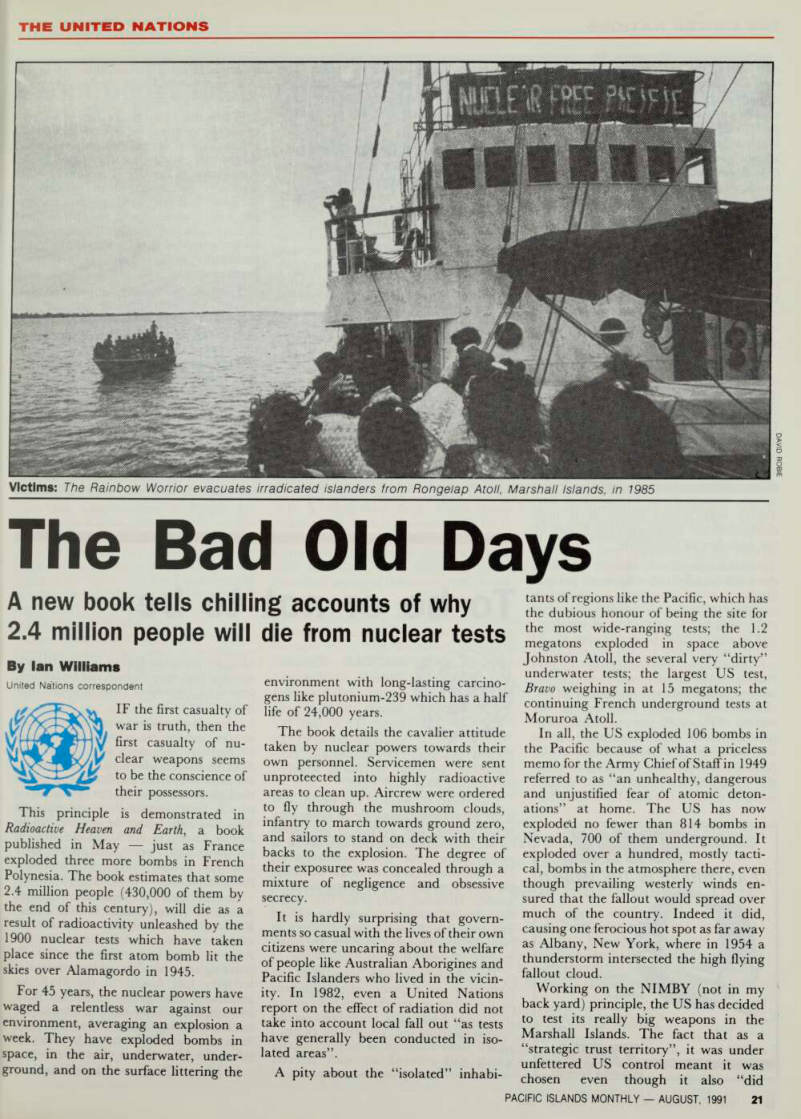
Victims: The Rainbow Worrior evacuates irradicated Islanders from Rongelap Atoll, Marshall Islands, In 1985
not meet the meteorogical require ments”. As a result, instead of being dispersed, the radioactive debris from the explosions came back to haunt both the personnel at the site and the local inhabitants. During the Bravo test, the islanders on Rongelap thought that the fallout was snow, and their children went out to play in it.
In 1956, an Atomic Energy Official noted that the people in the Northern Marshall Islands provided a unique research opportunity because the area “is by far one of the most contaminated in the world”, and “while it is true that these people do not live, I would say, the way the Westerners do, civilised people, it is nevertheless true that they are now more like us than mice”.
After being returned, no less than 19 of the 22 exposed “uncivilsed” children of Rongelap have since had nodules surgically removed from their thyroids.
It is not over yet, the monitoring of the health of the islanders is now adminis tered under Safeguard C, which, the authors point out, is a continuing programme to retain the capability for surface testing if the Partial Test Ban Treaty ever breaks down. It is now responsible for monitoring the health of the islanders of Rongelap.
Another exclusively Pacific problem
the book highlights is Ciguatera poison
ing a serious ailment which, it suggests, is caused by the destruction of reefs, both by the explosions themselves, and the associated construction damage.
Once kicked out of Algeria, the French moved to the Pacific, where they have now exploded about 170 bombs, to the chagrin of all those who live in the region. France seems to have had predilection for exploding bombs despite adverse weather reports because of the presence of VIPs. For example, in 1966, the Betelguese test went ahead despite weather reports, because De Gaulle had
to come to see-grandeur in action. The cost of his good impressions was paid the following day in Samoa, where beta activity rose almost 200,000 per cent as a result.
And of course, eloquently symbolic of the amorality induced in the testers was the sabotage by French tests was the sabotage by French agents of the Green peace boat Rainbow Warrior.
The British picked on Malden Island and Kirimati (Christmas) Island in what is now Kiribati, because it was far away from anyone with a voice or a vote. They tested nine British bombs, and allowed the US to test a further 24 there. Malden was uninhabited, but the inhabitants of Kirimati were taken olfshore while the bombs went off, and returned immedi ately afterwards. “Evacuation was thought unnecessary” during the later US tests, which included underwater detonations, but many islanders had the good sense to leave anyway.
Almost 100 Fijian servicemen took part in the tests, and their leader, Ratu Inoke Bainimarama, is quoted as saying the men had been given “name tags and
numbers to hang around their necks in case they were killed during the ex
plosion.”
While the Western Powers were re sponsible for much of the effects in the Pacific, their overall insouciance was shared by other nuclear powers. A commission in the USSR reported locals who were told to stay in the vicinity of the tests, and afterwards given a check up and “some vodka as protection against radiation” while a Chinese offic ial has admitted that “a few deaths have occurred” as a result of their test programme.
The book is deadpan, quoting official sources wherever possible. It lets the enormities speak themselves and leaves readers to decide themselves how out raged they should be. It is profoundly chilling that regardless of political sys tem, the people who made these de cisions, who continue to hide their effects, are not escaped characters from Doctor Strangelove. They are real people, who would be appalled if they accidentally ran over a dog, but saw no serious problems in encompassing the deaths of hundreds of thousands of people, includ ing many of their own citizens. □