Goodnight, Moresby
p. 14 · Read in the full issue
The Region
By Tanya Willmer
THE city’s two cinemas haven’t shown a film in three months. Its hotel bars and restaurants are all but empty just a few hours after dark, and the streets are deserted. Port Moresby is a city under curfew.
Prime Minister Rabbie Namaliu im posed a night-time curfew in Port Moresby and in several other cities in March in the hope of curbing rampant lawlessness. The city’s wealthier residents live in compounds behind barricades of iron gates, razor wire and security guards to shield them from gangs of marauding youths known as rascals.
A day without violence in Papua New Guinea is rare, but police and residents say the three-month curfew has begun to stem crime levels. “It has gone very well
but this curfew can only be a short-term measure,”
Papua New Guinea’s Chief Superintendent of Police, Denis Samin, said.
“It is a community prob lem that the whole country must face.”
In Port Moresby, the number of reported robberies dropped to 15 in the first month of the curfew from 118 the pre
vious month. The number of rapes fell to two from 33. “Crime is probably still holding at that level now,” said Samin.
“Last time a curfew was lifted crime flourished to be bigger than ever but I don’t think it will come back on the same scale this time.”
Port Moresby was placed under a
curfew in 1985 for five months because of gang violence. A few days before the current curfew began an Australian soldier was shot in the back and killed by rascals in Port Moresby, and a Japanese volunteer worker and four New Zea landers were stripped and beaten.
“A society in which the ordinary citizen cannot move about without fear of attack, a society in which business cannot function without the threat of armed hold-up and a society in which women live in constant fear even in their own homes is not a free society at all,”
Namaliu said at the time.
Doctor Bruce Harris, an American anthropologist who spent two and a half years living with rascals, believes the government is beginning to put strategies in place to win the battle against crime.
“Most of the moves thus far have been beefing up the police and defence forces,” said Flarris, First Assistant Secretary of Social Affairs in the Department of Finance and Planning. “Ultimately it comes back to employment and job creation, in the medium-term improving prisons, correctional services and a more effective prosecution system. There should be long-term planning to ensure the resources that will come from the mineral boom are not frittered away.”
Chief Superintendent Samin said the country’s police force, around 4700 strong, needs to be strengthened: “We need 10,000 to even approach doing the job properly.” While statistics show an encouraging drop in crimes of violence, police have had to resort to strong arm tactics to quell recent civil disturbances.
At least 200 police armed with auto matic rifles and tear gas took control of the University of PNG in June in a
crackdown against students who have
been boycotting
classes. The students
were protesting against
a decision to award Parliamentarians a pay rise while the nation’s workforce has had to do without under gov ernment austerity measures.
In June, seven
people were injured
when workers at the
Porgera gold mine in
the Highlands clashed with police called in to
halt a week-long strike. “There is no question the situation has worsened over the last four or five years, but I really hope this country can do very well over the next 10 or 20 years with wisdom and planning,” said Harris. “It is a young country having to come to grips with a tremendous amount of change and social dislocation in a short time.” □
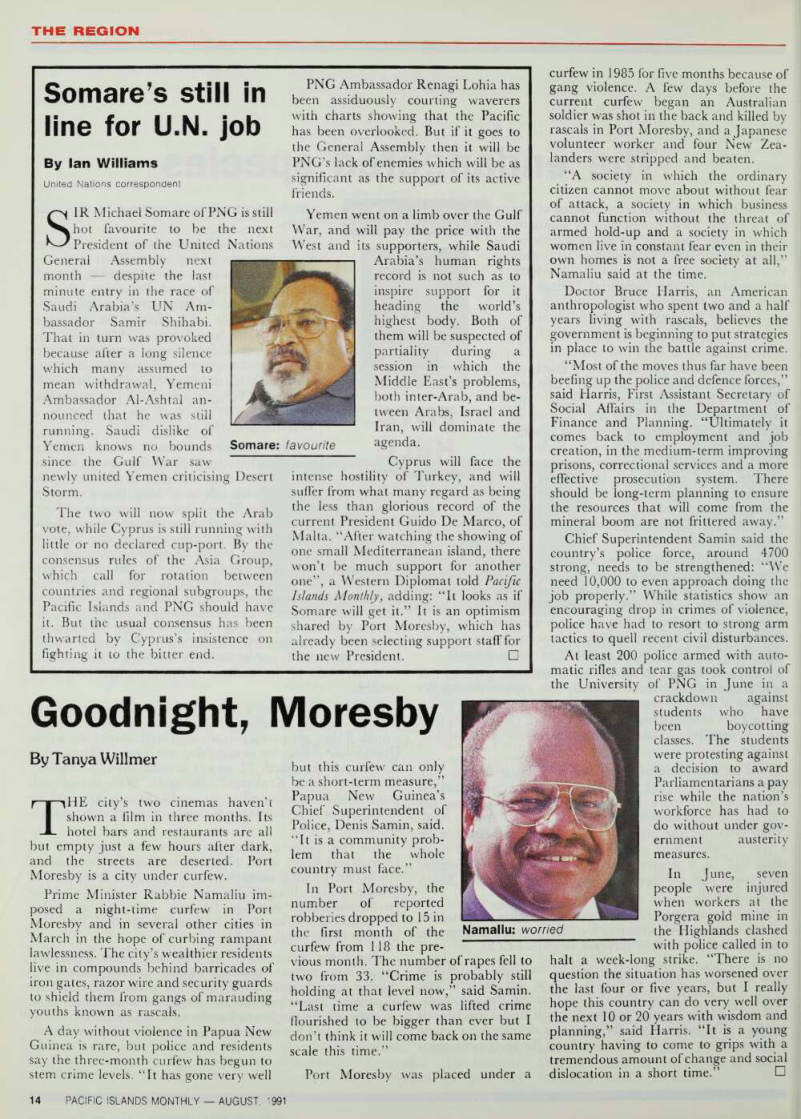
Namaliu: worried