Losing the Battles
pp. 8-10 · Read in the full issue
• The Region / French Polynesia
Anti-tax blockades rock Flosse’s coalition and highlight French Polynesia’s ever-present financial difficulties
By Al Prince
PRESIDENT Gaston Flosse’s majority coalition government has lost two major political battles among several skirmishes during its first four months in office. As a result, the ultimate question is whether this government, indirectly elected in March by voters seeking a definite political change in French Polynesia and a restoration of confidence, can now hang on to win the war during the remaining four years and seven months before the next scheduled elections.
The first battle, with potential cata strophic long-term effects on all future foreign investments, particularly in the tourist industry, occurred on June 17 on
Tahiti’s sister island of Moorea. By a vote of 1900 1449, Moorea residents effectively killed for the timebeing a
Japanese developer’s proposed U 5594.3
million combination 147-room deluxe Sheraton Hotel and a championship international golf course.
But that vote did not involve a legal referendum on a project for which the developer, Mitsuhiro Nishikawa, had signed with the previous government a USSI3O,OOO-a-year, 30-year lease of Ter ritorial Government-owned land and made the first of four scheduled pay ments totalling U 55940,000 for relocat ing farmers for the golf course.
Instead, the vote involved what the French call a consultation populaire. This, in effect, is a non-legal-binding opinion poll that the Flosse government reportedly expected to easily win by an 80 per cent
margin. The clear defeat was Flosse’s first since returning to power on April 5 after a four-year absence. The vote also posed a major threat of undermining any future government decisions by opponents of any project with enough muscle to
organise a concultation populaire.
The second and most devastating battle defeat for the Flosse government occurred on the night of July 10, briefly threatening to turn into a repeat of the October 23, 1987 night of rioting, burning and looting that left French
Polynesia’s capital of Papeete with war
like scars.
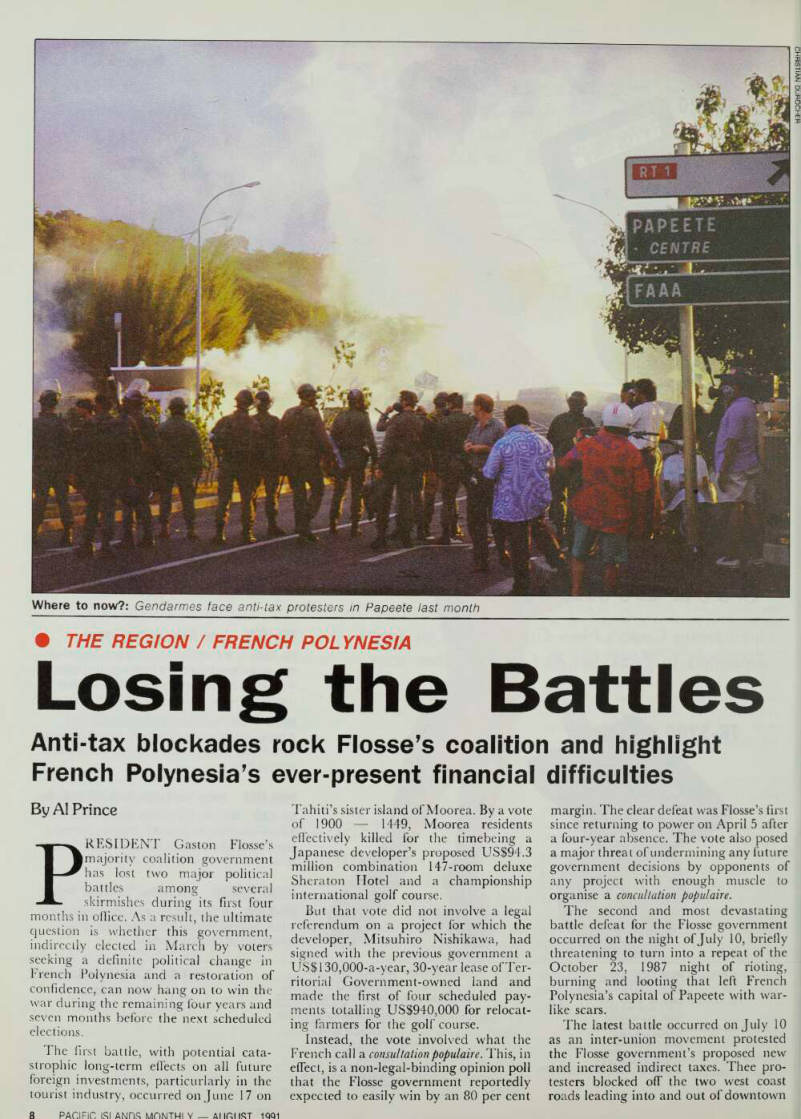
The latest battle occurred on July 10 as an inter-union movement protested the Flosse government’s proposed new and increased indirect taxes. Thee pro testers blocked off the two west coast roads leading into and out of downtown
Where to now?: Gendarmes face anti-tax protesters in Papeete last month
Papeete for the second time in less than a month.
French High Commissioner Jean Montpezat sent in gendarmes armed with tear gas launchers and wearing riot helmets and face masks within five hours after the blockades had gone up. This was in contrast to a bigger, longer and economically expensive road blockade in late June when the French State refused to use force against it.
On July 10, the obviously underman ned gendarmes were given clear instruc tions to remove the blockades formed by mostly Papeete municipal trucks and other heavy equipment, with equally clear orders not to use any physical force against rock-throwing demonstrators.
This has been confirmed on several occasions by French Government offic ials in French Polynesia.
The blockades were eventually re moved, but at the cost of minor injuries to 34 gendarmes and more serious injuries to three other gendarmes, who had to be hospitalised, according to official gendarmerie reports.
The only other officially-reported in juries involved a Tahitian who, while under epilepsy attack, drove a four-wheel drive vehicle at high speed into a crowd of demonstrators and gendarmes, strik ing a civilian. Both were hospitalised.
But it was not until after marathon negotiations until nearly the dawn of July 11 that the High Commissioner and religious officials were able to produce an agreement between the Territorial Gov ernment and the inter-union leaders.
The agreement halted the anti-tax dem onstrations and removed the road block ades. French officials said some demon strators'were armed.
That agreement, however, rolled back all of the new and increased taxes that were originally to have gone into effect by July 1. The taxes were part of the Flosse government’s attempt to cover about 40 per cent of a reported U 5573.4 million 1991 budget deficit inherited from the previous government.
The tax proposals, some of which had already been cut in half or eliminated in order to bring an end to the six-day June road blockades, involved increases on all non-essential foodstuff imports, beer, cigarette rolling tobacco, gasoline, diesel fuel and electric power consumption. 1 he new taxes would have been applied to house rents over USSI24O a month and all insurance policies.
One of the many ironies, as well as contradictions, highlighting the two major political battles within the past two months was the inter-union’s call for an income tax of limited duration on all salaries over USS2B3O monthly as a substitution for all of the government’s other tax proposals.
One of the reasons that French
Polynesia already has such high import
taxes, and thus, high prices is because it has no income tax of any kind. No politician is courageous or politically stupid enough to try and get one adopted. Before and after the March 17 Territorial Assembly election, Flosse firmly said he is opposed to French Polynesia having an income tax. This is certainly one of the most unpopular measures any politician could possibly think of trying to get adopted.
Calm was restored in Tahiti in time for the traditional July 14 Bastille Day parade in downtown Papeete. But two days earlier, Territorial Government
President Flosse had stepped aside for a week of reflection less than 24 hours after returning from Paris, turning the running of his government over to Vice- President Michel Buillard, who had signed the protocol agreement with inter union leaders on July 11 in Flosse’s absence.
After a week of consultations with a variety of political, religious and business leaders, Flosse was back in his presiden tial office on July 19, obviously in a much better frame of mind than he had been.
Flosse was obviously bitter towards the French State for the way it handled the
July blockade situation and towards the inter-union oficials and opposition party leaders for their alleged roles in trying to undermind and destabilise the Terri torial Governmennt. Anyway, he was almost back to where he had started a month earlier in dealing with the reported budget deficit, xhe ma j or difrerence) said Flosse, was ( b e p rcnch State’s sudden willingness to provide additional subsidies to cover that portion of , he blldget de r lc it that the
Territory had proposed covering with
the new and increased indirect taxes, What Flosse emphasised over and over was that the High Commissioner Montpezat had announced the ad
ditional French State subsidies for the first time during the tense negotiations between the Territory and the inter-union leaders on July 11.
As far as Flosse was con cerned, the budget deficit problem was under control and it was now time to return to die pressing task of finding foreign investors to boost the local economy and create much needed new jobs. As
proof, Flosse immediately met
with a group of visiting Ha waiians and then began meet ings with a group of visiting South Koreans, talking to both about possible invest ments in French Polynesia.
However, political ob servers as well as Flosse critics did not agree that life had completely returned to nor mal in French Polynesia. In his April 4 speech to the Territorial Assembly upon be ing elected government presi dent by the majority coalition in that legislative body, Flosse
said: “A responsible policy
must be impartial and gen erous, perceptive and firm in its convictions.”
The history of the past two months would appear to indi cate that Flosse has had diffi
culty in carrying out such a policy. Fie apparenly did not foresee the persuasive grassroots movement mounted in Moorea by religious leaders, a union official from Papeete, environmental groups and opposition political leaders, including independence party leader Oscar Temaru.
In view of such opposition to the golf course/hotel project, people are still wondering why Flosse agreed to the holding of the consultation populaire and then announced that the government would not pursue the project when the “voting” results proved disastrous.
Many people are wondering why
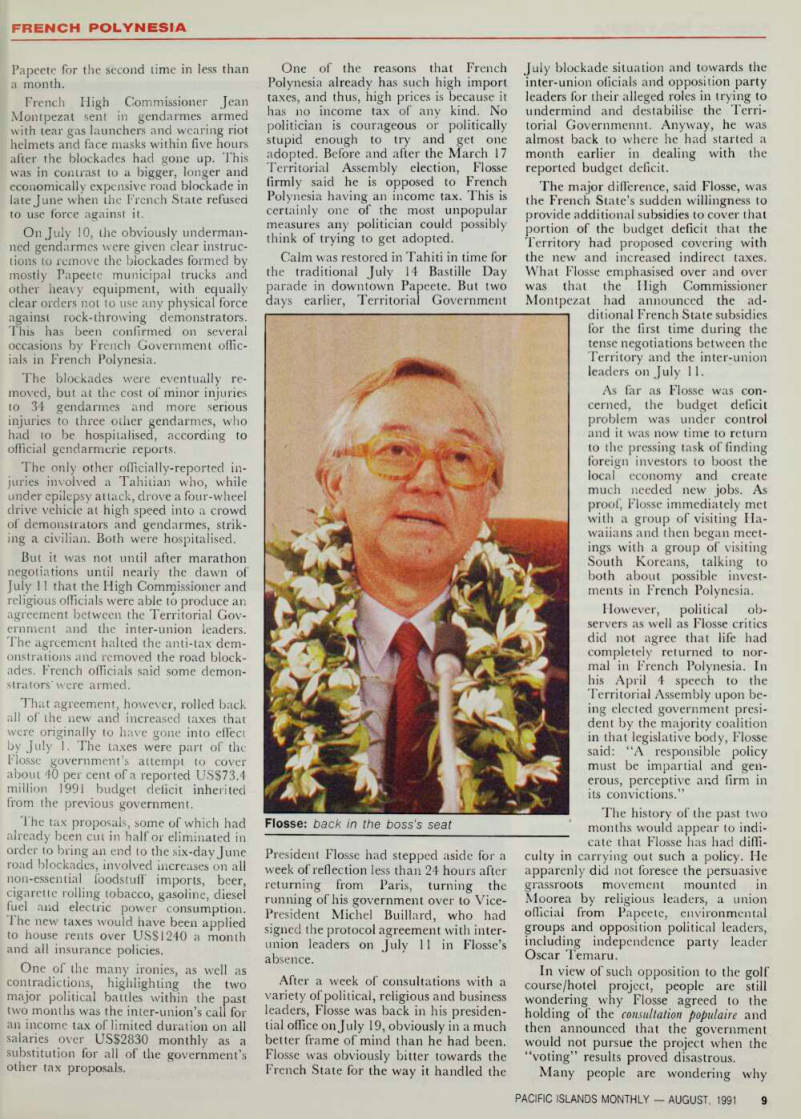
Flosse: back in the boss's seat
Flosse apparently did not anticipate how unpopular his tax proposals would be, even though the opposition was initiated by a relative minority sector of the population.
There were two possible explanations for Flosse’s recent actions. First, within Flosse’s tightly-knit circle of Cabinet ministers, advisers and high-ranking presidential office officials, two people were asked whether Flosse was losing control of the political situation or whether he had been badly advised.
Both, insisting on anonymity, said it was a “combination of both.”
The second possible explanation came from one of the many former political adversaries whom Flosse has dealt with by the handfuls over the years. Also insisting on anonymity, this person suggested that the problem for Flosse, as well as most of today’s political leaders in French Polynesia, is that he is tied to an
increasingly outmoded polical system
that the Tahitians call metua, or clan chief, a term that has its roots in ancient history when Tahitians were divided into tribes led by a strong leader.
According to this source, French Polynesia is going to have to wait another generation to grow up, become educated in civics at university level and get some government experience before they will be able to govern Frenmch Polynesia as a team of qualified leaders. The source implied that by that time, men like Flosse would have retired, leaving the political field open to a new generation.
Although potential young leaders like that exist today, the source said, they have difficulty getting their foot in the door because the old guard like Flosse prefer to surround themselves with non threatening French mercenary fonclonnaires, who come out of the same school, or similar schools, in France and get paid top dollars in French Polynesia.
Meanwhile, there are also several officially unanswered questions about some of those with major roles in the events of the past two months. One such obvious person is Hiro Tefaarere, general secretary of an increasingly powerful labour union and the official spokesman for the recent inter-union movement.
French Government officials here make no secret of the fact that Tefaarere is on the payroll of the Interior Ministry in Paris. Before becoming a union official several years ago, he worked as an inspector for the Direction des Renseignements Generaux, which has its office within the Direction des Polices Urbaines and involves furnishing infor mation to the State through the police, The French officials appear to find nothing unusual about a former plain clothes policeman not only working for a union that has little relationship to his former job, but continuing to be paid by
the French State while he helps organise two apparently illegal road blockades in less than a month and ends up in the front ranks during a confrontation with gendarmes during a riot.
Another role that has been questioned in recent weeks involves Papeete Major Jean Juventin, who is leader of one of the opposition parties in the Territorial Assembly, where he was president under the previous government led by Presi
dent Alexandre Leontieff.
Juventin claimed he had no prior knowledge of the planned use of Papeete heavy vehicles to create the two July 10 road blockades. He further said during a subsequent press conference that he may order an investigation, but that no sanctions would be applied to city workers for alleged improper use of
municipal property.
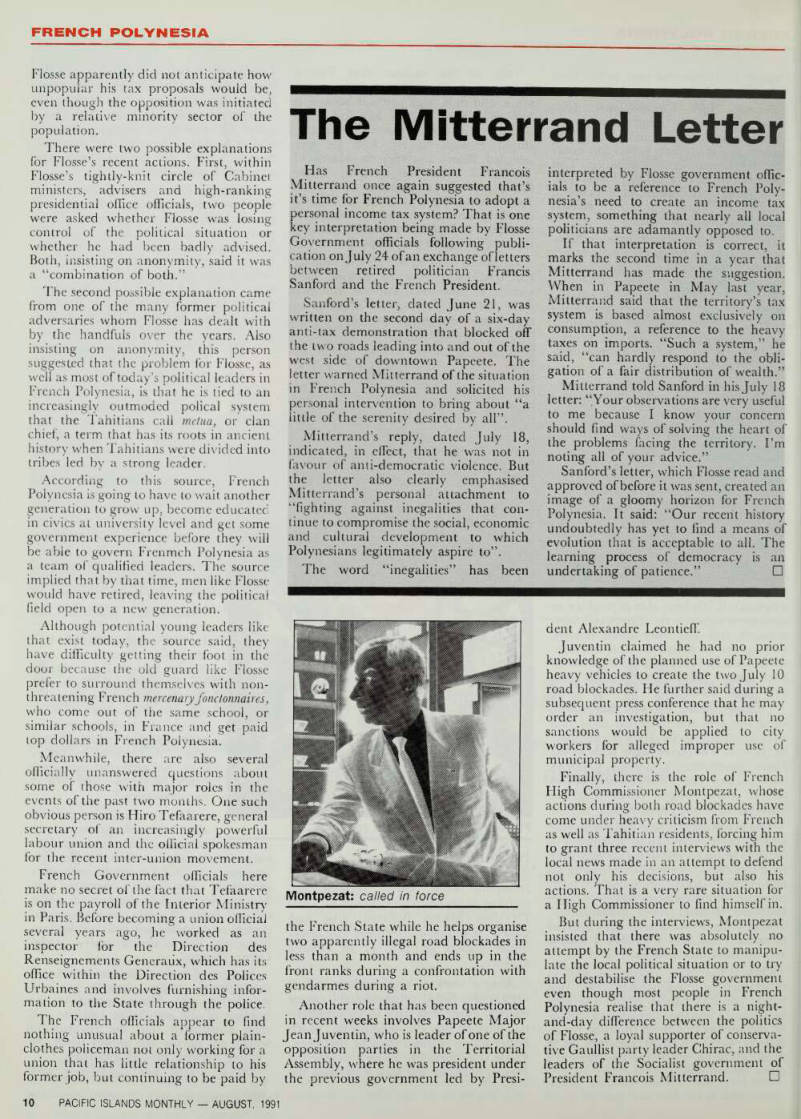
Finally, there is the role of French High Commissioner Montpezat, whose actions during both road blockades have come under heavy criticism from French as well as Tahitian residents, forcing him to grant three recent interviews with the local news made in an attempt to defend not only his decisions, but also his actions. That is a very rare situation for a High Commissioner to find himself in.
But during the interviews, Montpezat insisted that there was absolutely no attempt by the French State to manipu late the local political situation or to try and destabilise the Flosse government even though most people in French Polynesia realise that there is a night and-day difference between the politics of Flosse, a loyal supporter of conserva tive Gaullist party leader Chirac, and the leaders of the Socialist government of President Francois Mitterrand. □
Montpezat: called in force