Wages of
pp. 54-57 · Read in the full issue
The Region
Wages of tuna workers frozen
By David North
ALL workers un4er the US flag except those, in American Samoa got a raise in the minimum wage to $4.25 an hour on April 1 this year.
In a much delayed move, the US Department of Labor decided effectively in January not to increase the minimum wage for American Samoa’s tuna can nery or territorial government workers.
There are about 4000 workers in each category.
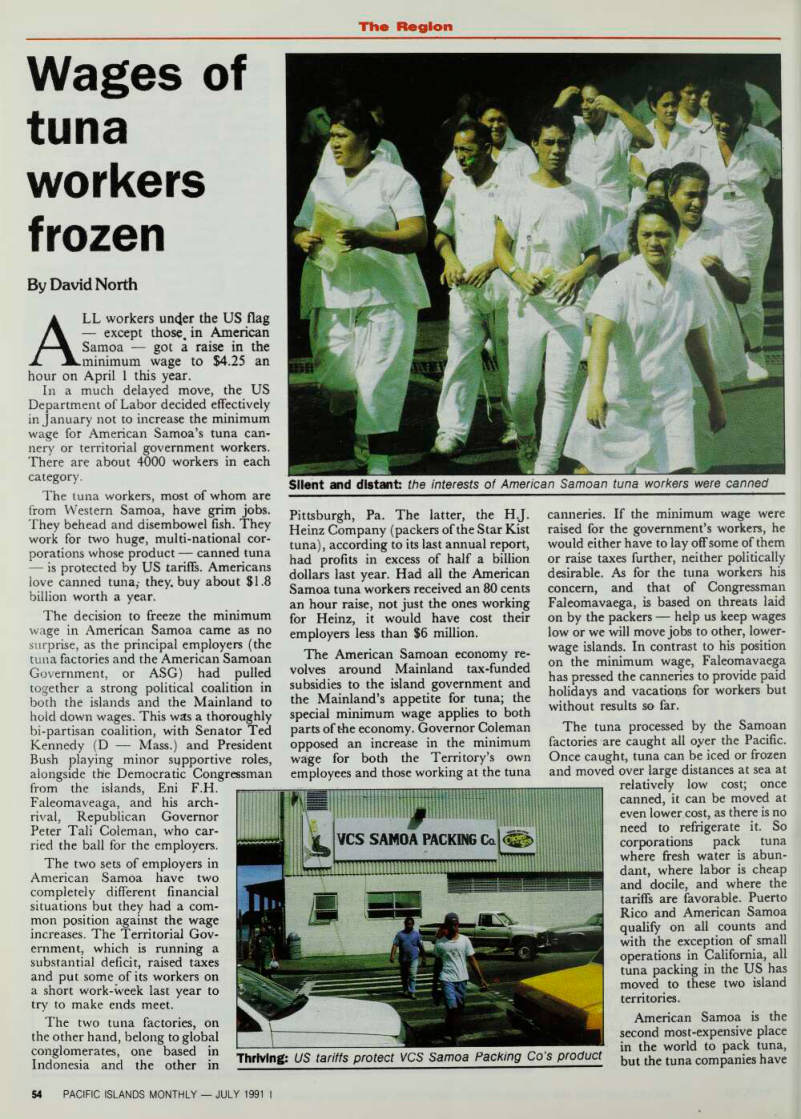
The tuna workers, most of whom are from Western Samoa, have grim jobs.
They behead and disembowel fish. They work for two huge, multi-national cor porations whose product canned tuna - is protected by US tariffs. Americans love canned tuna,- they, buy about $l.B billion worth a year.
The decision to freeze the minimum wage in American Samoa came as no surprise, as the principal employers (the tuna factories and the American Samoan Government, or ASG) had pulled together a strong political coalition in both the islands and the Mainland to hold down wages. This was a thoroughly bi-partisan coalition, with Senator Ted Kennedy (D Mass.) and President Bush playing minor supportive roles, alongside the Democratic Congressman
from the islands, Eni F.H.
Faleomaveaga, and his arch rival, Republican Governor Peter Tali Coleman, who car ried the ball for the employers.
The two sets of employers in American Samoa have two completely different financial situations but they had a com mon position against the wage increases. The Territorial Gov ernment, which is running a substantial deficit, raised taxes and put some of its workers on a short work-week last year to try to make ends meet.
The two tuna factories, on the other hand, belong to global conglomerates, one based in Indonesia and the other in
Pittsburgh, Pa. The latter, the H.J.
Heinz Company (packers of the Star Kist tuna), according to its last annual report, had profits in excess of half a billion dollars last year. Had all the American Samoa tuna workers received an 80 cents an hour raise, not just the ones working for Heinz, it would have cost their employers less than $6 million.
The American Samoan economy re volves around Mainland tax-funded subsidies to the island government and the Mainland’s appetite for tuna; the special minimum wage applies to both parts of the economy. Governor Coleman opposed an increase in the minimum wage for both the Territory’s own employees and those working at the tuna
canneries. If the minimum wage were raised for the government’s workers, he would either have to lay off some of them or raise taxes further, neither politically desirable. As for the tuna workers his concern, and that of Congressman Faleomavaega, is based on threats laid on by the packers help us keep wages low or we will move jobs to other, lower wage islands. In contrast to his position on the minimum wage, Faleomavaega has pressed the canneries to provide paid holidays and vacations for workers but without results so far.
The tuna processed by the Samoan factories are caught all oyer the Pacific.
Once caught, tuna can be iced or frozen and moved over large distances at sea at
relatively low cost; once canned, it can be moved at even lower cost, as there is no need to refrigerate it. So
corporations pack tuna
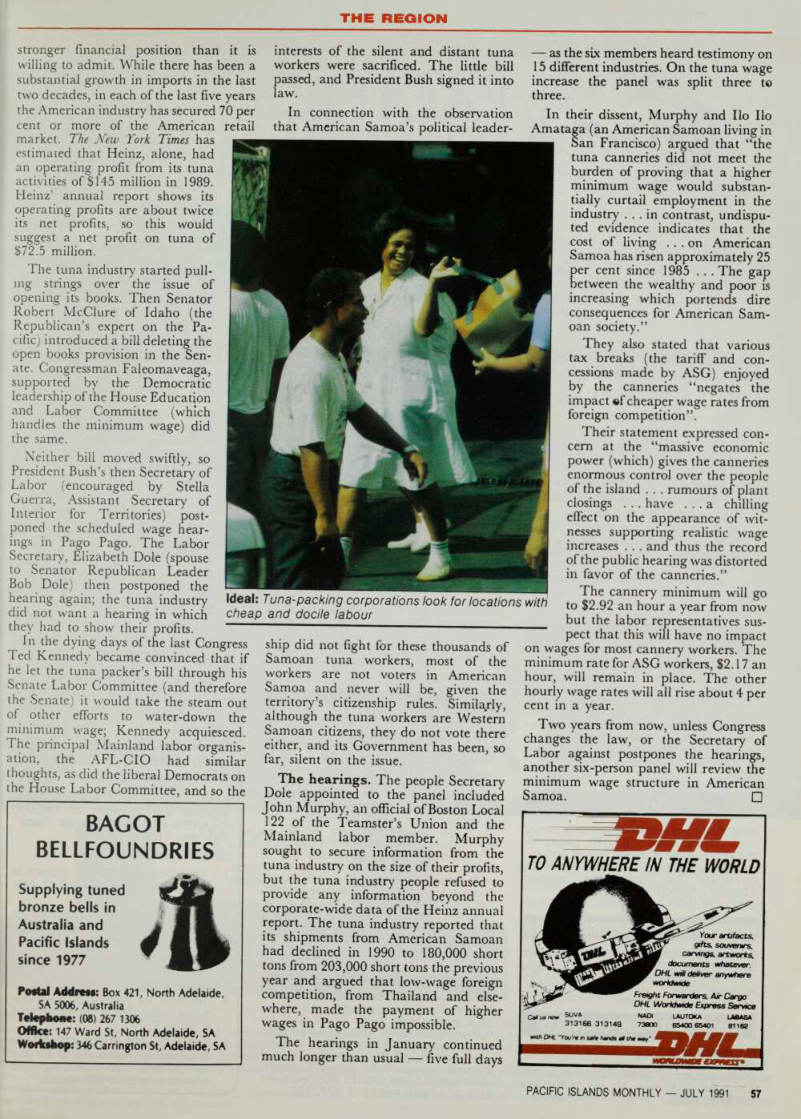
where fresh water is abun dant, where labor is cheap and docile, and where the tariffs are favorable. Puerto Rico and American Samoa qualify on all counts and with the exception of small operations in California, all tuna packing in the US has moved to these two island territories.
American Samoa is the second most-expensive place in the world to pack tuna, but the tuna companies have
Silent and distant: the interests of American Samoan tuna workers were canned
Thriving: US tariffs protect VCS Samoa Packing Co's product
tw'O strong reasons for staying: it is the
cheapest place under the American Flag
to pack tuna and the flagged location
gives them protective tariffs of 6 to 30 per cent; and they have tens of millions of dollars invested in their plants. But the threat to move, stressed recently by the closing of a small cannery in Puerto Rico, terrifies island politicians.
Minimum wages in American Samoa are set in a Mainland context, as federal grants help under write the territory’s government. In re cent years the econ omies in Guam, the Virgin Islands and Puerto Rico have all matured to the ex tent that special ar
rangements are no longer needed their employers pay the regular minimum wage. The special low rates apply only in American Samoa.
Despite opposition from the White
House, the-Congress increased the Mainland minimum wage in 1989 to 53.80 an hour last April, with another increase to
54.25 an hour which went into effect on April 1 of this year. As soon as this decision was made, the tuna factories and the Governor of American Samoa moved in an effort to prevent those wages being
paid in Pago Pago.
The employers went into this struggle with three major advantages: long
established ground rules for making de cisions favor em ployers; employers were ably rep resented by lawyers, lobbyists and poli ticians in Washing ton, while virtually no one spoke up for the workers; the issue is so obscure and so complex that there has been no media attention outside of Pago, Pago (and
Pim).
The ground rules. If any off shore employers want to avoid the Mainland minimum, they may petition to the US Secretary of Labor to establish a
six-person board to decide the issue.
Three board members are drawn from the islands, and three from the Main land; there are two public, two employer, and two workers’ representatives. While the Secretary of Labor makes all six appointments, deference is given to the Governor of Samoa in connection with the three island representatives.
In case of a tie, the minimum wage set earlier remains in place. In effect, both public members and both labor members must support an increase, assuming that both employer members oppose it.
The lobbyists. Before the six-person panel could meet there was a legislative accident, the resolution of which showed the tuna industry’s prowess in Washing ton.
Back in 1989 when the minimum wage
increases were going through Congress a
long-standing provision in the US Mini mum Wage Act, previously applied to Puerto Rico but not to American Samoa, was applied to the latter. No one noticed it at the time (such bills are long and
complex). This provision required that
an American Samoan employer wanting exemption from the coverage of the Mainland minimum must open its books to show it would be adversely affected by application of the regular minimum wage.
The tuna industry was adamantly
opposed to the provision, presumably
because it would have weakened its position on the minimum wage and because it would have shown that it could afford to spend some money cleaning up the mess it makes in Pago Pago Harbor.
The American tuna industry is in a
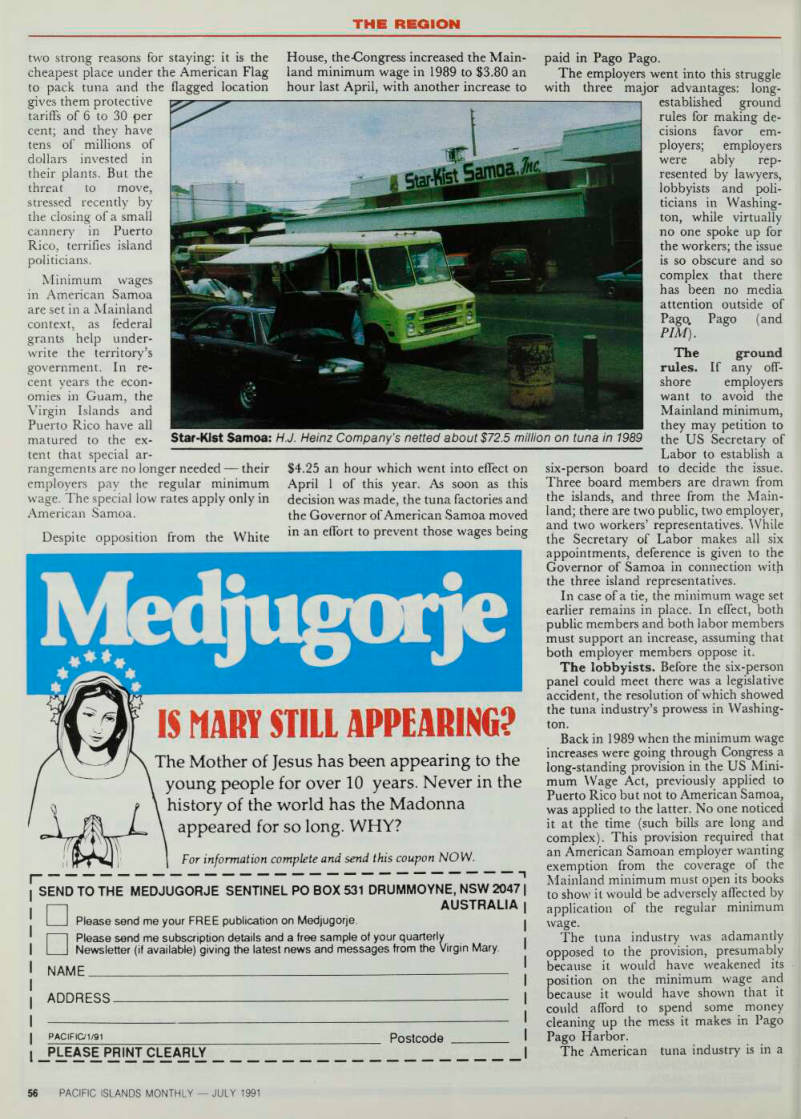
Star-Kist Samoa: H.J. Heinz Company’s netted about $72.5 million on tuna in 1989
stronger financial position than it is willing to admit. While there has been a substantial growth in imports in the last two decades, in each of the last five years the American industry has secured 70 per cent or more of the American retail
market. The Mew York Times has estimated that Heinz, alone, had an operating profit from its tuna activities of $145 million in 1989.
Heinz’ annual report shows its operating profits are about twice its net profits, so this would suggest a net profit on tuna of $72.5 million.
The tuna industry started pull ing strings over the issue of opening its books. Then Senator Robert McClure of Idaho (the Republican’s expert on the Pa cific) introduced a bill deleting the open books provision in the Sen
ate. Congressman Faleomaveaga,
supported by the Democratic leadership of the House Education and Labor Committee (which handles the minimum wage) did the same.
Neither bill moved swiftly, so President Bush’s then Secretary of Labor (encouraged by Stella Guerra, Assistant Secretary of Interior for Territories) post poned the scheduled wage hear ings in Pago Pago. The Labor Secretary’, Elizabeth Dole (spouse to Senator Republican Leader Bob Dole) then postponed the hearing again; the tuna industry did not want a hearing in which they had to show their profits.
In the dying days of the last Congress Ted Kennedy became convinced that if he let the tuna packer’s bill through his Senate Labor Committee (and therefore the Senate) it would take the steam out of other efforts to water-down the minimum wage; Kennedy acquiesced.
The principal Mainland labor organis ation, the AFL-CIO had similar thoughts, as did the liberal Democrats on the House Labor Committee, and so the
interests of the silent and distant tuna workers were sacrificed. The little bill passed, and President Bush signed it into law.
In connection with the observation that American Samoa’s political leader-
ship did not fight for these thousands of Samoan tuna workers, most of the workers are not voters in American Samoa and never will be, given the
territory’s citizenship rules. Similarly,
although the tuna workers are Western Samoan citizens, they do not vote there either, and its Government has been, so far, silent on the issue.
The hearings. The people Secretary Dole appointed to the panel included John Murphy, an official of Boston Local 122 of the Teamster’s Union and the Mainland labor member. Murphy sought to secure information from the tuna industry on the size of their profits, but the tuna industry people refused to provide any information beyond the corporate-wide data of the Heinz annual report. The tuna industry reported that its shipments from American Samoan had declined in 1990 to 180,000 short tons from 203,000 short tons the previous year and argued that low-wage foreign competition, from Thailand and else where, made the payment of higher wages in Pago Pago impossible.
The hearings in January continued much longer than usual five full days
as the six members heard testimony on 15 different industries. On the tuna wage increase the panel was split three to three.
In their dissent, Murphy and 110 110 Amataga (an American Samoan living in
San Francisco) argued that “the tuna canneries did not meet the burden of proving that a higher minimum wage would substan tially curtail employment in the industry ... in contrast, undispu ted evidence indicates that the cost of living ... on American Samoa has risen approximately 25 per cent since 1985 . . . The gap between the wealthy and poor is increasing which portends dire consequences for American Sam oan society.”
They also stated that various tax breaks (the tariff and con cessions made by ASG) enjoyed by the canneries “negates the impact of cheaper wage rates from
foreign competition”.
Their statement expressed con cern at the “massive economic power (which) gives the canneries enormous control over the people of the island , . . rumours of plant closings . .. have ... a chilling effect on the appearance of wit nesses supporting realistic wage increases . . . and thus the record of the public hearing was distorted in favor of the canneries.”
The cannery minimum will go to 52.92 an hour a year from now but the labor representatives sus pect that this will have no impact
on wages for most cannery workers. The minimum rate for ASG workers, 52.17 an hour, will remain in place. The other hourly wage rates will all rise about 4 per cent in a year.
Two years from now, unless Congress changes the law, or the Secretary of Labor against postpones the hearings, another six-person panel will review the minimum wage structure in American Samoa. □
Ideal: Tuna-packing corporations look for locations with cheap and docile labour