Missing by a mile
p. 39 · Read in the full issue
Sport
By Loveni Enari
LOOKING at the results of the Fijian’s three-match tour to New Zealand last month one could sum up their perform ances by as accentuating the positive and eliminating the negative ... or “almost but not quite there”.
As usual the Fijians showed they can score tries from any position on the field and their oft-quoted “natural flair” excited the crowds. But they also pulled anew trick out of the bag when they showed the benefits of increased atten tion to the intricacies of forward play though with the likes of 2.04 m (six foot seven), 128 kg lock, Aisake Nadolo, there isn't much that’s intricate about this
Fijian pack.
They outweighed the Auckland pack by an astounding 77kg, and this sort of muscle and the focus on lineouts and
scrums prompted team manager, Peter Hughes, to predict a Fijian win over Auckland. It’s part of Eden' Park history now that Fiji lost 36-6 and in doing so boosted Auckland’s impressive home re cord to 38 consecutive wins. The last time Auckland lost at home was back in 1987 when their All Blacks were away allowing Can terbury to sneak by them.
Boasting such an impressive
record, why then did Hughes so boldly predict a Fijian win? And why is coach Viriviri finding it difficult to conceal a smile when he talks about this New Zealand tour that ended with just one win from three matches?
For both men it all comes back to that summing up of “almost but not quite there . At this stage in the game “almost” translates to good enough. The “game” re ferred to is of course the Rugby World Cup in October and with four months to go, both men are satisfied Fiji is on course for a
strong showing.
“To me the whole tour has been n success, said Viriviri before departing New Zealand for the last match on their tour against Australian provincial champions, Queensland. “We came here for ihe experience and to get the natch fitness we are lacking. That experience meant we achieved a hat we hoped to.
“Technically also we have ichieyed a lot. There has been a ot of improvement in the scrums md lineouts and in that sense it
was a good build up for the World Cup.
Of course it was demoralising for the players when they saw the scoreboard at the end of the game. But for what we came for they should be happy.
“The players are fit but not match fit.
They still need plenty more matches under their belts. For so early in the season to attain the standards we have I feel we are doing exceptionally well.”
Positive words indeed, and Hughes echoes Viriviri’s feelings. You get the feeling if his side faced Auckland tomor row, Hughes would double any bets he may have put on the first game.
“I did think Fiji would win,” said Hughes. “Mainly because of the work that had been done on the scrums and lineouts and because of the size of our forward pack. This is the biggest Fijian team we’ve ever had and we had moved out of the learning stage into the
correcting stage.
“And I felt the spirit in the team. The confidence was there but the bodies on the field didn’t respond. Mentally we were well prepared but our big guys found the Auckland pace a bit too much and so presumably Fiji now have the big
forwards capable of matching the ‘super
powers’ such as New Zealand and England. But to many of the crowd at Eden Park, Fiji seems to have acquired the extra beef at the expense of their traditional flair.”
Against Auckland they seemed intent on winning the game up front and many a rolling maul was attempted, only to crumble at the feet of All Blacks like Steve McDowell and 010 Brown, while their backs were starved of the call cut twice. But if that’s a criticism, it’s the type which doesn’t worry Viriviri. For many years now the Fijian style of rugby has been criticised for a perceived lack of commitment and attention to techniques in the forward exchanges.
That often has proved to be the undoing of many a gbod fijian side. But
under Viriviri, and technical di rector, George Simpkin, that sort of criticism has hopefully passed.
Viriviri doesn’t feel their tra ditional flair will be sacrificed in improving their forward pack.
“At the moment we’re looking to strike the ideal balance between big forwards who can compete in the tight exchanges and the fast running backs that throw the ball around. I’m really confident we’re on that road ... if it’s just enter taining the crowd then we’ll have to discard it.”
Ironically, in their last match of the tour against Australian prov
incial champions Queensland, the
home side turned on both winning and entertaining rugby, thrashing the tourists 40-13. Three big losses doesn’t provide many fond mem ories but, surprise, surprise, Viriviri and Co are sticking to their tune. They believe they lost momentum early in the first half whenever referee Brian Leask failed to play the advantage.
According to Viriviri: “We thought at least three times tries could have been scored.”
Switching the focus away from their side and eliminating that negativity they were “almost there'’ in many facets of their play. But not quite.
Maybe they need to be re minded that no matter how much the positive is accentuated and highlighted, missing by an inch is as good as missing by a mile. □
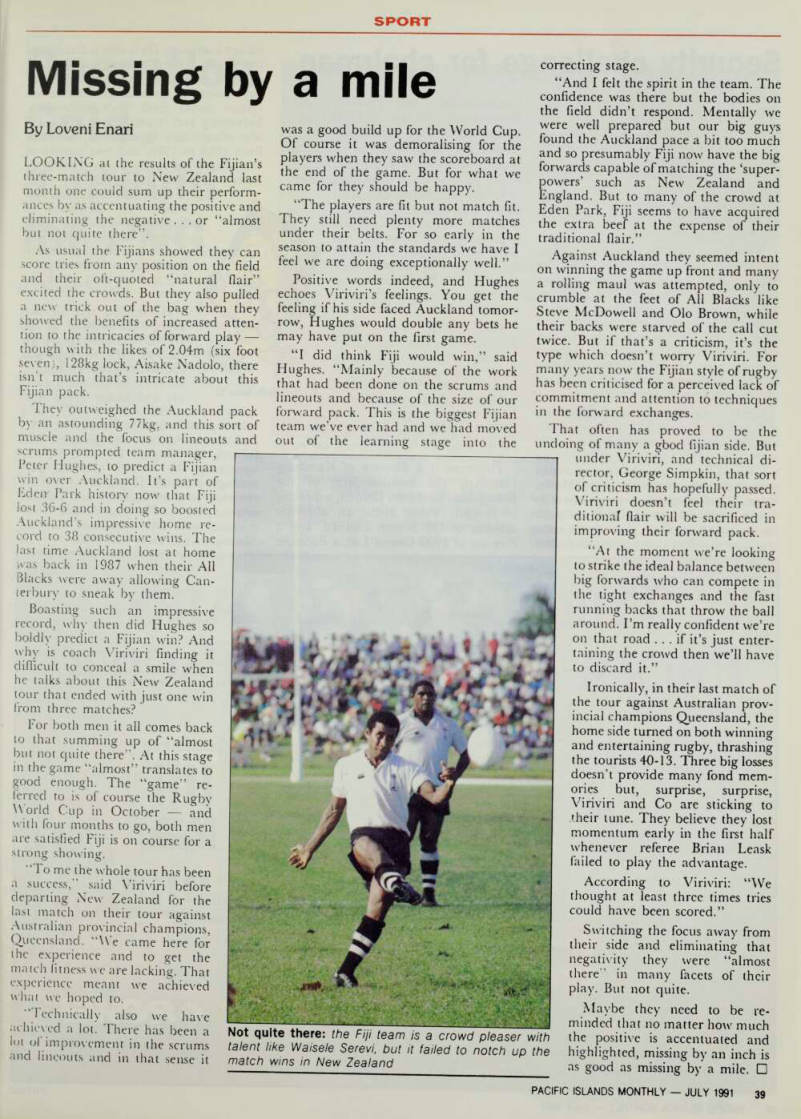
Not quite there: the Fiji team is a crowd pleaser with talent like Waisele Serevi, but it failed to notch up the match wins in New Zealand