Growing, growing,
pp. 9-10 · Read in the full issue
growing . . .
By Beryl Cook
EVENTS in Fiji in the last month have highlighted the Interim Gov ernment’s commitment to pursuing sustained economic growth at all costs, and raised the question of just how big a role traditional loyalties will have to play in shaping the face of Fiji’s political and economy future.
The introduction of two economy decrees by the Interim Government on May 29 gave the message loud and clear that sustained economic growth would be sought come hell or high water.
And hell or high water may be an appropriate analogy.
Critics, especially trade union ists, see the introduction of the The Sugar Industry Special Pro tection Decree and the Protection of the National Economy Decree 1991 as foundations for an un democratic hell “draconian” measures imposed on residents by an authoritarian regime. Sup porters of the interim government believe it is a “we mean business” message to refloat the economy on troubled international waters stirred up by the 1987 coups.
Whether hell or high water, there will be casualties along the way.
The unions have been the first hit. The sugar industry decree, an amendment to the Sugar Industry Act, was introduced in response to the sugar industry crisis the dispute over a third cane payment had disrupted the start of the crushing season, and farmers had
boycotted harvesting. The decree
includes tough penalties, with
anyone deemed to be interfering
with the “orderly planting or growing or harvesting of sugar cane” facing a fine of Fslo,ooo of a 14-year jail term or both.
The national economy decree extends similar protection to tourism, the Fiji
Electricity Authority, civil aviation,
copra, mining and oil (exploration and exploitation), the transport industry and telecommunication with the same penal ties, and a FSSOOO fme or seven years jail for inciting or encouraging someone else to offend. Directors, officers and officials of body corporates, trade unions, indus trial associations or any other organis ation can be held liable.
The government introduced the de crees after the harvest boycott and a 14-week strike by Vatukoula gold miners. Introducing them was a hard nosed economic decision, designed to provide stability for employees and business operators in Fiji, and for international investors who can provide the impetus for long-term growth.
The interim government’s general policy is to move Fiji from an inward oriented economy protected by import licences and high tariff barriers to an outward-oriented economy, looking for expanding and profitable markets over-
seas. The idea is to make Fiji more competitive with better quality products and business operations, and to lift its international status bringing it closer to promising trade and investment mar kets in Europe and Asia.
According to critics, such a plan will put greater distance between the “haves” and the “have nots”, making long-term casualties out of the poor. With domestic rents rising, the newly established Public Rental Board selling off up to 71 per cent of low-cost rental properties formerly held by the Housing Authority, and a Value Added Tax (VAT) expected to
bump up prices, critics say the prospects for Fiji’s poor are dim.
But the message delivered by Minister for Finance and Economic Planning Josevata Kamikamica at the Fiji Insti tute of Accountants Congress at The Warwick on May 31 to June 2 basically maintained that moves such as the VAT would be in the long-term, broader interests of all people in Fiji.
He told delegates taxation links the market economy of private trading and government in its aim of providing services to the people of Fiji. The market economy of private trading was “the engineroom of the whole system. Unless it works efficiently, we do not generate adequate employment and incomes. Nor do we generate the surpluses that can be taxed for communal purposes.”
He said VAT should be seen as part of •the larger tax system, alongside a progressive income tax which would make the overall picture more equitable.
The potential effects of VAT on the poor and unemployed seems to have passed over the heads of many in Fiji, particularly the poor and rural dwellers who, proceeding with the everyday business of growing dalo for subsistence, probably have always assumed they have little to lose in the complex world of high finance. Some groups and individuals concerned with social welfare have decried the effects the VAT will have on the poor.
The Government has not yet ad dressed the issue, maintaining it is staying “open to public suggestions” until July 31. But there are indications that at least some government members place the plight of the poor lower on the list of priorities than the overall objecdve of growth.
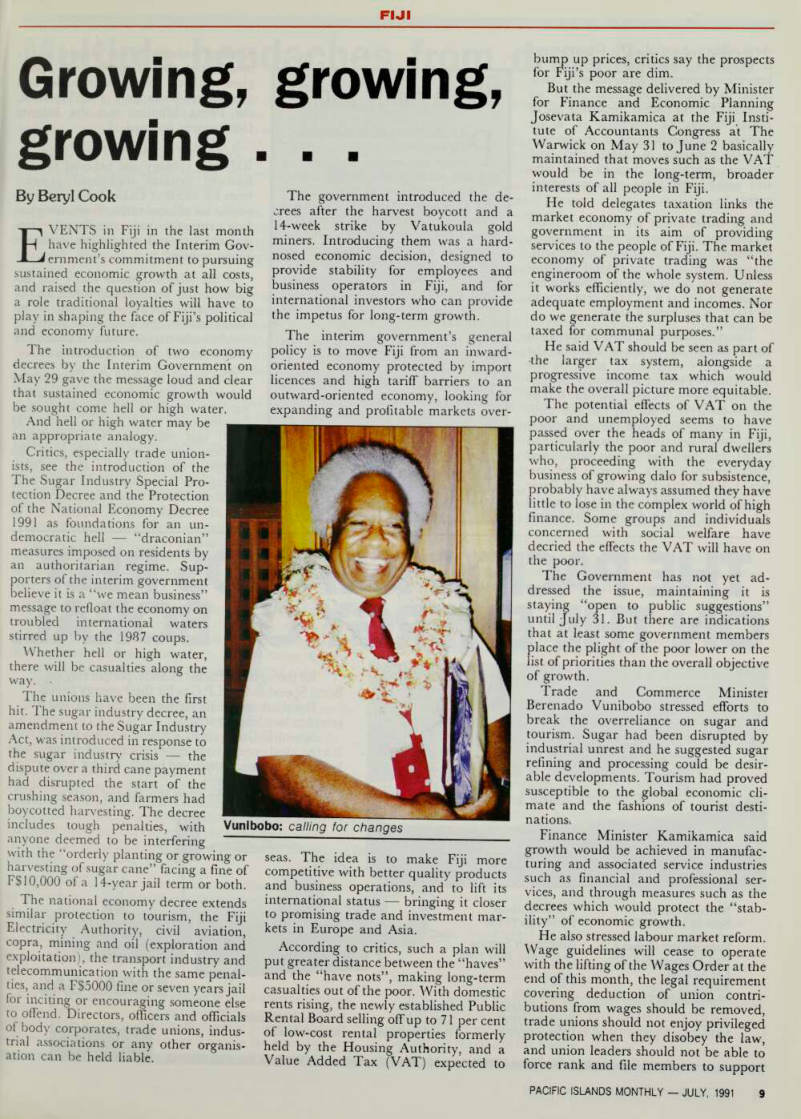
Trade and Commerce Minister Berenado Vunibobo stressed efforts to break the overreliance on sugar and tourism. Sugar had been disrupted by industrial unrest and he suggested sugar refining and processing could be desir able developments. Tourism had proved susceptible to the global economic cli mate and the fashions of tourist desti nationsv Finance Minister Kamikamica said growth would be achieved in manufac turing and associated service industries such as financial and professional ser vices, and through measures such as the decrees which would protect the “stab ility” of economic growth.
He also stressed labour market reform.
Wage guidelines will cease to operate with the lifting of the Wages Order at the end of this month, the legal requirement covering deduction of union contri butions from wages should be removed, trade unions should not enjoy privileged protection when they disobey the law, and union leaders should not be able to force rank and file members to support
Vunibobo: calling for changes
their actions, he said. The Government is looking at amending legislation to
provide independent supervision of trade
union ballots, setting time limits on validity of strike ballots, requiring use of postal ballots in elections of union leaders, and establishing a strong me diation capacity in arbitration and tribunal machinery through staff who will assist negotiators of wage agree ments.
The Government is hoping to boost investment, both public and private. A sustained upturn in private investment, taking it from 6 per cent of GDP to about 12 per cent, could help the government achieve its aim of 4 to 5 per cent growth in GDP, Kamikamica said.
This aim may have been thwarted to some extent by a shock call for the government’s resignation, made by the Fiji Military Forces Commander, Major- General Sitiveni Rabuka, on June 6. The Major-General, whoi led the two mili tary coups in 1987, said the government was “out of touch” with the people, had failed to solve the sugar crisis, and disenchanted people Fiji with the pro posed VAT, the Fijian Political Party being sponsored by the Great Council of Chiefs, and the two decrees. The unions
followed with vociferous support in the media, but the Major-General apolo gised publicly and traditionally and reconfirmed his support of the President, the Prime Minister and the Interim Government on June 12.
According to The Fiji Times (June 13), Rabuka’s apology was believed to have followed extreme traditional pressure from his chiefs of Cakaudrove and from within his officers’ ranks, “indicating just how strongly and significantly tra ditional ties and allegations dominate
Fijian politics”.
If the Major-General really has de cided to put his personal beliefs and/or his political ambitions second to his obligations to the traditional system of chiefly authority, the lesson is unlikely to be lost on the people themselves.
The extent to which the Government can rely on this traditional allegiance to support its vision of the future will become clear when ethnic Fijians, at least, cast votes in the long-awaited election. Success at the polls may also depend, however, on the public’s willingness to support a longer-term economic vision which lies only at the end of a tough road to reform. □