Tora Tora Tora
pp. 6-8 · Read in the full issue
Fiji
A senior Cabinet Minister challenges the chiefs’ right to contest next year’s elections
By Jale Moala
A WALK with Apisai Tora on a Sunday morning is a six-and-half-hour trip of torture. He said it’s two miles, when you finish it’s about 10. From 8.30 am to 3pm you walk. For the visitor, the only consolation is that the walk makes Tora talk. “This way it’s easy, you relax.” And so Tora, the man many fear as a political renegade, opened up his mind and spilled out his heart.
“Fiji,” he said, “needs to change. We can’t hold back the clock and return our people to the past when we are just a few steps *away from the 21st century. The future is up ahead.”
Tora is the Minister for Infrastructure and Public Utilities in the interim government. He has become unpopular in Cabinet after launching and becoming president of a new party, the All National Congress (ANC), to contest Fiji’s first post-coup general election next year. The ANC, a multiracial organis ation, is now the biggest threat to the
Fijian Political Party (FPP) which is being sponsored by the Great Council of Chiefs to win all 37 Fijian seats in the
new parliament.
Tora walked out of his village and stopped on the dusty road to pick up a sugarcane flower. “Look around you the cane is flowering. Do you know what that means? It means they are sweetest ... they are crying out to be cut. But what are we doing? We are spoiling everything simply because we are not talking to each other,” meaning the sugarcane harvest boycott by the National Farmers’ Union.
A few kilometres farther on he looked up at the sun: “It’s not very good today, there’s no heat. I like it when it’s hot, when you can feel the heat on your face ... feel the fumes coming up from the ground and soak into you you can eat it.”
Then remembering his visitor he returned to the subject: “The leadership of the next parliament (in Fiji) is an interesting question. Who will be the leader? That’s what everybody’s wanting to know. And that’s where my party comes in. We want to have a say.”
Up and down a hill he walked to the foot of the legendary mountain called the Sleeping Giant: “Now we climb. This is the nice bit.” And so Tora walked up the mountain from where his ancestors viewed the valley below nearly 3000 years ago on their crosscountry trip eastwards. “Now you hear so much about the Great Council of Chiefs and their Fijian Political Party. They are saying it will unite the Fijian people. But I say, rubbish!
“The Great Council of Chiefs is a respectable and honoured institution.
They should be above everything else, just making sure everything’s in order.
That’s the way it was until 1987 when Sitiveni Rabuka staged his military coups. Rabuka summoned the Great Council of Chiefs and they endorsed his actions. At that very moment they lost the trust of the non-Fijians in this country. Now they want a political party.
“What do they want a political party for? What if the FPP loses one seat, or two or three or loses the province altogether, or two provinces which is possible? Do you know what that will
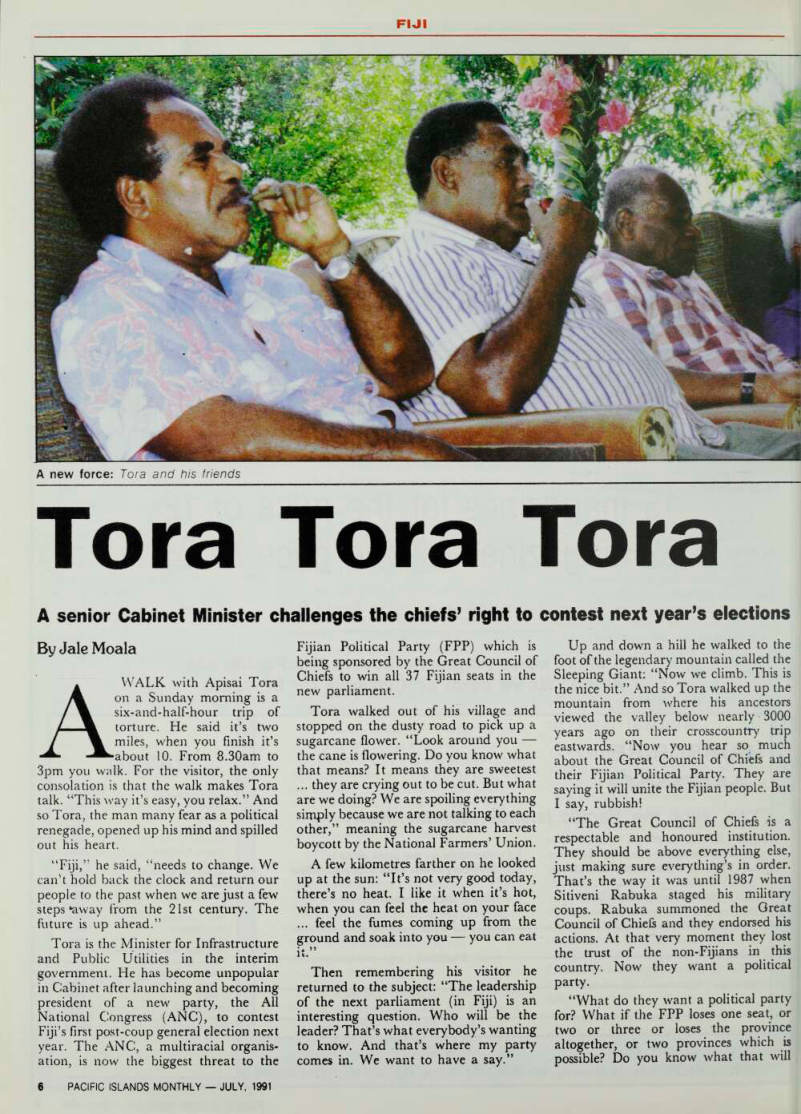
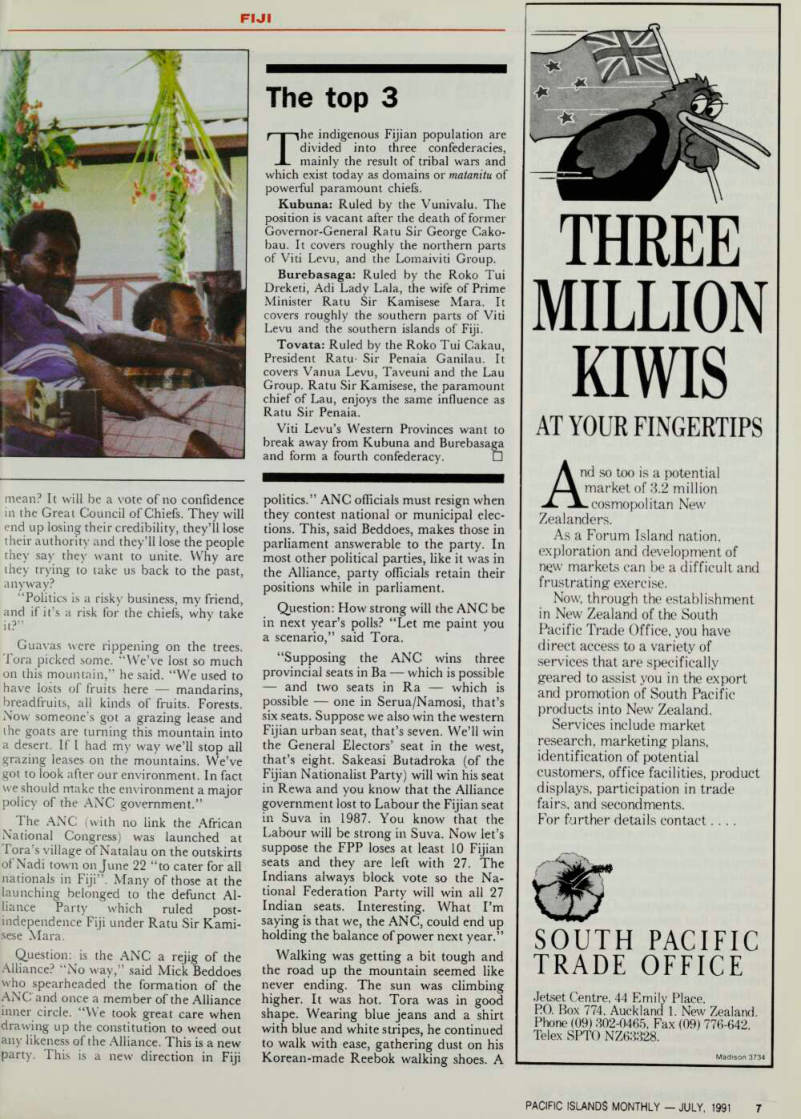
A new force: Tora and his friends
mean? It will be a vote of no confidence in the Great Council of Chiefs. They will end up losing their credibility, they’ll lose their authority and they’ll lose the people they say they want to unite. Why are they trying to take us back to the past, anyway?
“Politics is a risky business, my friend, and if it’s a risk for the chiefs, why take it?”
Guavas were rippening on the trees.
Tora picked some. “We’ve lost so much on this mountain,” he said. “We used to have losts of fruits here mandarins, breadfruits, all kinds of fruits. Forests.
Now someone’s got a grazing lease and the goats are turning this mountain into a desert. If I had my way we’ll stop all grazing leases on the mountains. We’ve got to look after our environment. In fact we should make the environment a major policy of the ANC government.”
The ANC (with no link the African National Congress) was launched at Tora’s village of Natalau on the outskirts of Nadi town on June 22 “to cater for all nationals in Fiji”. Many of those at the launching belonged to the defunct Al liance Party which ruled post independence Fiji under Ratu Sir Kami sese Mara.
Question: is the ANC a rejig of the Alliance? “No way,” said Mick Beddoes who spearheaded the formation of the ANC and once a member of the Alliance inner circle. “We took great care when drawing up the constitution to weed out any likeness of the Alliance. This is a new party. This is a new direction in Fiji
politics.” ANC officials must resign when they contest national or municipal elec tions. This, said Beddoes, makes those in parliament answerable to the party. In most other political parties, like it was in the Alliance, party officials retain their positions while in parliament.
Question: How strong will the ANC be in next year’s polls? “Let me paint you a scenario,” said Tora.
“Supposing the ANC wins three provincial seats in Ba which is possible and two seats in Ra which is possible one in Serua/Namosi, that’s six seats. Suppose we also win the western Fijian urban seat, that’s seven. We’ll win the General Electors’ seat in the west, that’s eight. Sakeasi Butadroka (of the Fijian Nationalist Party) will win his seat in Rewa and you know that the Alliance government lost to Labour the Fijian seat in Suva in 1987. You know that the Labour will be strong in Suva. Now let’s suppose the FPP loses at least 10 Fijian seats and they are left with 27. The Indians always block vote so the Na tional Federation Party will win all 27 Indian seats. Interesting. What I’m saying is that we, the ANC, could end up holding the balance of power next year.”
Walking was getting a bit tough and the road up the mountain seemed like never ending. The sun was climbing higher. It was hot. Tora was in good shape. Wearing blue jeans and a shirt with blue and white stripes, he continued to walk with ease, gathering dust on his Korean-made Reebok walking shoes. A
small white towel was bound Chinese style around his head. “Don’t force yourself,” he told his visitor, then chanting “cha cha cha cha ...” he trotted up the mountain to the next turn, and waited. There was no shade.
Question: Why is Tora so confident of his support in the western provinces of the main island of Viti Levu? It boils down to the region’s attempt to form a Western Confederacy, (see box, page 7) The Western Confederacy issue is a uniting force in the western regions of Viti Levu where much of the country’s resources are: gold, tourism, pine, the main international airport, and sugar.
“You really can’t blame the people in this part for wanting a Western Confed eracy,” Tora said. “They know that their land provides the major portion of the wealth that runs this country and so rightly they desire to have a greater say in how that wealth is distributed. They were hurt when the Great Council of Chiefs did not even listen to them.”
Does this mean that a vote for the ANC by people in the west is a vote for the Western Confederacy? “Right!”
From the top of the mountain, Tora looked at the green valley below with its flowering sugarcane and small farm houses. The whole Nadi area was displayed before him in one spectacular panorama. Tora shook his head, his eyes closing into that familiar squint, and said: “You look at this and begin to wonder why we are fighting.” There was no answer from the Sleeping Giant. Only silence.
Tora, 57, is a leader. He is the chief of Natalau, a nice little village of a little fewer than 300 people. The village is one of the better developed in the sugarcane belt and there his people treat him with much respect. Tora has a powerful influence in his Province of Ba.
His initiative in the launching of the ANC has attracted much anger in Cabinet where some of his colleagues regard him as a renegade. Yet few people in Cabinet would match his loyalty to the Prime Minister, Ratu Sir Kamisese.
“I’ve known Ratu Sir Kamisese Mara longer than many Ministers in Govern ment,” he said. “My allegiance to him was sealed in the traditional way in the presence of my people, my chiefs and my spiritual ancestors.”
On the 25th of last month Electoral Commission chairman Qoriniasi Bale said Fiji’s first post-coup general election could be as early as February or March next year. This has given Tora’s ANC a jump start over most parties chasing a place in the new parliament.
The National Federation Party/Fiji Labour Party Coalition is still without a leader following the resignation of Adi Kuini Bavadra, This is expected to be decided this month.
The Fijian Political Party will launch
its constitution in October, barely enough time to preach its gospel. The Ministry of Fijian Affairs has been trying to influence people at village level to pay to be members. Last report: not very successful.
TT , r ... , . vvtvt i Urban Fijians opposed to FPP have formed a Council of Commons hat is monitoring the build-up to the election to ensure that parties opposed to FPP do not field rival candidates against FPP m
Fijian constituencies.
Next year’s general election will be a test for the Great Council of Chiefs and its survival as an institution for the indigenous people. If they lose then they become the endangered species of Fiji’s
new order.
Back home, Tora sipped coconut juice and listened to a Fijian couple asking for advice. Earlier in the morning he had attended to two Indians. One was a youth needing work and the other an elderly mother whose house had burnt dowl / and whose son she said died after b - arrested and rdeased by the ,• ® p uke , his everyday h e’s in the vU , .. said a villager. “Sometimes he sees three, four people here before breakfast ... all kinds of problems, all kinds of people.” This shows that down in the west Tora is serious business, Those who regard him lightly in the east better take note. D