Traps and trappings on
pp. 46-47 · Read in the full issue
Shipping
Traps and trappings on the ferries of Tonga
By Douglas M. Thorsen
WHEN the Fokololo-oe Hau finally arrived 36 hours late one showery night, I bought a ticket on the wharf for a deck passage to Vava’u for Tl B and found that it was the only kind they had!
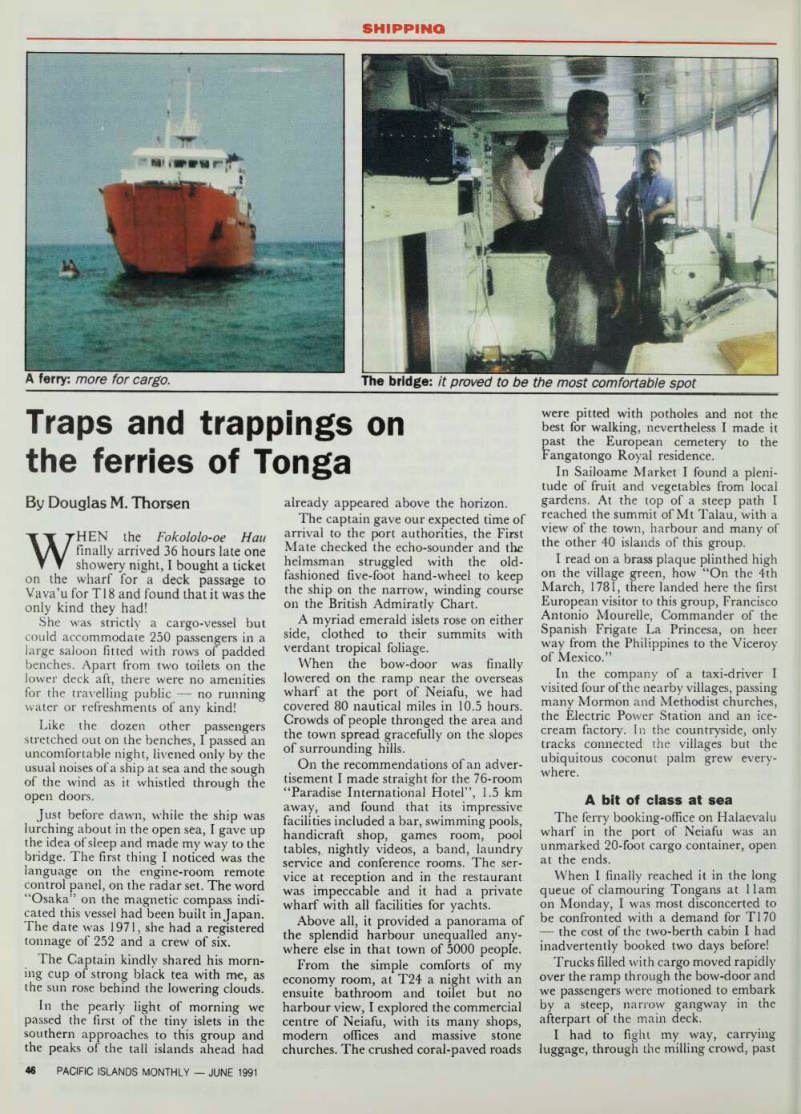
She was strictly a cargo-vessel but could accommodate 250 passengers in a large saloon fitted with rows of padded benches. Apart from two toilets on the lower deck aft, there were no amenities
for the travelling public no running
water or refreshments of any kind!
Like the dozen other passengers stretched out on the benches, I passed an uncomfortable night, livened only by the usual noises of a ship at sea and the sough of the wind as it whistled through the open doors.
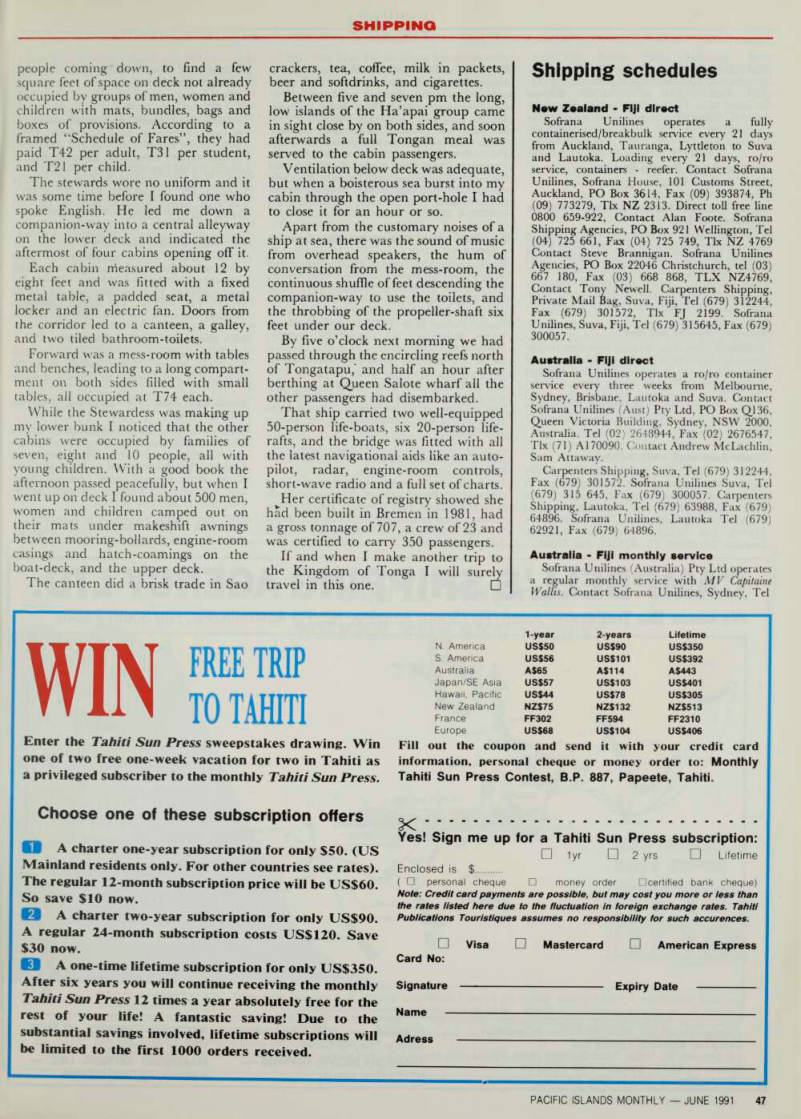
Just before dawn, while the ship was lurching about in the open sCa, I gave up the idea of sleep and made my way to the bridge. The first thing I noticed was the language on the engine-room remote control panel, on the radar set. The word “Osaka” on the magnetic compass indi cated this vessel had been built in Japan.
The date was 1971, she had a registered tonnage of 252 and a crew of six.
The Captain kindly shared his morn ing cup of strong black tea with me, as the sun rose behind the lowering clouds.
In the pearly light of morning we passed the first of the tiny islets in the southern approaches to this group and the peaks of the tall islands ahead had
already appeared above the horizon.
The captain gave our expected time of arrival to the port authorities, the First Mate checked the echo-sounder and the helmsman struggled with the old fashioned five-foot hand-wheel to keep the ship on the narrow, winding course on the British Admiratly Chart.
A myriad emerald islets rose on either side, clothed to their summits with
verdant tropical foliage.
When the bow-door was finally lowered on the ramp near the overseas wharf at the port of Neiafu, we had covered 80 nautical miles in 10.5 hours.
Crowds of people thronged the area and the town spread gracefully on the slopes of surrounding hills.
On the recommendations of an adver tisement I made straight for the 76-room “Paradise International Hotel”, 1.5 km away, and found that its impressive facilities included a bar, swimming pools, handicraft shop, games room, pool tables, nightly videos, a band, laundry service and conference rooms. The ser vice at reception and in the restaurant was impeccable and it had a private wharf with all facilities for yachts.
Above all, it provided a panorama of the splendid harbour unequalled any where else in that town of 5000 people.
From the simple comforts of my economy room, at T 24 a night with an ensuite bathroom and toilet but no harbour view, I explored the commercial centre of Neiafu, with its many shops, modern offices and massive stone churches. The crushed coral-paved roads
were pitted with potholes and not the best for walking, nevertheless I made it past the European cemetery to the
Fangatongo Royal residence.
In Sailoame Market I found a pleni tude of fruit and vegetables from local gardens. At the top of a steep path I reached the summit of Mt Talau, with a view of the town, harbour and many of the other 40 islands of this group.
I read on a brass plaque plinthed high on the village green, how “On the 4th March, 1781, there landed here the first European visitor to this group, Francisco Antonio Mourelle, Commander of the Spanish Frigate La Princesa, on heer way from the Philippines to the Viceroy of Mexico.”
In the company of a taxi-driver I visited four of the nearby villages, passing many Mormon and Methodist churches, the Electric Power Station and an ice
cream factory. In the countryside, only
tracks connected the villages but the übiquitous coconut palm grew every where.
A bit of class at sea The ferry booking-office on Halaevalu wharf in the port of Neiafu was an unmarked 20-foot cargo container, open at the ends.
When I finally reached it in the long queue of clamouring Tongans at 11am on Monday, I was most disconcerted to be confronted with a demand for Tl7O the cost of the two-berth cabin I had inadvertently booked two days before!
Trucks filled with cargo moved rapidly over the ramp through the bow-door and we passengers were motioned to embark by a steep, narrow gangway in the afterpart of the main deck.
I had to fight my way, carrying
luggage, through the milling crowd, past
A ferry: more for cargo.
The bridge: it proved to be the most comfortable spot
people coming down, to find a few square feet of space on deck not already occupied by groups of men, women and children with mats, bundles, bags and boxes of provisions. According to a framed “Schedule of Fares”, they had paid T 42 per adult, T3l per student, and T2l per child.
The stewards wore no uniform and it was some time before I found one who spoke English. He led me down a companion-way into a central alleyway on the lower deck and indicated the aftermost of four cabins opening off it, Each cabin measured about 12 by eight feet and was fitted with a fixed metal table, a padded seat, a metal locker and an electric fan. Doors from the corridor led to a canteen, a galley, and two tiled bathroom-toilets.
Forward was a mess-room with tables and benches, leading to a long compart ment on both sides filled with small tables, all occupied at T 74 each.
While the Stewardess was making up my lower bunk I noticed that the other cabins were occupied by families of seven, eight and 10 people, all with young children. With a good book the afternoon passed peacefully, but when I went up on deck I found about 500 men, women and children camped out on their mats under makeshift awnings between mooring-bollards, engine-room casings and hatch-coamings on the boat-deck, and the upper deck.
The canteen did a brisk trade in Sao
crackers, tea, coffee, milk in packets, beer and softdrinks, and cigarettes, Between five and seven pm the long, low islands of the Ha’apai group came in sight close by on both sides, and soon afterwards a full Tongan meal was served to the cabin passengers, Ventilation below deck was adequate, but when a boisterous sea burst into my cabin through the open port-hole I had to close it for an hour or so.
Apart from the customary noises of a ship at sea, there was the sound of music from overhead speakers, the hum of conversation from the mess-room, the continuous shuffle of feet descending the companion-way to use the toilets, and the throbbing of the propeller-shaft six feet under our deck, By five o’clock next morning we had
passed through the encircling reefs north
of Tongatapu,' and half an hour after berthing at Queen Salote wharf all the other passengers had disembarked.
That ship carried two well-equipped 50-person life-boats, six 20-person life rafts, and the bridge was fitted with all the latest navigational aids like an auto pilot, radar, engine-room controls, short-wave radio and a full set of charts, certificate of registry showed she had been built in Bremen in 1981, had a gross tonnage of 707, a crew of 23 and was certified to carry 350 passengers, If and when I make another trip to the Kingdom of Tonga I will surely travel in this one. □