The State of tourism
pp. 38-39 · Read in the full issue
By Angela McCarthy
WITH New Zealand cutting its annual aid to the islands, the Cook Islands will have to in crease income from other sources just to maintain the present standard of living.
The pressure is likely to be on tourism which, along with financial services, is the biggest source of national income.
The Tourist Authority’s first quarterly tourist arrival figures for 1991 has shown a phenomenal increase of 22.5 per cent over 1990’s first quarterly but the industry is unsure whether this will continue.
According to the Cook Island Tourist Authority figures, tourism provides more than 30 per cent of the workforce with jobs. In the last 10 years the number of restaurants, motels and transport services have doubled. But further development is likely to be needed.
Any changes probably will be done sensitively, given the Tourism Master Plan Project funded by the Asian Development Bank, which is under way in Rarotonga. Its brief is to prepare a
20-year perspective for the Cook Island tourist industry, with a detailed plan for the next five years. The five-man team is led by Robert Cleverdon a tourism development planner for the RPT Econ omic Studies Group in London, with four years experience as UNDP tourism
regional advisor for Fiji.
A draft report by his team will be tabled at a Cook Island tourism forum in July where the findings will be discussed before the report is finalised. Cleverdon says the Prime Minister, who is Minister of Tourism, has insisted on two guiding principles optimise, not maximise, and focus on local opportunity to make the industry something for Cook Island ers and not for foreigners.
“We don’t want to leave the legacy of a homogenised tourist destination, so we look to identifying and building on resources that are different, and one of the main differences is obviously the people. If you have to import personnel then there is a blurring of identity,”
Cleverdon said.
Most of the accommodation on the island is selfcontained and owner
operated with over a third owned and run by Cook Islanders. There are 691 rooms at present. According to govern ment statistics the occupancy rate for 1990 was 60 per cent which was up 5 per cent on 1989, so the accommodation available at present is not stretched and the 22.5 per cent jump has been catered for.
Cook Islanders are dominant in tour operations and bars and most of the service industries such as retailing, al though restaurant management is mostly by foreign residents. The industry has safeguards against being taken over by foreign interests through two laws one states local majority shareholding is needed in any business venture, and the other disallows the sale of land, so land can only be leased from the traditional family owners. So far multi-national foreign involvement has been kept.
But in 1988 the Cook Island tourist industry moved into a new phase. Then the Cook Islands government signed a contract with Italian bank, Icle Bank of Romee, and Italian contractor, SICEL, to build a 200 room, four-star hotel on a turn-key basis in Rarotonga for a 100 per cent borrowed sum ofNZSSI million (in Deutschmark currency). Unfortu nately it has become a developmental nightmare. From its inception the project
has been plagued with problems and criticism over the amount of money borrowed and the validity for such accommodation on Rarotonga. With a change of government in January 1989, a Commission of Inquiry was set up to look into the hotel deal.
It found the project riddled with inconsistencies and criticised the fact no private tendering was done; that the hotel site was still undecided; that there was no design or management; that the
SICEL feasibility study expected 75 per
cent occupancy in the first year; that there had been no provision for turnover tax or royalties to landowners; and that “the risks of continuing to hold the obligations in foreign currency have been likened to playing Russian roulette with the country’s economy, with three bullets in the chamber of the gun.”
It also found it odd that government hadn’t pursued private sector groups who had indicated an interest. The Commission’s feasibility study showed the hotel would impose a substantial obligation on Government to meet annual shortfalls. It concluded that it would be possible although difficult to get out of the project through default or a private sector takeover, but that if it continued then contract terms had to be
renegotiated, including changing the
loan currency. The Henry' Government chose to go ahead and develop architec tural plans, and secure the services of the Sheraton group to manage it once opened. The new agreement included paying full turnover tax with exemptions on duties and levies for plant and
equipment. An eighteen-hole golfcourse
was also added. It appears that the loan is still in Deutchmarks.
But problems continued, culminating in November 1990 with the Cook Island government hotel owning company Ecil serving a 14 day notice of default to the construction company SICEL for lack of progress. It was then announced that SECIL, who had gone under “controlled administration” in Italy and had all credit frozen, could not account for all of
NZ$3O million it had drawn down. The project stopped for five months with the Cook Islands owing interest on money that has achieved little for the country.
Earlier this year the Cook Islands government secured a further NZ$2O million loan through the bank Icle. New plans meant a reduction in room num bers and in the artificial lagoon size 4.
The construction contract, with a new italian contractor Stephany SPA, now includes granting of 15 per cent of total work to local contractors.
The Prime Minister is confident the balance of the NZ$3l million will eventually be returned by SICEL, but the Cook Islands are now NZ$7l million in debt for a hotel project that is still, as the Rarotongans say, “a hole iq the ground”. The hotel that was once to be opened November 1991, then June 1992, is now due to open mid 1993. The government is servicing that loan right now, and there is still no sign of movement on the site.
The government also has 63 per cent ownership on the Rarotonga Hotel.
When it opened in 1976 as a joint venture with THC, Air New Zealand and the Cook Island Government it was intended to be the flagship hotel for Rarotonga. It never has been in fact some people see it as a liability for the tourism industry because of its bad service reputation and inability to pay its bills. In the early eighties two tourism primary whole salers, United Travel Services Ltd, South Pacific Travel Ltd and Scholes Oakley Travel Ltd, took over from THC and Air New Zealand with the Cook Island
Government Property Corporation hold
ing majority shares.
At one stage an Australian company, Randall Pacific, were negotiating with government over a proposal to refurbish and upgrade the Raratongan and an other Government-owned property in Aitutaki, and build a country club and golfcourse next to the Sheraton, but the deal fell through.
The Sheraton management are now consultants for the Rarotongan, running it day to day. John Eaton, preopening manager for Sheraton, says they are doing this as a favour to government. He feels the lack of a strategic plan with the Rarotongan has been a major problem.
None of the directors had hotel experience and it needed a capital injection which the government and bank are working on, he said. “For the government as major shareholder it was an embarrassment that the place was losing money. Now we are making money to the Gross Profit line in 12-24 months it should be able to pay other expenses,” he said.
The industry is all about making money from tourist investments. The private accommodation sector and tour operators are doing well, retail is surviv ing, Air Rarotonga is expanding. The government ventures, however, are showing negative return. The Cook Islands are hoping that will change with NZ$7l million on the line it needs to. □
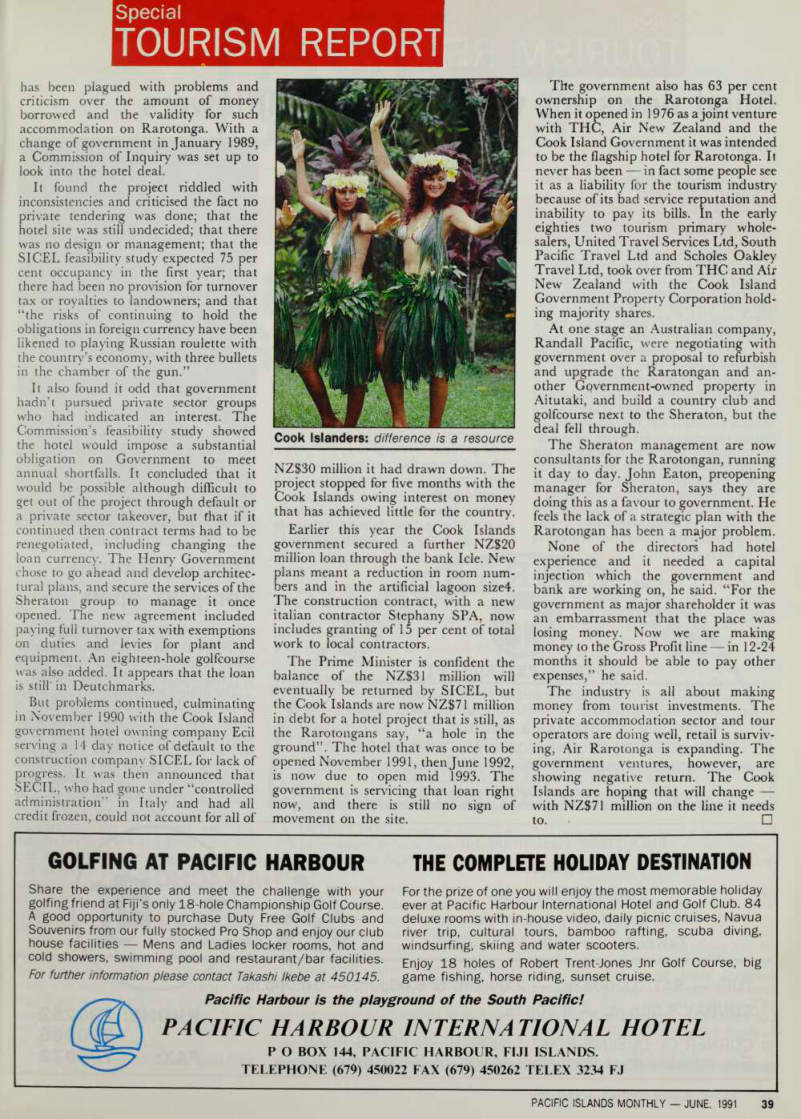
Cook Islanders: difference is a resource