Settling our fate from afar
pp. 27-33 · Read in the full issue

By David North
ON Sunday morning, April 28, Pacific Island tourism got a healthy boost the cover story and page after page of glowing accounts of Fiji in the New York Times travel section; on Sundays the prestigious Times has more than 1.7 million readers, many affluent enough to come to the Pacific.
On Sunday evening, April 28, Pacific Island tourism got a sock in the jaw an 1-1-minute attack on the safety standards of Hawaiian Airlines on Sixty Minutes , one of America’s most-watched television programs (with no mention of Hawaiian Airlines remarkable, 61-year long record of avoiding serious acci dents.) Months earlier, a series of decisions made in Baghdad, Washington, and Tokyo substantially reduced the flow of Japanese tourists, particularly into Sai pan, Guam, and Hawaii. First Saddam Hussein decided to invade Kuwait (send ing aviation fuel prices soaring), then George Bush decided to strike back (creating a fear of aviation terrorism in many potential tourists), and finally a number of faceless Japanese executives decided it would not be politic for their companies to fund vacations for their employees in American Flag resorts it would not look right for Japanese to be partying while the US fought the Gulf war.
A\ hat pulls these seemingly unrelated matters together is that in each case a distant decision by a nation’s leader, an editor, or a TV producer a decision
totally beyond the control of the Pacific islands tourist industry, had a major impact on island tourism. It is a grim reminder of the limited ability of the islands to manage the flow of tourists.
There are four major flows of tourists to the Pacific Islands Australians and New Zealanders, Japanese, North Am ericans and Europeans. With the excep tion of the minority who come on cruise ships they are all air-borne, and the relative ease, the relative cost, and the
perceived safety of air travel play big roles in determin ing how many will visit.
At times distant decision-makers have moved, us ually quite in directly and often not deliberately, to
affect air travel to the islands from two major potential markets, North America
and Japan.
A fundamental (but hidden) set of decisions relates not to tourism directly, but to how nations handle their airlines.
In most of the world airlines operate something like cartels, with little internal competition and sturdy finances. This is certainly the x:ase in Asia, and is only a little less true in Australia and New Zealand. In the US and Canada, however, there are many airlines, and all have been operating for the last dozen years or so under “deregulation”, a sort of near pure, dog-eaf-dog form of capitalism in which weaker airlines are
pushed into serious financial troubles, and weakest (like America's once mighty Eastern Airlines) simply die.
So there is an anomaly, one of the largest group of potential tourists to the South Pacific (the North Americans) must arrive on the weaker or “deregulated” airlines, while the smaller populations of potential tourists from Japan, Australia, and New Zealand can travel on the financially sturdier, cartelised carriers. (The individual tour ists may pay higher fares on these airlines than they do on the North American lines, but that is another consideration.) The Pacific islands, to make matters worse, have attracted the very weakest of American carriers (financially speaking).
Pan American, now in bankruptcy, sold its lines in the Pacific to United several years ago and United has opted to fly over the islands on its way to what it regards as better markets in Australia and New Zealand. Pan American once served both Fiji and Guam, for example, but United chose not to follow suit.
Similarly Continental, sister line to the late Eastern, and now in dire financial trouble itself, expanded into the Pacific several years ago. It continues to serve Hawaii and Guam, and through its subsidiary Air Micronesia, most of what had been the Trust Territories, but it ended its service to Fiji several years ago.
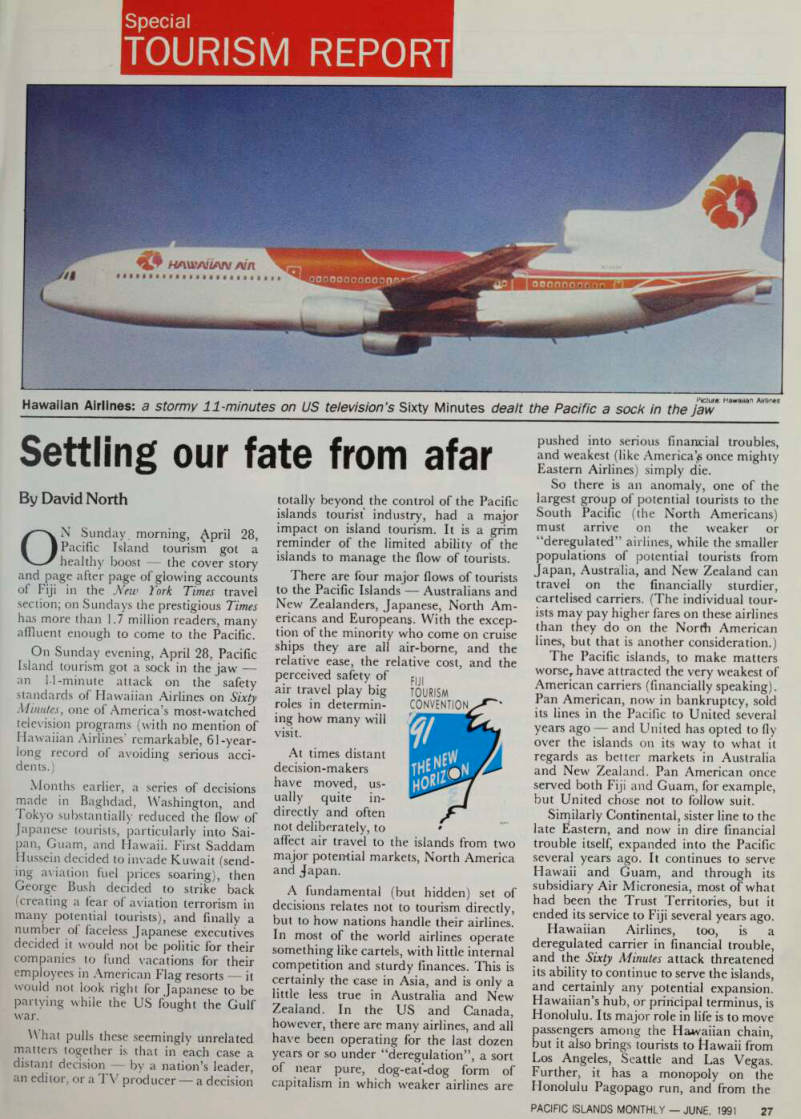
Hawaiian Airlines, too, is a deregulated carrier in financial trouble, and the Sixty Minutes attack threatened its ability to continue to serve the islands, and certainly any potential expansion.
Hawaiian’s hub, or principal terminus, is Honolulu. Its major role in life is to move passengers among the Hawaiian chain, but it also brings tourists to Hawaii from Los Angeles, Seattle and Las Vegas.
Further, it has a monopoly on the Honolulu Pagopago run, and from the
Picture: Hawaiian Airlines Hawaiian Airlines: a stormy 11-minutes on US television's Sixty Minutes dealt the Pacific a sock in the Jaw
latter base it also serves Western Samoa and Tonga. Another route is Honolulu-
Papeete-Rai^itonga.
Until about a year ago, Hawaii Airlines was thinking of moving into the Honolulu-Nadi run; had it done so, it would have filled a gap — that of a North America-based airline flying that run.
Pan-Am had served that route, Conti nental dropped out about three years ago, and, in April, Canadian Pacific did the same. Qantas and Air New Zealand fly from the US (via Honolulu) to Fiji. (Air Tungara has confirmed plaits to inaugurate a route linking Honolulu, Christmas Island and Tarawa in Kiri bati, and Nadi Fiji from May 23.) If any one or' two of the four since departed airlines were still active on the Honolulu-Nadi route it would not only bring more tourists to Fiji, it would help other nations as well. As Donald Panza, regional manager for Fiji’s Pacific Air in Los Angeles put it, “the typical South Pacific tourist is multidestinational he wants to see more than one country.”
Further, all four of these lines have or had active networks of local agents, terminals, and advertising programs in North America much more so than Qantas and Air New Zealand all capable of helping promote Pacific islands tourism.
But the Sixty Minutes producers were not thinking of the interests of Pacific Island tourism when they decided to rip into the Hawaiian Airlines’ safety record. They had what they thought was* a good expose, and they aired it.
Ed Bradley, a familiar television face and voice, and wheelhorse for this program, opened by speaking of the various promotions, such as frequent flyer pro grams, now being offered by US airlines, and then got to his point.
“...the question persists, if they’re giving away all this free sendee are they cutting back on maintenance to pay for it? The airlines say no. They brag about how well they maintain their planes.
“Hawaiian Airlines, however, would have a tough time bragging about how it maintained its planes)’
Bradley then said that two American government agencies had “blackballed”
Hawaiian Airlines last year the
Defence Department, regarding flying
troops, and the General Service Admin istration, regarding flights by civil ser vants.
He then did on-camera interviews with a retired Federal Aviation Administra tion (FAA; supervising inspector, and a former Hawaiian Airlines mechanic. The mechanic ( now an employee of Hawaii an s arch-rival, Aloha Airways, a factor not mentioned on the air) said that he had found a defective part of a landing gear, and his supervisor had told him to
ignore. it, just change the tyre. The incident was reported to FAA which took its time to check on it and the aircraft, according to Bradley, flew for several months with the questionable part.
Bradley also noted that both the airline and the Department of Defence, which had barred the use of the airline for troop movements, had refused to be interviewed on camera by Sixty Minutes, knowing, I suspect, that this is usually a pretty brutal process. . r TT .. .
According to Hawaiian Airlines, what
Sixty Minutes did not mention were the
following:
« The mechanic, Tom Sealy was with HA only briefly and was talking about an event more than three years ago; Since then the airline has come under new management (John Ueberroth is the CEO), and new policies; « That it spends dose sloo mil|ion a yea r on maintenance; m tv r t-i Defence Department has long since reversed its position on the safety of the airline, and has awarded the
line a $57 million contract to fly troops to and from the Persian Gulf; • and that no other American airline, perhaps none in the world, has flown 61 years without a fatality or accident.
Some people who know the airline well defended it, including Don Brugman, Manager of Air Marshall Islands (AMI) in Majuro, who saw it as a media ratings ploy. But not everyone who knows Hawaiian Airlines loves it some of those who use it in the monopoly situation, the Honolulu-Pagopago route, are highly critical of line’s treatment of passengers. There is a series of complaints about delays, lack of communication, and similar matters not safety.
Hawaiian Air has been having severe financial problems. Its last annual financial report showed a $l2l million loss on sales of $341 million — reportedly the greatest annual financial loss of any Hawaii-based corporation in the history of the state. If it follows South Pacific International Airlines to the great hanger in the sky it will be due to heavy losses, not Sixty Minutes.
Under its new leadership, Hawaiian Airlines has renegotiated much of its debt and its plane-leasing arrangements. It dropped its Honolulu-Guam route, where it'was head to head with Conti nental, and it got out of the Alaska- Hawaii route which it had pioneered, but which did not prove profitable. It also picked up the $57 million charter deal to fly American troops to and from the Persian Gulf. Its first quarter earn ings this calendar year will not show a profit, but they will show a remarkable improvement over the $26 million loss in the first quarter of 1990.
The open system of deregulation of US airlines has led to weaker airlines serving fewer islands. Meanwhile a quite differ ent economic and political environment, Japan’s closed system, also led to fewer tourists for the islands. In both cases distant decisionmakers, largely unwit tingly, undermined island tourism.
The tourist industries in Guam, Sai-
pan, and Hawaii hope the reduced flow ofjapanese tourists during the Gulf War was short-term. It was, however, severe.
The Guam Visitors Bureau reported 32,000 cancellations in April and worried the figure would reach 42,000 in May.
Some major islands do not see that many arrivals in a year. Fiji’s best month in the last two years was August, 1990, when 27,823 tourists arrived, The Government of Guam announced that the April decline in arrivals meant that the Territorial Treasury lost $2.2 million in gross receipts taxes, while the tourist industry itself lost untold more, Meanwhile, Hawaii suffered as well (though it has a much more significant flow of tourists from the US mainland), In February its flow of tourists was down 20 per cent from the previous year, mostly due to Japanese defections.
Hawaii’s Governor, John D. Waihee m (D), went to see the Japanese ambassador in Washington while the other governors conferred with Bush Administration officials during the an nual Governor’s meeting in Washington, Waihee’s message to Ambassador Ryohei Murata was the sharp decline in Japan ese tourists was, unwittingly, meshed
with Saddam Hussein’s efforts to undermine the US economy. Guam’s Governor, Joseph Ada (R), flew to Japan in March to make the same point.
In addition to dis covering some walking room on Waikiki Beach, observers noted two in teresting aspects of Japanese tourism in this connection: First, Japanese tour ists are much more valu able financially. Ha waii’s State Economist,
Gregory Pai, calculated that the average
Japanese tourist spends (US) $5BO per
day in Hawaii, about four-and-a-half times as much as a Mainland American.
Secondly, Japanese tourists often ar rive in bunches because their employer is footing the bill. Several years ago routinely pro-business Japanese tax pol
icy was adjusted to give Japanese
corporations tax-breaks when they fi nanced employees’ vacations. This con centrated decisionmaking power with a small group of corporate executives. The reduction in the flow of Japanese tourists to the US resorts was thus caused both by individual fears of Iraqi-caused ter rorism and corporate decisions that it was not good form to send one’s firm’s employees off to vacation while Ameri cans fought a war.
On a more positive note, the big New York Times spread lavished affection on Fiji, particularly its outer islands. Head lines, photos and text carried the same tone, as three American women wrote four long stories about “Fiji’s Easygoing Ways,” “Wakaya: A Retreat Far Away From It All,” “Taking a Cruise in the Lazy Land of Blue Lagoon,” and “At Home on a Remote Island,” an account of a visit to Ono Island, just off the tip of Kadavu Island. (These were news stories by freelance journalists, not puff pieces by tourism publicists.) The coverage included some criticisms such as tiny roaches, musty towels, and coffee that “was barely more than hot brown water” on a Blue Lagoon Cruise but the writer still enjoyed herself.
Lots of writers want to tell of their travels, particularly in The Times , so there is no lack of copy; but somebody in charge, on New York’s West 43rd Street, allocate the space to Fiji on April 28. It was only the wildest of coincidences that some other media executive in the CBS headquarters a mile or so away, decided that Sunday, April 28, was the day to attack Hawaiian Airlines. □
John Ueberroth: airline president
Ed Bradley: Sixty Minutes presenter