Island airlines’ new task
pp. 23-25 · Read in the full issue

By Robin Bromby
THE tourism goals set by island nations for the next decade have given regional airlines a whole new challenge. If the 1980 s was the decade in which viable and locally owned carriers emerged, then the 1990 s will require them to look beyond offering basic services to home airports.
Tourism will only grow with an airline network which allows holidaymakers to
fly from Taipei, Singapore or Bangkok
direct to an island, then move around the region relatively easily. Australia and New Zealand, the main foreign desti nations for carriers such as Polynesian, Niue Airlines, Air Vanuatu, Solomon Airlines and Air Niugini, will not provide the sheer numbers of tourists especially given the economic recessions there. Asia and North America are the keys.
The Solomon Islands wants to treble its visitor numbers by the year 2000 (see page 45). Western Samoa is preparing a a new tourism industry plan. By mid next year even Niue will have two hotels and need to lure the visitors. Papua New Guinea desperately wants to get a visitor industry going. And Fiji, dependent on the industry, needs new sources of tourists to maintain economic growth.
The competition is hot. For long-haul travellers from North America and Asia, there is Honolulu, Australia, New Zea land and Micronesia. And those desti nations all have one key ingredient: well developed airline links with cities around the Pacific rim.
Honolulu is the hub of the North Pacific with enormous seat capacity from
Japan and the United States. Even Micronesia now has services out of Japanese and South Korean cities (with links to Taipei growing). Australia and New Zealand have national carriers which can promote them internationally.
The great progress in the South Pacific during the 1980 s was the lessening of dependence on outsiders, as evidenced when Canadian Airlines withdrew its South Pacific services. It maintained that routes to Auckland and Sydney via Nadi could be served by Qantas and Air New Zealand linking with its attenuated network at Honolulu. But some points are worth making.
First, Canadian Airlines was one of a handful of air services providing Fiji with a direct link with North America, and Fiji’s tourism interests were presumably not a major factor when the airline considered the future of its South Pacific services. Second, Canadian no longer has a vested interest in promoting Fiji as a destination. Air New Zealand and
Qantas, while providing services through
Fiji from various North American cities, will advertise their home countries with
more diligence.
It is not easy for the smaller airlines to provide substitute long-haul services.
Fiji’s Air Pacific badly burned its fingers with its service to Hawaii, Kiribati’s Air Tungara has generated its own long running saga seeking a sevice to Hawaii with a leased Boeing 727, while Air Nauru ate up huge sums of phosphate revenue before opting out of several
routes, including that to Hong Kong.
The director of the Tourism Council ol the South Pacific (TCSP), Malakai Gucake, said it was not the same when
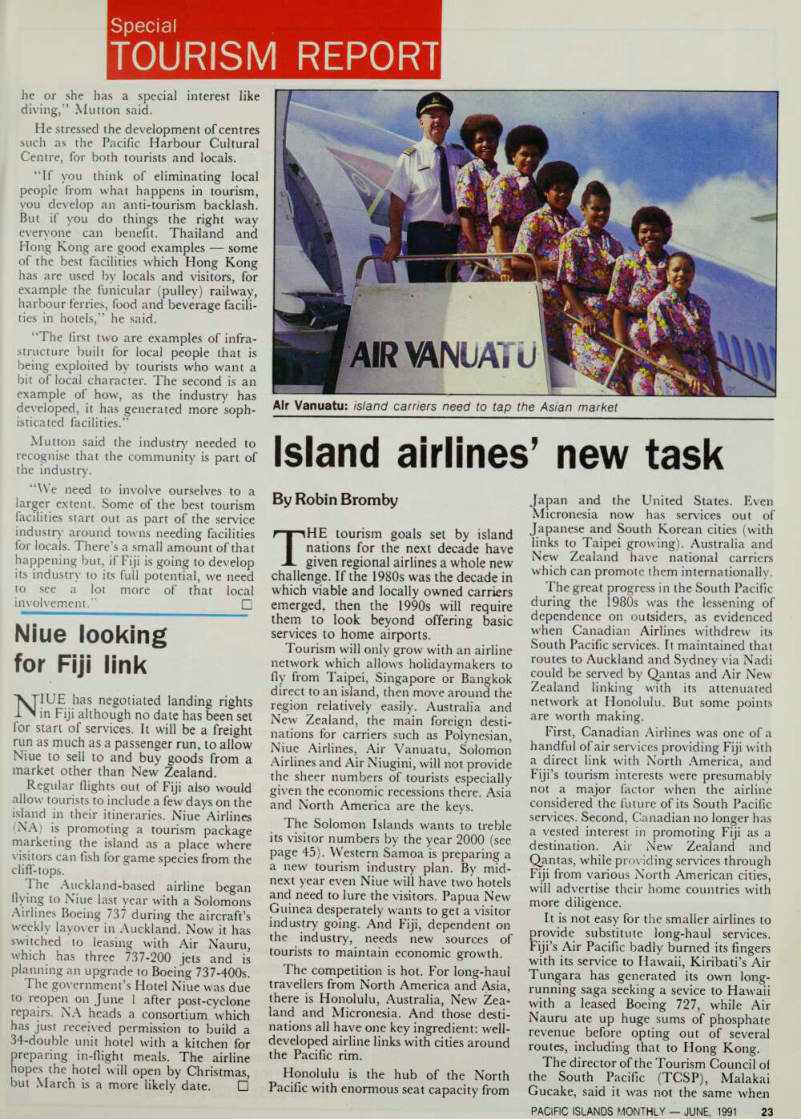
Air Vanuatu: island carriers need to tap the Asian market
a country relied on foreign airlines.
Much of the traffic which Canadian was generating from Europe and Canada will not be replaced, although the TCSP realised that airlines now had to make tough commercial decisions.
Fiji has tried unsuccessfully to interest one of the US carriers (Continental, American and United) flying to Austra lia in calling at Nadi, and the absence of a US carrier from Nadi remains a major gap. The Fiji Government is being asked to exert influence, but the US carriers are all up against the financial wall and will offer no favours. Long-haul fares are the key to international operations and the new generation of aircraft make it possible to fly across the Pacific without intermediate refuelling points ■ — a role which once favoured Pago Pago, Pa peete, Nadi and even places such as Canton Island.
South Pacific transport links run by
outsiders have almost always been tail ored to operators rather than Pacific clients. Route networks connect various islands with the major Pacific rim destinations, but rarely with each other (Hawaiian Airline’s services are one exception although its use of DC-8s on some island routes means limited seat
capacity).
It has been a struggle for the region’s own carriers but the TCSP’s Gucake is pleased at the progress. Air Niugini has its own wide-bodied aircraft and has expanded its network out to Auckland at one end, Singapore at the other. Poly nesian (Western Samoa), Air Vanuatu, Solomon Airlines, Niue Airlines, Air Marshall Islands all survived the inten sity of birth pangs. While there is still much to be done, these carriers have improved services around the South Pacific beyond what anyone hoped for back in the 19705.
Now they need to turn to Asia, Air Pacific has just launched its second weekly service to Tokyo, and Micronesia is well served from northern Asia.
Rumours still are emanating from within Air New Zealand that it is on the verge of signing an agreement with China Airlines, Eva Airlines, and both govern ments for Auckland New Zealand/Nadi Fiji %•>!. And the Fiji Cabinet agreed on May 14 to seek a bllateral alr service a S reemelU with Hon S Kong before 1997.
I( is unlikely, though, that carriers such as Korean, Singapore, Garuda and Thai International till be interested in in any significant expansion through the South plcific. They have more import ant fish to fr T It will remain the island carriers’ task to find a way to tap these Asian markets for the sheer numbers of tourists needed to give the South Pacific a jolt. It will not