Cultural cure for high-cost holidays
pp. 21-23 · Read in the full issue

SMALL businesses have failed to cash in on the demand for cultural experiences depriving themselves of profits, and hindering the industry’s ability to offer attractive deals, accord ing to a tourism leader.
A group of New Zealand tourism operators who visited Fiji recently told Pacific Islands Monthly that accommo dation and meal costs were a turn-off for tourists.
“A lot of our clients would be happy to come back again because they love the people and the natural attractions of the area, but quite a few r are more experi enced travellers now and they’re not so scared to travel a bit further from home particularly when they see the packages offered by places like Bali and Hawaii,” one of the agents said.
She said tourists seemed more un happy about land content prices, than airfares.
“The price of accommodation is much higher than other places and some of our clients are amazed to see the effect the price of meals can have when they’re added on to the bill. Some of them get a shock because they expect it to be a lush tropical land of plenty; then they’re
amazed at things like thef cost of a plate of fruit at the resorts,” she said.
“The economic recession has put price, high on their list of priorities, so when we explain the alternatives many of them decide to try somewhere a bit different that’s a bit further from home, but costs the same or less.”
Fiji Hotels Association chief executive,
Kevin Mutton, said the high cost of some meals in resorts/hotels was linked to import ing certain goods.
He said tourists could keep holiday costs down by or dering local food or, if they are stay-
ing close to a town, by catching a taxi to some of the local eating places. This also would be a cultural experience.
Mutton believes the local community has failed to cash in on this.
“We have recognised for quite some time that we need additional secondary tourism local restaurants and activi ties outside the major hotels which cater
to people going out for the day,” he said.
Only a few local entrepreneurs had attracted this kind of business, by developing the product and using exper tise to promote it, Mutton said.
He said the Fiji Government could help local people gain direction, as they had when residents of Taveuni Island began their Tavoro Falls amenities project. (The $60,000 New Zealand government-funded project is a seven kilometre track covering 2000 hectares of Bauma Forest Park with its waterfalls and pools.) “There is a definite need for more cultural experiences, eating experiences and sale of quality souvenir items handicrafts, jewellery and clothes. There are almost 300,000 tourists coming in and I suspect a lot are leaving with money in their pockets,” he said.
Growing markets such as Japan, North America and Europe also expect activities away from the beach.
“These people come a long way and they want to see and do as much as they can. A lot of them don’t just want to lie on the beach. The averagejapanese after a few days looks for something else, unless
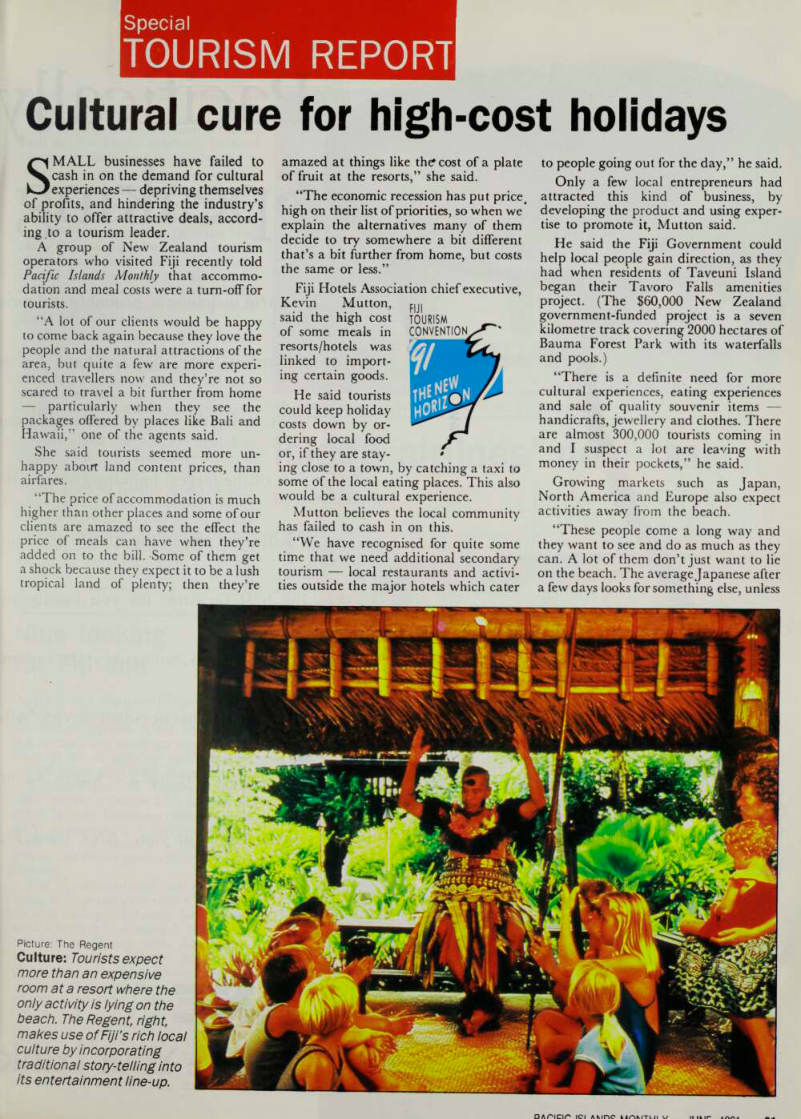
Picture: The Regent Culture: Tourists expect more than an expensive room at a resort where the only activity is lying on the beach. The Regent , right, makes use of Fiji’s rich local culture by incorporating traditional story-telling into its entertainment line-up.
he or she has a special interest like diving,” Mutton said.
He stressed the development of centres such as the Pacific Harbour Cultural Centre, for both tourists and locals.
“If you think of eliminating local people from what happens in tourism, you develop an anti-tourism backlash.
But if you do things the right way everyone can benefit. Thailand and
Hong Kong are good examples some
of the best facilities which Hong Kong has are used by locals and visitors, for
example the funicular (pulley) railway,
harbour ferries, food and beverage facili ties in hotels,” he said.
“The first two are examples of infra structure built for local people that is being exploited by tourists who want a bit of local character. The second is an example of how, as the industry has developed, it has generated more soph isticated facilities.”
Mutton said the industry needed to recognise that the community is part of
the industry.
“We need to involve ourselves to a larger extent. Some of the best tourism facilities start out as part of the sendee industry around towns needing facilities for locals. There’s a small amount of that happening but, if Fiji is going to develop its industry to its full potential, we need to see a lot more of that local involvement.” □