Still trouble with tourism
p. 15 · Read in the full issue
TAHITI’S 30-year-old tourism de velopment history has been high lighted by almost never enough hotel rooms, international airline seats, tourists and money for overseas promo tion. And the Tahiti Tourist Board has been increasingly criticised by industry officials for being too politically oriented and not up to. overseeing or guiding French Polynesia’s biggest single private industry.
But a new problem has emerged in the
past year — an “anti progress’ ‘ revolt am ong Tahitians, par ticularly in the outer islands, wanting to preserve the land for their children. They have organised several demonstrations ag ainst the building of big, new hotels and golf courses by foreign, pa r tic u 1 ar 1 y Ja pan ese, investors. The revolt has left potential in vestors and hotel de
velopers wondering
how serious Tahiti is about building up its
industry, to help the
French Overseas Ter ritory improve its bal ance of payments.
But several tourist industry officials feel bigger hindrances are the economic impact
operating two weekly flights from Los Angeles and Auckland for three years.
During the first four months of this year, Tahiti’s international airline situ ation has been encouraging. On April 1 Qantas Airways restored the third weekly flight from Los Angeles and Sydney that it had cancelled in October 1989. Since last October, both Qantas and Air New Zealand (two weekly flights from LA and Auckland) have drastically reduced their number of transit passen gers and increased their passenger loads of Tahiti-destination and stopover tour ists.
Last year, Air New Zealand carried 21 per cent of all Tahiti’s tourists, second only to UIA French Airline’s 25 per cent share. With UTA having cancelled one ofits three weekly flights from Paris and ilie US west coast on May 1 and with UIA and Air France (one weekly Paris LA-Tahiti flight) carrying more Eur opeans and fewer Americans, both Air New Zealand and Qantas should in crease their overall shares of Tahiti’s
of France’s 25-year-old nuclear testing program and French Government subsidies for Tahiti, and a job market dominated by the public sector, which pay s higher wages than private sectors like the tourist industry. c ouch officials argue that as long as this Territory of 200,000 people has a high, gross national product of U 557,830 per inhabitant, thanks mainly to Tahiti’s econ . omic dependence on France, there is * less incentive to develop tourism.
tourists and particularly their American shares. Last year, UTA carried 30 cent of the US tourists, Qantas carried 25 per cent, Air New Zealand carried 19 per cent and Air France carried 5 per cent, according to the Territorial Civil Avi
ation Department.
More good news for Tahiti was recently announced by Minerve. Start ing July 1 it will operate a weekly regularly scheduled flight from Paris via Los Angeles and hopes to add a second in 1992. With Club Med now a major stockholder in Minerve, tourist industry officials expect to see Minerve take most of the Tahiti Club Med business away from UTA.
On the negative side, Flosse’s attempt to get French approval for the French carrier Air Outre Mer to fly to Tahiti was recently vetoed in Paris the French Government has the final say, illustrating one of the biggest obstacles in increasing Tahiti’s international airline services.
Christian Vernaudon, president and board chairman of Air Tahiti, the
Despite its struggling performances. its international airport in March 1961, has never lacked optimistic, even dream hke predictions for the future ranging rom ? n underwater lagoon hotel, a g am blmg casino and 4-500 super deluxe £otc s to an ° f 4 ’ 0 , 00 hotel rooms and 200,000 tourists yearly, Last year Tahiti had a volume of 132,361 tourists, its lowest since 1985 (122,086 tourists) and far behind its best year of 1986 (161,238 tourists). But 1991 is not expected to produce many more tourists than last year, mainly due to the Gulf war, the US recession, and financial
hardships of interna tional airlines.
Although Tahiti’s
previous four Terri torial Governments since 1982 have each had a goal of ending up with 4000 hotel rooms and 200,000 tourists yearly within four to five years, Ta hiti began 1991 with a hotel capacity of 2824 rooms, which is un likely to increase much this year. One tourist industry official said only 1000 of those ho tel rooms are good enough to be commer cialised. Tahiti needs 1500 new, good rooms,
particularly overwater
bungalows on Bora Bora, to meet the de mands of today’s tour ists, he said. □
Territory’s inter-island carrier, and Ta hiti Vacations, a Los Angeles-based tour operator, welcomed the Minerve devel opments because Club Med meant more stability for Tahiti’s industry than an airline like Continental. Minerve’s July 1 switch from San Francisco to Los Angeles would attract American tour operators, who found 80 per cent of Tahiti’s American clients saw LA as the gateway to Tahiti.
Vernaudon said if Tahiti stopover business develops as expected, the hotels would have much better occupancy rates for the fourth quarter of this year, leading to a potentially good tourist volume year in 1992.
Vernaudon said there was no need for a second Tokyo-Tahiti flight because there were no more overwater bungalows on Bora Bora to fill. What is missing, he said, are another 1500 “good” hotel rooms built in a relaxing, distinctly Polynesian style next to a nice lagoon, to top up the 1000 existing ones which could be commercialised. □
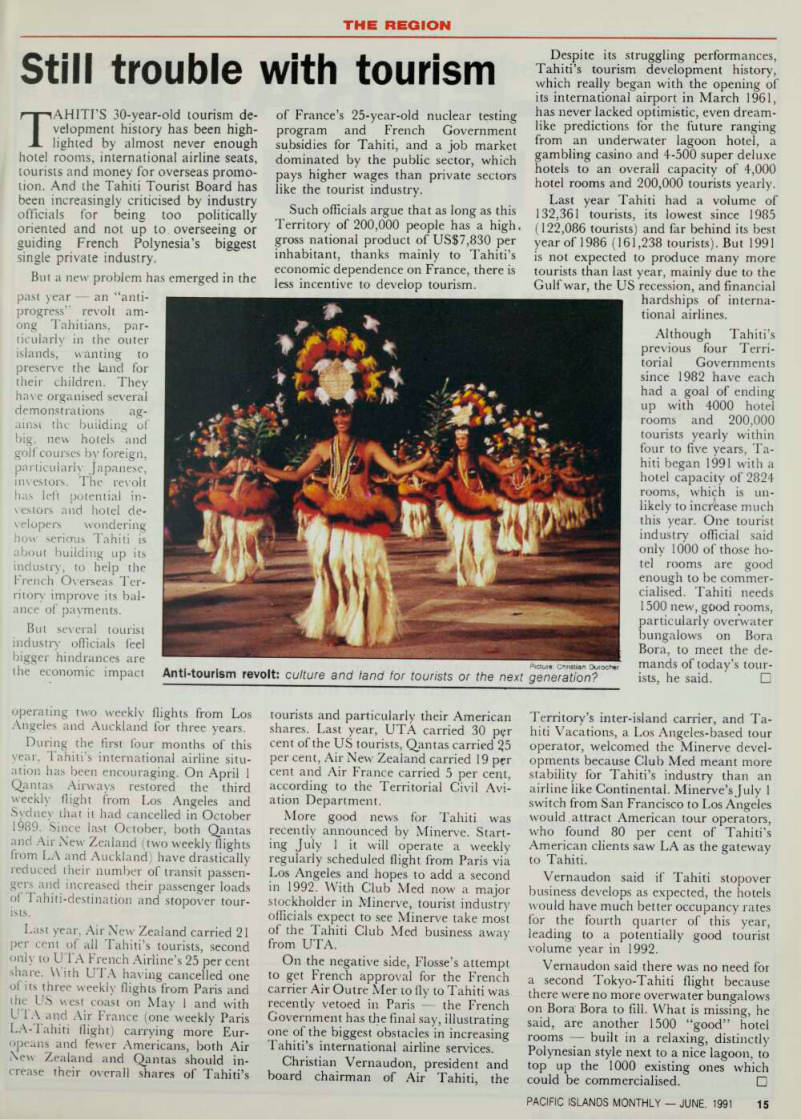
Picture: Christian Durocher Anti-tourism revolt: culture and land for tourists or the next generation?