Wakening the Maori dreams
pp. 53-54 · Read in the full issue
Pacific People
By Lito Vilisoni
IT started with United States presi dential candidate, Rev Jesse Jackson, and his message to disadvantaged blacks; “It is morning time ... time to wipe the sleep from our eyes .. and to turn our dreams to waking reality.”
National’s Maori Affairs minister, Winston Peters, last year adopted the concept and urged Maoridom to share his vision. Today, that vision is set to take Maoridom into the 21st Century.
Peters, Tauranga MP, is pushing for the adoption of an ambitious plan to reform Maori administration, and spur Maori development over the next 30 to 50 years. The plan is detailed in his headline-rousing report, Ka Awatea (It is Day), which records the tragic lot of Maori: In health, Maori male life expectancy is seven years less than non- Maori. The number of women who die of lung cancer is three times that of non- Maori. In education, 30 per cent of Maori boys do not advance primary school each year. Non-Maori students pass twice the number of School Certifi cate subjects that Maori students pass.
And in employment, Maori largely hold semi-skilled or unskilled jobs. They make up 8 per cent of the labour force, but 20.5 per cent of the unemployed.
Peters believes a new and more powerful agency than the Labour established Manatu Maori (Ministry of Maori Affairs) and Te Tira Ahu Iwi (Iwi Transition Agency), can turn these nagging figures around. The new agency, the Ministry of Maori Development, (which would be set up with ministry and ITA funding), would run on $155 million a year, have 11 regional offices and a staff of about 350. It would concentrate on housing, health, educa tion and job training and economic initiatives, and include special units such as a Maori Education Commission. By placing a more active and proactive role in bureaucracy, it would help arrest and reverse the entrenched position of Maori on the bottom of the scrap-heap.
Much of Ka awatea , launched last month, is familiar Peters-policy. Many of the reforms he plans to introduce were spelled out in his impassioned “morning time” speech as Opposition Spokesman on Maori affairs, last May. Peters promised National would direct state resources to Maoridom to help it “com pete and win unassisted unaided by state paternalism 0 and “without the welfarism which had robbed a gener ation of Maoridom of an independent future.”
Ka Awatea keeps faith with Peters’ speech and many of the comments he
made at the time, including: “The ills that afflict our young people are just as much a Maori problem as they are a matter of government policy.”
A “hand up” rather than a “hand out” philosophy is strong in the report.
For example, it warns that rising social discontent could surface alongside in creasing state dependence. It also urges
“negative funding” the unemploy
ment benefit be used “positively” on
programmes such as big forestry projects
where the jobless could work and get the dole, and the programme a subsidy.
The report goes some way to restoring
some of the mana Maoridom lost through a string of so-called “rip-off” stories during the Labour reign. Labour’s reforms were well-intentioned, but many programmes, such as job schemes, were riddled with holes, encouraging abuse.
Devolution, too a laudable concept proved too ambitious for many iwi (tribe), who lacked the expertise, such as accountancy to cope with the adminis tration. The public saw it as yet another Maori “failure”. One of the programmes to get the thumbs down in the report, is the Mana Enterprise Scheme, which tried to get Maori into jobs. A business development programme run by experts, is suggested in its place.
Response to Ka Awatea has ranged from a “welcome initiative” by some media to claims by detractors that it’s a bid by the ambitious Peters to cement his ministerial command in preparation of another jab at the leadership. Ka Awatea is a test of Peters’ ministerial mettle ... a test of whether he can achieve as much for Maoridom as his Labour predecessor, Koro Wetere, seemingly did. Wetere, David Lange and Geoffrey Palmer’s loyal lieutenant, was seen by critics (largely Maori) as a prisoner of his political loyalties, a sorry casualty of the Maori loans affair, the greatest internal crisis of Labour’s first term. But bellyach ing (and there was plenty of it) aside, many believe Wetere will go down as one of the best Maori affairs ministers.
Peters’ self-confidence speaks for itself.
Asked whether he was confident the National government would adopt Ka Awatea , he put his mana on the line by saying: “I’m staking my political career on it. I’m staking my political career on it because it is what the country needs, for Maoridom’s sake, and the country’s sake.” Maoridom share his vision judg ing by the response to the report. "Most
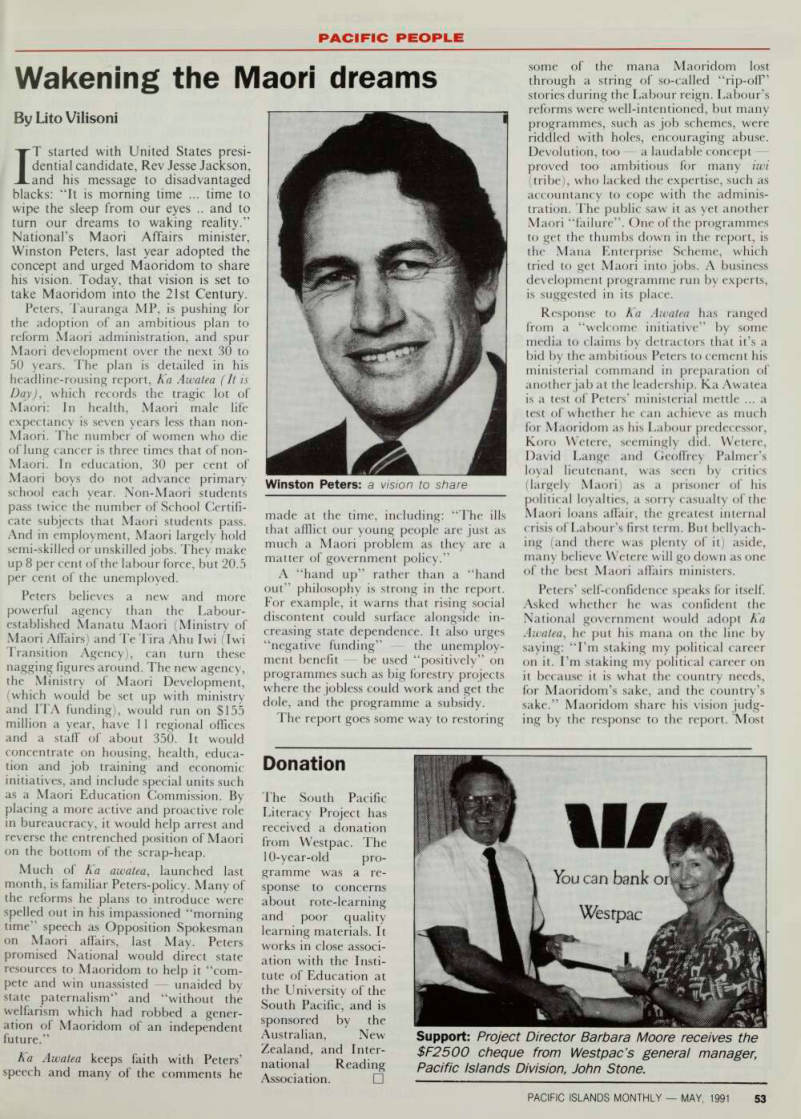
Winston Peters: a vision to share
of the 250 leaders many of them the most influential in the country who were called to Wellington for the grand launch, endorsed the report, albeit cau tiously. Two said it was a start, a third had reservations about the future role of iwi, and a fourth paid homage to Peters: “He’s one of the bravest politicians since Ngata ... He will stick his neck out for Maoridom.” (The legendary Ngata was one of the country’s first Maori MP’s.) Peters’ courage has never been in doubt, even to Maori activists who see
him as a “white Maori”. What many want to know is if he can turn the 100-page report and its 68 recommenda tions from a wish list to policy. They also want to see if Ka Awatea can push Maori interests centre stage as national inter ests. But the big question for many is, has Peters the political skills and standing with his colleagues to pull it off?
Most of Peters’ colleagues see him as self-serving, but he’s not without allies.
One of his staunchest is former prime minister, Sir Rob Muldoon. But Peters
doesn’t have the ear of most of his colleagues, especially that of Kiwi Prime
Minister Jim Bolger. Bolger finds Peters
troublesome, disliking especially his
penchant for speaking outside of his Maori portfolio. Bolger and others see it as Peters undermining his leadership.
Peters, who rates well in the opinion polls, has tilted his hat at the leadership, but is fond of quipping “I’m happy just being the member for Tauranga.”
Last year, Bolger demoted the media sexy Peters for the second time in 13 months after his decidedly risky behav iour during the hustle for Kiwi votes in October. Peters questioned the party’s 0 - 2 per cent by 1993 inflation target one week into a very wobbly election cam paign. Soon after, he criticised his
colleagues election performances, includ
ing Bolger’s and was silenced only with threats of exclusion from Cabinet. Peters won a seat in the inner circle (he’s gone from number eight to 17) despite Bolger’s misgivings, largely because the latter had no choice. As Peters later said, he was a must for the job. Many in mainstream Maoridom wanted Bolger, but having the PM as Maori Affairs minister would have signalled a stronger support for Maori issues than National was perhaps prepared to commit itself to at that stage.
In the six months Peters has been Maori Affairs minister, he’s continued to be outspoken and at times critical of the government. But last month, he scored one of his biggest coups with the release of Ka Awatea. Peters won the scorn of his colleagues when he delivered the radical report to Cabinet only after he had sold it to Maoridom. He then proceeded to treat the document as government policy despite Bolger’s coolness, and dismissal of Ka Awatea as just another ministerial report, and the opinion of only its authors. When he was accused of trying to stitch up the Government Peters said: “Am I to be condemned for my
openhanded democracy?”
Peters seeming disloyalty has encour aged some to think he’ll become a casualty. Yet, many believe he’s got what it takes to be an effective leader for Maoridom. As he showed with Ka Awatea, he’s got the skills to survive the rumble and tumble. For, as Bolger and Peters know, National will have to tread carefully to avoid a backlash if the report isn’t adopted. Maoridom, in limbo since Labour’s demise, has been waiting a government show of commit ment. The relationship could prove troubled if Ka Awatea is dumped without a sound reason or, as some believe, because of the hostilities with Peters.
Last year, critics said Peters would make a poor minister because he wasn’t fluent in Maori. Peters retorted that the language of politics was more important.
Today, he’s proving that there’s some truth in his argument. □