End of the cold war
pp. 47-48 · Read in the full issue
Violence flares, Vatukoula fights another strike
By Yashwant Gaunder
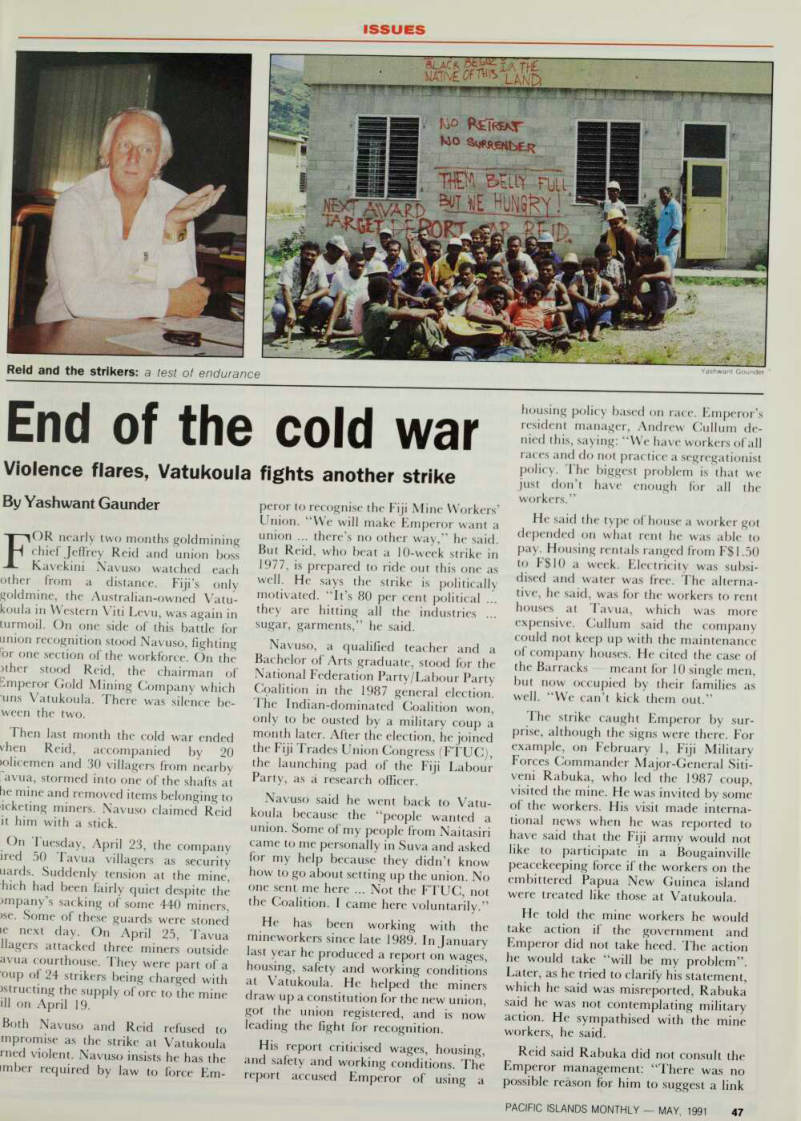
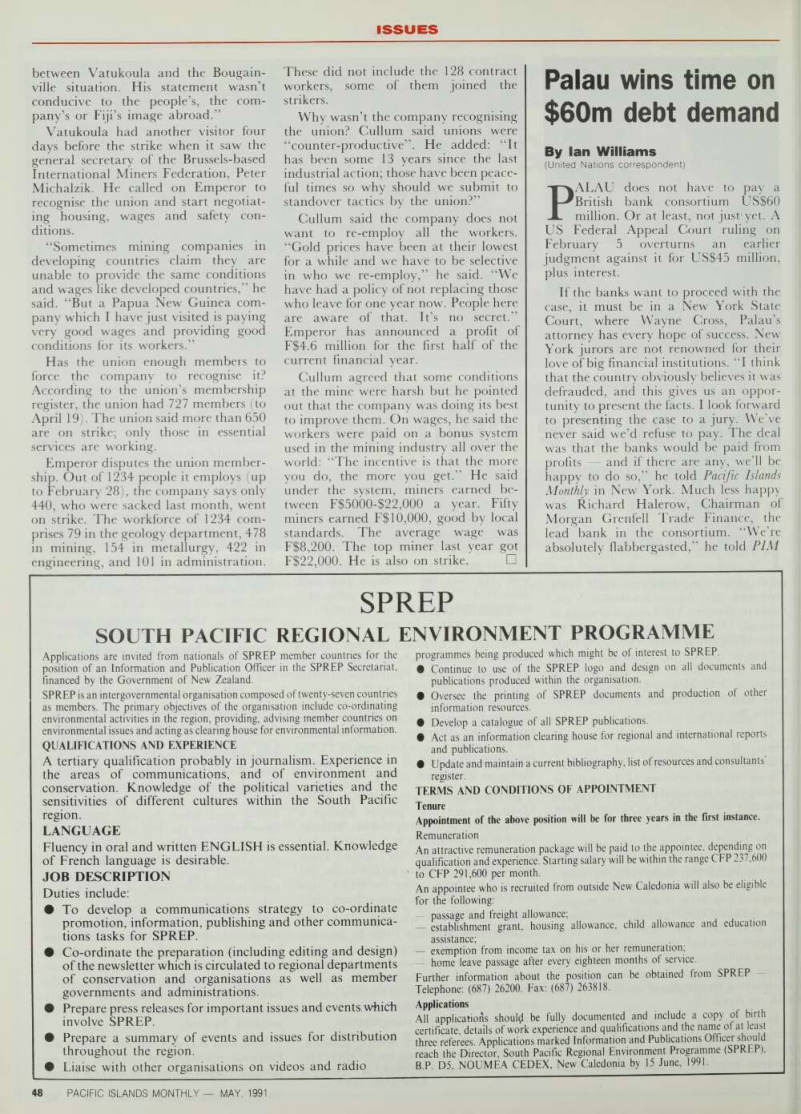
FOR nearly two months goldmining chief Jeffrey Reid and union boss Kavekini Navuso watched each other from a distance. Fiji’s only goldmine, the Australian-owned Vatu koula in Western Viti Levu, was again in turmoil. On one side of this battle for union recognition stood Navuso, fighting or one section of the workforce. On the uther stood Reid, the chairman of
Smperor Gold Mining Company which
uns Vatukoula. There was silence be ween the two.
Then last month the cold war ended vdien Reid, accompanied by 20 lolicemen and 30 villagers from nearby avua, stormed into one of the shafts at he mine and removed items belonging to icketing miners. Navuso claimed Reid it him with a stick.
On Tuesday, April 23, the company ired 50 Tavua villagers as security uards. Suddenly tension at the mine, hich had been fairly quiet despite the )mpany’s sacking of some 440 miners, )se. Some of these guards were stoned ie next day. On April 25, Tavua Hagers attacked three miners outside avua courthouse. They were part of a oup of 24 strikers being charged with istructing the supply of ore to the mine ill on April 19.
Both Navuso and Reid refused to mpromise as the strike at Vatukoula med violent. Navuso insists he has the imber required by law to force Em
peror to recognise the Fiji Mine Workers’
Union. “We will make Emperor want a union ... there’s no other way,” he said.
But Reid, who beat a 10-week strike in 1977, is prepared to ride out this one as well. He says the strike is politically motivated, it’s 80 per cent political ... they are hitting all the industries sugar, garments,” he said.
Navuso, a qualified teacher and a Bachelor of Arts graduate, stood for the National Federation Party/Labour Party Coalition in the 1987 general election.
The Indian-dominated Coalition won, only to be ousted by a military coup a month later. After the election, he joined the Fiji Trades Union Congress (FTUC), the launching pad of the Fiji Labour Party, as a research officer.
Navuso said he went back to Vatu koula because the “people wanted a union. Some of my people from Naitasiri came to me personally in Suva and asked for my help because they didn’t know how to go about setting up the union. No one sent me here ... Not the FTUC, not the Coalition. I came here voluntarily.”
He has been working with the mineworkers since late 1989. In January last year he produced a report on wages,
housing, safety and working conditions
at Vatukoula. He helped the miners draw up a constitution for the new union, got the union registered, and is now leading the fight for recognition.
His report criticised wages, housing, and safety and working conditions. The report accused Emperor of using a
housing policy based on race. Emperor’s
resident manager, Andrew Cullum de nied this, saying: “We have workers ofall races and do not practice a segregationist policy. The biggest problem is that we just don’t have enough for all the workers.”
He said the type of house a worker got depended on what rent he was able to pay. Housing rentals ranged from E 51.50 to FSIO a week. Electricity was subsi dised and water was free. The alterna tive, he said, was for the workers to rent houses at Tavua, which was more expensive. Cullum said the company could not keep up with the maintenance of company houses. He cited the case of the Barracks meant for 10 single men, but now occupied by their families as well. “We can’t kick them out.”
The strike caught Emperor by sur prise, although the signs were there. For
example, on February 1, Fiji Military
Forces Commander Major-General Siti veni Rabuka, who led the 1987 coup, visited the mine. He was invited by some of the workers. His visit made interna tional news when he was reported to have said that the Fiji army would not like to participate in a Bougainville peacekeeping force if the workers on the embittered Papua New Guinea island were treated like those at Vatukoula.
He told the mine workers he would take action if the government and Emperor did not take heed. The action he would take “will be my problem”.
Later, as he tried to clarify his statement, which he said was misreported, Rabuka said he was not contemplating military action. He sympathised with the mine workers, he said.
Reid said Rabuka did not consult the Emperor management: “There was no possible reason for him to suggest a link
between Vatukoula and the Bougain ville situation. His statement wasn’t conducive to the people’s, the com pany’s or Fiji’s image abroad.”
Vatukoula had another visitor four days before the strike when it saw the general secretary of the Brussels-based International Miners Federation, Peter Michalzik. He called on Emperor to recognise the union and start negotiat ing housing, wages and safety con ditions.
“Sometimes mining companies in developing countries claim they are unable to provide the same conditions and wages like developed countries,” he said. “But a Papua New Guinea com pany which I have just visited is paying
very good wages and providing good
conditions for its workers.”
Has the union enough members to force the company to recognise it?
According to the union’s membership register, the union had 727 members (to April 19). The union said more than 650 are on strike; only those in essential services are working.
Emperor disputes the union member ship. Out of 1234 people it employs (up to February 28), the company says only 440, who were sacked last month, went on strike. The workforce of 1234 com prises 79 in the geology department, 478 in mining, 154 in metallurgy, 422 in engineering, and 101 in administration.
These did not include the 128 contract workers, some of them joined the strikers.
Why wasn’t the company recognising the union? Cullum said unions were “counter-productive”. He added: “It has been some 13 years since the last industrial action; those have been peace ful times so why should we submit to standover tactics by the union?”
Cullum said the company does not want to re-employ all the workers.
“Gold prices have been at their lowest for a while and we have to be selective in who we re-employ,” he said. “We have had a policy of not replacing those who leave for one year now. People here are aware of that. It’s no secret.”
Emperor has announced a profit of F 54.6 million for the first half of the current financial year.
Cullum agreed that some conditions at the mine were harsh but he pointed out that the company was doing its best to improve them. On wages, he said the workers were paid on a bonus system used in the mining industry all over the world: “The incentive is that the more you do, the more you get.” He said under the system, miners earned be tween Fssooo-522,000 a year. Fifty miners earned FS 10,000, good by local standards. The average wage was F 58,200. The top miner last year got F 522,000. He is also on strike. □