Bankbills strike a sour note
p. 31 · Read in the full issue
By Geoff Spencer
THE export of Australia’s revolution
ary “long-lasting” plastic bankbill
technology has hit an embarrassing snag, with ink rubbing off thousands of notes made for Western Samoa within a few weeks of release.
The producers, Note Printing Austra lia, a Melbourne division of the Reserve Bank, said the cause had been identified and the entire issue of the two-tala note would be reprinted free of charge.
Singapore and Western Samoa are the only overseas countries to have bought the new-tech currency.
Note Printing’s general manager,
Robert Larkin, said the cause of the Samoan problem had been identified and would be solved, and he did not believe it would adversely affect future exports to other markets.
He declined to say how much the reprint would cost or how many “bad” notes had been printed, although sources in Apia said more than a million had been ordered.
The two-tala note was made by a similar process to Australia’s bicenten nial plastic $lO note.
It was issued late last year in honour of half a century of public service by Western Samoa’s revered Head of State, Malietoa Tanumafili 11. This dates from 1940 when the Head of State received the paramount title of Malietoa.
Unfortunately, the worst affected area
of the note has been the royal leader’s
portrait.
‘We wanted to have a special (bank note for the Head of State) and of course
the special turn ed out to be not
as high quality as
he had antici pated,” said Fi nance Minister
Tuilaepa Sailele.
The minister said Note Prin ters had been
“flabbergasted”
when informed.
The two-tala note is the lowest and most traded denomination in Western Samoa.
As such, its old paper version used to wear out
quickly.
Disappointed
officials at the Central Bank of
Samoa, which is responsible for currency circulation, said the plastic notes were being withdrawn.
Paper notes would be re-released until a new batch from Melbourne was ready.
The Banks’ Assistant Manager for Administration, Puipui Leaula Tenari, said some people had deliberately tried
to deface the new currency in a bid to
disprove its reputation.
“They used erasers, left the money out in rain, rubbed it in the ground . . . All sort of things,” he said.
However, later it was discovered that printing chemistry was primarily to blame: a pigment used in the ink had not
bound cor rectly.
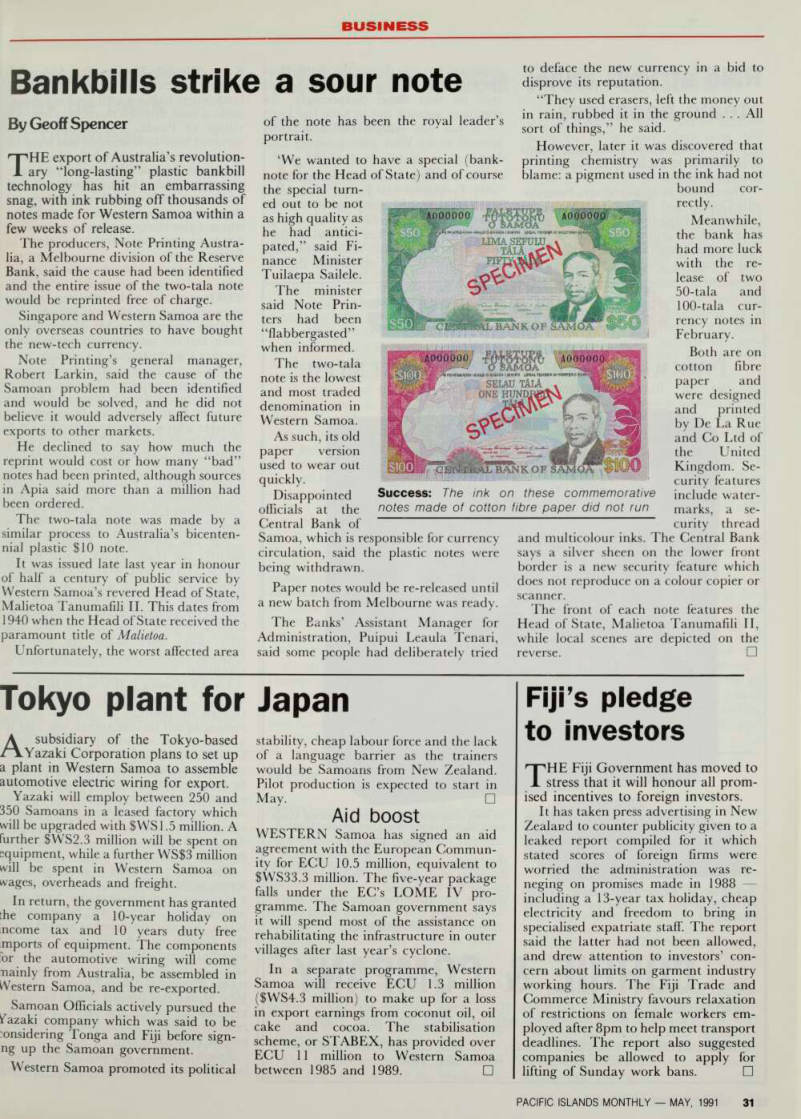
Meanwhile, the bank has had more luck with the re lease of two 50-tala and 100-tala cur rency notes in February.
Both are on cotton fibre paper and
were designed
and printed
by De La Rue and Co Ltd of the United Kingdom. Se curity features include water marks, a se curity thread
and multicolour inks. The Central Bank says a silver sheen on the lower front border is a new security feature which does not reproduce on a colour copier or scanner.
The front of each note features the Head of State, Malietoa Tanumafili 11, while local scenes are depicted on the reverse. □
Success: The ink on these commemorative notes made of cotton fibre paper did not run