The friendly island that
pp. 24-27 · Read in the full issue
wants to be left alone
By Ngaire Douglas
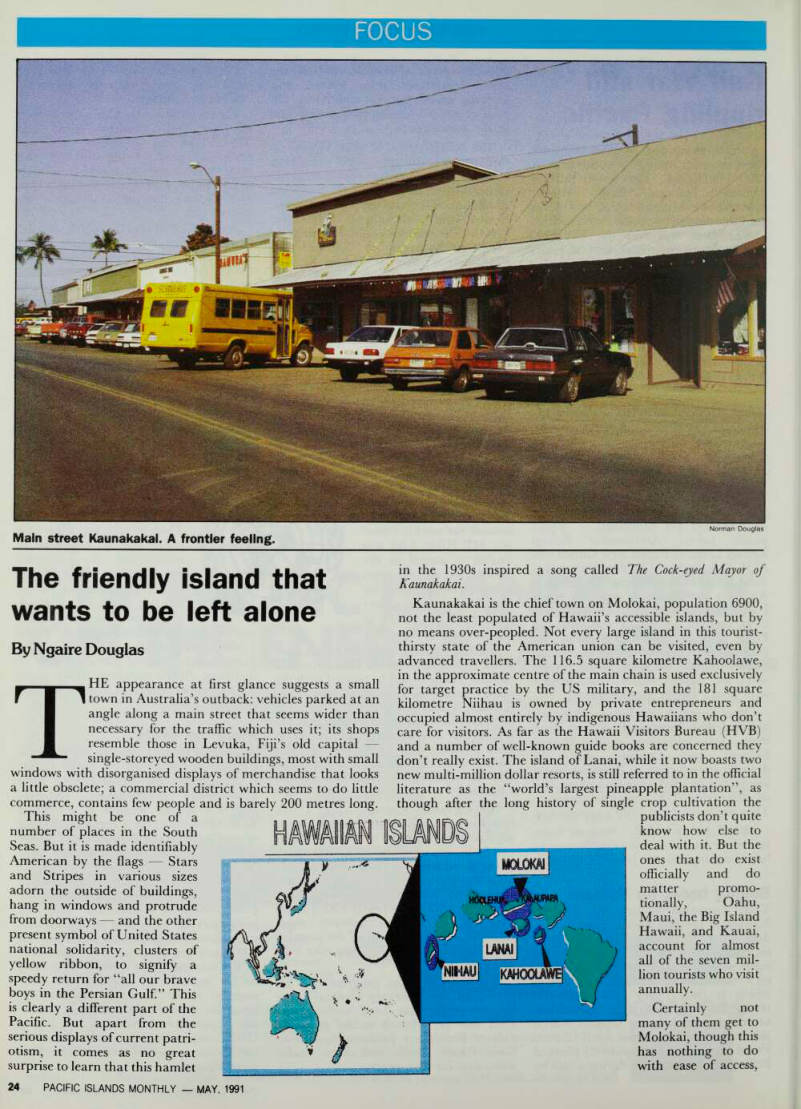
THE appearance at first glance suggests a small town in Australia’s outback: vehicles parked at an angle along a main street that seems wider than necessary for the traffic which uses it; its shops resemble those in Levuka, Fiji’s old capital single-storeyed wooden buildings, most with small windows with disorganised displays of merchandise that looks a little obsolete; a commercial district which seems to do little commerce, contains few people and is barely 200 metres long.
This might be one of a number of places in the South Seas. But it is made identifiably American by the flags Stars and Stripes in various sizes adorn the outside of buildings, hang in windows and protrude from doorways and the other present symbol of United States national solidarity, clusters of yellow ribbon, to signify a speedy return for “all our brave boys in the Persian Gulf.” This is clearly a different part of the Pacific. But apart from the serious displays of current patri otism, it comes as no great surprise to learn that this hamlet
in the 1930 s inspired a song called The Cock-eyed Mayor oj Kaunakakai.
Kaunakakai is the chief town on Molokai, population 6900, not the least populated of Hawaii’s accessible islands, but by no means over-peopled. Not every large island in this tourist thirsty state of the American union can be visited, even by advanced travellers. The 116.5 square kilometre Kahoolawe, in the approximate centre of the main chain is used exclusively for target practice by the US military, and the 181 square kilometre Niihau is owned by private entrepreneurs and occupied almost entirely by indigenous Hawaiians who don’t care for visitors. As far as the Hawaii Visitors Bureau (HVB) and a number of well-known guide books are concerned they don’t really exist. The island of Lanai, while it now boasts two new multi-million dollar resorts, is still referred to in the official literature as the “world’s largest pineapple plantation”, as though after the long history of single crop cultivation the
publicists don’t quite know how else to deal with it. But the ones that do exist officially and do matter promo tionally, Oahu, Maui, the Big Island Hawaii, and Kauai, account for almost all of the seven mil lion tourists who visit annually.
Certainly not many of them get to Molokai, though this has nothing to do with ease of access,
since the island is only 15 minutes by air from Honolulu, making it the closest of the “neighbour islands”. On a clear evening the lights of Honolulu’s suburbs can be seen from Molokai across the Kaiwi channel, though they don’t appear to hold any permanent fascination for Molokaians. Nor, for that matter, does Molokai appear to have a great appeal for visitors, a condition which most of its residents seem to find pleasing but which apparently disturbs people in the travel business. “It is a mystery to me,” wrote one Honolulu-based
travel writer recently, “why people don’t flock to Molokai, why it isn’t overrun with tourists, for it has some of the most unusual attractions, magnificent scenery and genuine ‘Hawaiianness’ of any island in the chain. Yet it remains largely undiscovered.”
The term is relative, of course. According to the Hawaii Visitors’ Bureau, Molokai actually wel comes close to 100,000 visitors a year though most are said to be from other parts of Hawaii but this figure pales beside the total numbers who come to the Aloha State or even the one million annually claimed by both nearby Maui and Hawaii island both of which contain tourist areas which might be fairly said to be overdeveloped.
Molokai has almost none of this, and the little it does have is contained in one part of the island’s windswept western coast where the incongruously large Kaluakoi Hotel and Golf Course and two adjacent condominium developments are located.
Aimed originally at the top end of the overseas visitor market, the entire 15-year-old complex is starting to wear the tired, slightly shopworn look which even the most ambitious resorts acquire when their market begins to desert them.
That Molokai’s permanent residents are not over-keen on this sort of thing is apparent from the recent vigorous reactions to a proposed develop ment in the highlands of the island’s central district. As evidence of the grassroots Hawaiianness of the cause, a group calling itself Hui Ho’opakele ‘Aina (Rescue The Land) is opposing the construction of a private golf course on the grounds that the project actually “includes all the resort amenities and more that are included in the existing Kaluakoi resort ...” and therefore conflicts with the island’s community develop ment plan. Threats by the developers to charge the Hui with offences under a Federal Act have not dampened the group’s opposition to the scheme and a large-scale confrontation might be in the making.
In the catchy parlance of tourism in Hawaii, Molokai is known as the Friendly Island, a name its residents seem to approve. Can one be friendly and still be opposed to the growth of the visitor industry here? “We’re not objecting to visitors,” a Hui sympathiser said, “only to this kind of project, which is completely at odds with the way that this island should progress. We have some unusual attractions here and we don’t want to be
overcome by the sort of development that has spoiled parts of Maui or the Big Island (Hawaii). This is a low key place. They should leave it like that.”
This is a familiar objection, one that is heard regularly in many parts of the Pacific whenever the matter of tourism development is raised. But whether Molokai is allowed to remam low key or not, no one could seriously doubt that some °r S attract^ons are at the very least unusual and at least one is, Irankly peculiar.
The arid-seeming nature of much of the landscape comes as a surprise. There is only one significant stand of coconuts, a four-hectare patch of 1000 trees allegedly planted in the 1860 s by Kamehameha V and, except for a couple of fairly well forested spots, the island’s vegetation consists of vast areas of mesquite scrub (called kiawe) and niaouli, both introduced, at least one intentionally as cattle fodder. In these surroundings, only slightly more unlikely than the vegetation is the presence of a 320-hectare reserve containing about 1000 African animals
- giraffe, zebra, eland, ostrich, impala ... gambolling and occasionally posing for visitors’ cameras in their savannah-like setting.
The reserve housing the imported beasts is contained within the much larger Molokai Ranch, a privately-owned enterprise whose total area of 21,000 hectares actually comprises almost one-third of the entire island. The exotic fauna are of course protected, but elsewhere on the island residents and visitors can indulge in the American enthusiasm for shooting things by
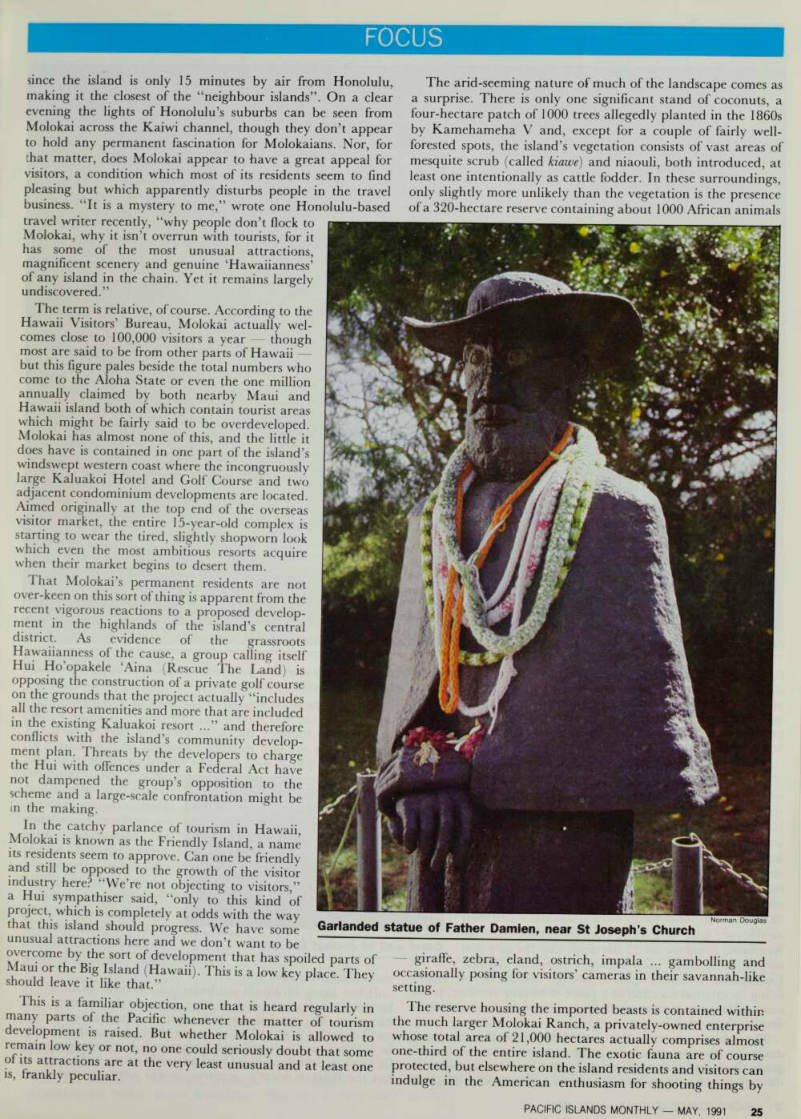
Norman Douglas Garlanded statue of Father Damien, near St Joseph’s Church
bringing down a variety of other introduced game, including deer, goats, boar, partridge, pheasant and turkey. “Most of the people here”, it was said in all seriousness, “are really hunters and gatherers”, though there appeared to be a deficiency of gatherable food items, especially since pineapple planting has been phased out.
If this sort of thing doesn’t appeal then there are a variety
of other natural and man-made works, the majority of which are to be found in Molokai’s eastern half. Not the least important of these from the aspect of Hawaiian culture is the remarkable number of traditional fishponds which line the coast. These are no mere holes in the reef, but large, carefully engineered structures which in ancient times belonged exclusively to royalty, having been built by com moners. Molokai has the largest number of ponds 60 at one time, some dating back 600 years and their significance may be gauged both from their size (the Keawanui Pond covers 22 hectares) and the fact that two of them have been declared National Historic
Landmarks. Similarly valued, though thankfully no longer filling its original function as a place of human sacrifice, is the nearby Iliiliopae Heiau, one of the largest of the ancient temple sites in these islands.
The coastal scenery in this part of the island becomes more dramatic as one proceeds along an ever-narrowing and gradually steepening road which in part has been cut directly through old lava flows, leaving isolated and contorted outcrops
on the ocean side. But this view, pleasing enough, is eclipsed by the spectacle which greets one at the top of the hill.
Here, at the highest point of the winding precipitous road, one looks down 400 metres into the superb Halawa Valley, according to tradition the oldest inhabited part of the island and once the site of a thriving settlement. It is no longer so.
In 1946 an approaching tsunami caused its residents to flee:
very few returned.
Those that did now find their sanctity invaded on weekends by carloads of picknickers from other parts of the island, the more energetic of whom are usually intent on making an arduous four-kilometre hike up a mosquito-prone train to the hard-to-find Moaula Falls, Molokai’s only
outstanding cascade.
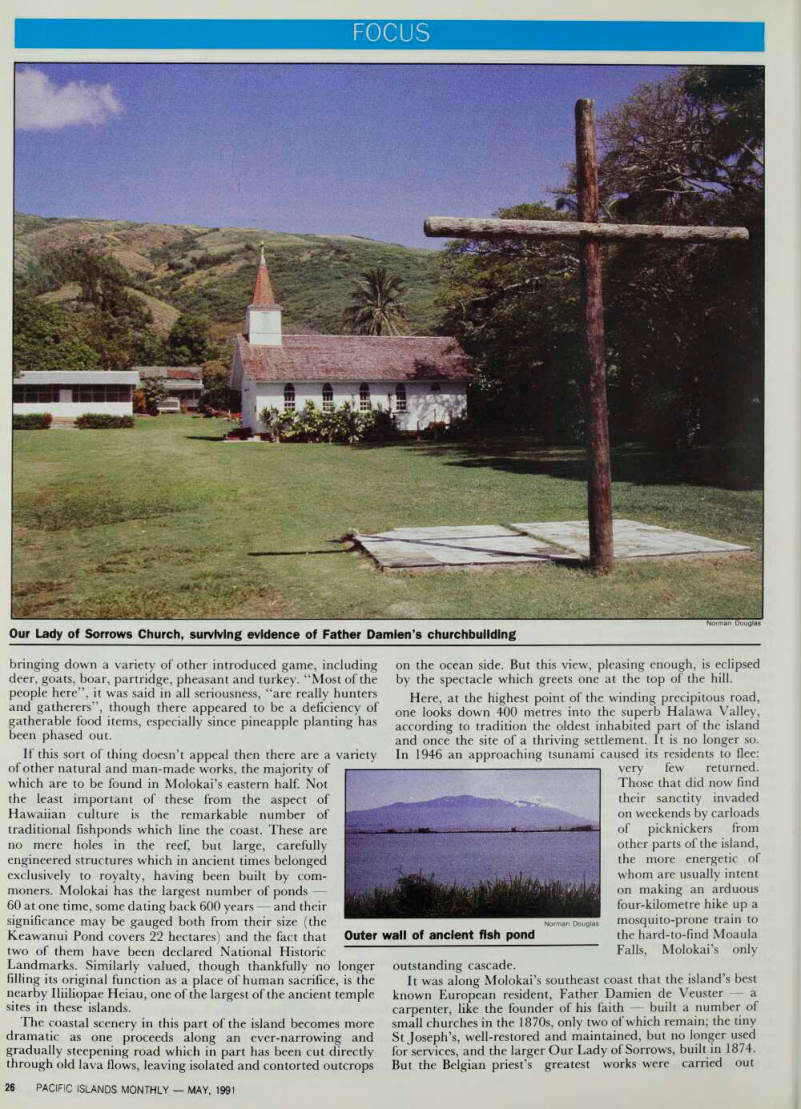
It was along Molokai’s southeast coast that the island’s best known European resident, Father Damien de Veuster a carpenter, like the founder of his faith built a number of small churches in the 1870 s, only two of which remain; the tiny St Joseph’s, well-restored and maintained, but no longer used for services, and the larger Our Lady of Sorrows, built in 1874.
But the Belgian priest’s greatest works were carried out
Our Lady of Sorrows Church, surviving evidence of Father Damien’s churchbuilding
Norman Douglas Outer wall of ancient fish pond
elsewhere, on the island’s north coast, in the area known as Kalaupapa, a place whose geography is as spectacular as its history is sad.
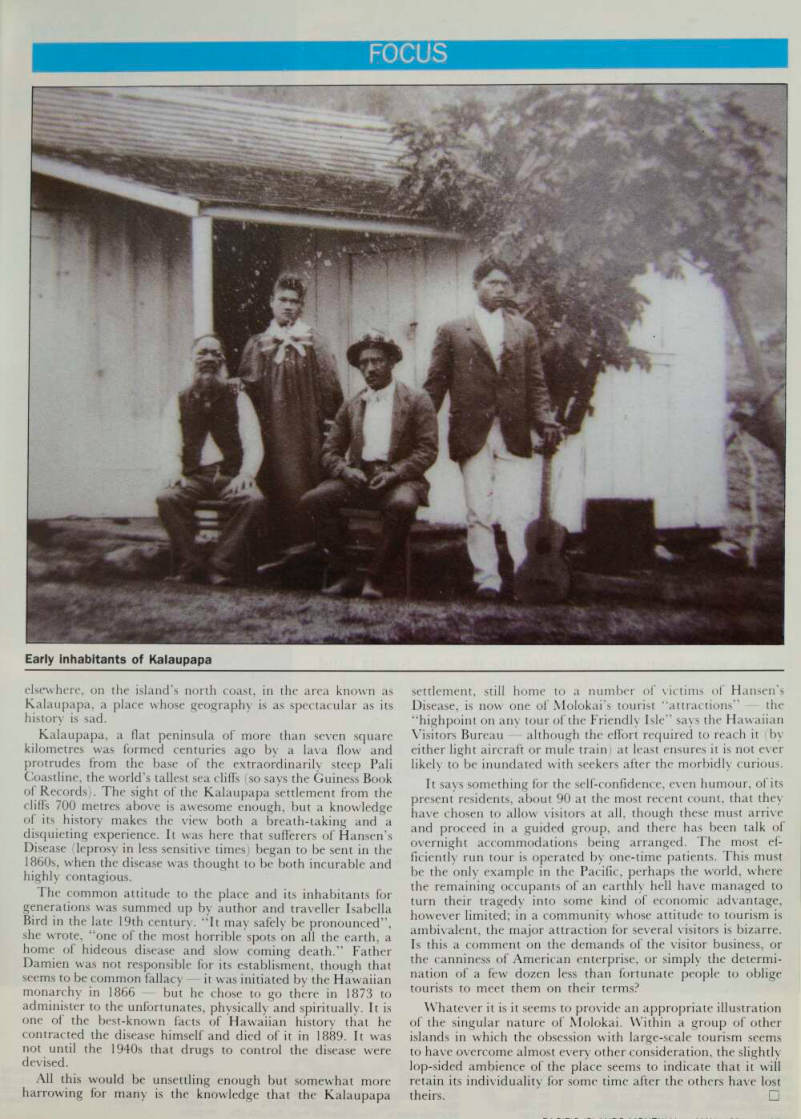
Kalaupapa, a flat peninsula of more than seven square kilometres was formed centuries ago by a lava flow and protrudes from the base of the extraordinarily steep Pali Coastline, the world’s tallest sea cliffs (so says the Guiness Book of Records). The sight of the Kalaupapa settlement from the cliffs 700 metres above is awesome enough, but a knowledge of its history makes the view both a breath-taking and a disquieting experience. It was here that sufferers of Hansen’s Disease (leprosy in less sensitive times) began to be sent in the 1860 s, when the disease was thought to be both incurable and highly contagious.
The common attitude to the place and its inhabitants for generations was summed up by author and traveller Isabella Bird in the late 19th century. “It may safely be pronounced”, she wrote, “one of the most horrible spots on all the earth, a home of hideous disease and slow coming death.” Father Damien was not responsible for its establisment, though that seems to be common fallacy it was initiated by the Hawaiian monarchy in 1866 but he chose to go there in 1873 to administer to the unfortunates, physically and spiritually. It is one of the best-known facts of Hawaiian history that he contracted the disease himself and died of it in 1889. It was not until the 1940 s that drugs to control the disease were devised.
All this would be unsettling enough but somewhat more harrowing for many is the knowledge that the Kalaupapa
settlement, still home to a number of victims of Hansen's Disease, is now one of Molokai’s tourist “attractions” the “highpoint on any tour of the Friendly Isle” says the Hawaiian Visitors Bureau although the effort required to reach it (by either light aircraft or mule train) at least ensures it is not ever likely to be inundated with seekers after the morbidly curious.
It says something for the self-confidence, even humour, of its present residents, about 90 at the most recent count, that they have chosen to allow visitors at all, though these must arrive and proceed in a guided group, and there has been talk of overnight accommodations being arranged. The most ef ficiently run tour is operated by one-time patients. This must be the only example in the Pacific, perhaps the world, where the remaining occupants of an earthly hell have managed to turn their tragedy into some kind of economic advantage, however limited; in a community whose attitude to tourism is ambivalent, the major attraction for several visitors is bizarre.
Is this a comment on the demands of the visitor business, or the canniness of American enterprise, or simply the determi nation of a few dozen less than fortunate people to oblige tourists to meet them on their terms?
Whatever it is it seems to provide an appropriate illustration of the singular nature of Molokai. Within a group of other islands in which the obsession with large-scale tourism seems to have overcome almost every other consideration, the slightly lop-sided ambience of the place seems to indicate that it will retain its individuality for some time after the others have lost theirs. □
Early inhabitants of Kalaupapa