the islands
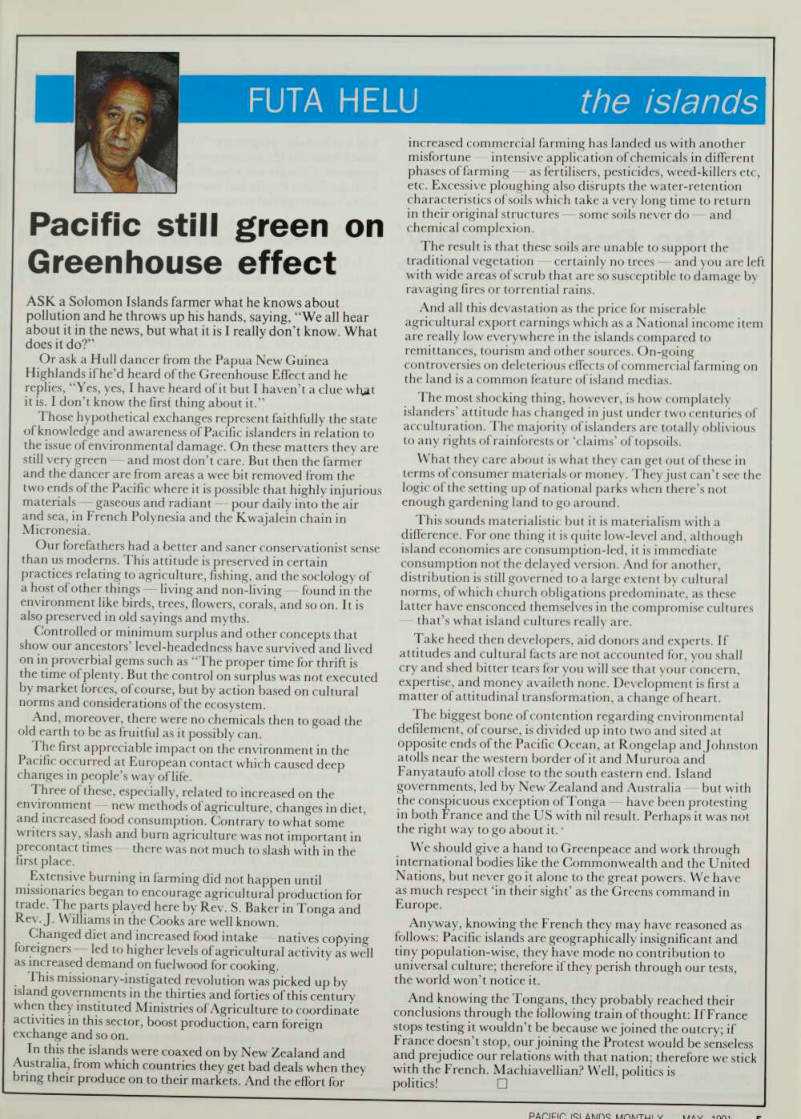
Futa Helu
Pacific still green on Greenhouse effect
ASK a Solomon Islands farmer what he knows about pollution and he throws up his hands, saying, “We all hear about it in the news, but what it is I really don’t know. What does it do?”
Or ask a Hull dancer from the Papua New Guinea Highlands if he’d heard of the Greenhouse Effect and he replies, “Yes, yes, I have heard of it but I haven’t a clue what it is. I don’t know the first thing about it.”
Those hypothetical exchanges represent faithfully the state ofknowledge and awareness of Pacific islanders in relation to the issue of environmental damage. On these matters they are still very green and most don’t care. But then the farmer and the dancer are from areas a wee bit removed from the two ends of the Pacific where it is possible that highly injurious materials gaseous and radiant pour daily into the air and sea, in French Polynesia and the Kwajalein chain in Micronesia.
Our forefathers had a better and saner conservationist sense than us moderns. This attitude is preserved in certain practices relating to agriculture, fishing, and the sociology of a host of other things living and non-living found in the environment like birds, trees, flowers, corals, and so on. It is also preserved in old sayings and myths.
Controlled or minimum surplus and other concepts that show our ancestors’ level-headedness have survived and lived on in proverbial gems such as “The proper time for thrift is the time of plenty. But the control on surplus was not executed by market forces, of course, but by action based on cultural norms and considerations of the ecosystem.
And, moreover, there were no chemicals then to goad the old earth to be as fruitful as it possibly can.
The first appreciable impact on the environment in the Pacific occurred at European contact which caused deep changes in people’s way of life.
Three of these, especially, related to increased on the environment new methods of agriculture, changes in diet, and increased food consumption. Contrary to what some writers say, slash and burn agriculture was not important in precontact times there was not much to slash with in the first place.
Extensive burning in farming did not happen until missionaries began to encourage agricultural production for trade. The parts played here by Rev. S. Baker in Tonga and Rev. J. Williams in the Cooks are well known.
Changed diet and increased food intake natives copying foreigners led to higher levels of agricultural activity as well as increased demand on fuelwood for cooking.
This missionary-instigated revolution was picked up by island governments in the thirties and forties of this century when they instituted Ministries of Agriculture to coordinate activities in this sector, boost production, earn foreign exchange and so on.
In this the islands were coaxed on by New Zealand and Australia, from which countries they get bad deals when they bring their produce on to their markets. And the effort for
increased commercial farming has landed us with another misfortune intensive application of chemicals in different phases of farming as fertilisers, pesticides, weed-killers etc, etc. Excessive ploughing also disrupts the water-retention characteristics of soils which take a very long time to return in their original structures some soils never do and chemical complexion.
The result is that these soils are unable to support the traditional vegetation certainly no trees and you are left with wide areas of scrub that are so susceptible to damage by ravaging fires or torrential rains.
And all this devastation as the price for miserable agricultural export earnings which as a National income item are really low everywhere in the islands compared to remittances, tourism and other sources. On-going controversies on deleterious effects of commercial farming on the land is a common feature of island medias.
The most shocking thing, however, is how complately islanders’ attitude has changed in just under two centuries of acculturation. The majority ofislanders are totally oblivious to any rights of rainforests or ‘claims’ of topsoils.
What they care about is what they can get out of these in terms of consumer materials or money. They just can’t see the logic of the setting up of national parks when there’s not enough gardening land to go around.
This sounds materialistic but it is materialism with a difference. For one thing it is quite low-level and, although island economies are consumption-led, it is immediate consumption not the delayed version. And for another, distribution is still governed to a large extent by cultural norms, of which church obligations predominate, as these latter have ensconced themselves in the compromise cultures that’s what island cultures really are.
Take heed then developers, aid donors and experts. If attitudes and cultural facts are not accounted for, you shall cry and shed bitter tears for you will see that your concern, expertise, and money availeth none. Development is first a matter of attitudinal transformation, a change of heart.
The biggest bone of contention regarding environmental defilement, of course, is divided up into two and sited at opposite ends of the Pacific Ocean, at Rongelap and Johnston atolls near the western border of it and Mururoa and Fanyataufo atoll close to the south eastern end. Island governments, led by New Zealand and Australia but with the conspicuous exception of Tonga - have been protesting in both France and the US with nil result. Perhaps it was not the right way to go about it.
We should give a hand to Greenpeace and work through international bodies like the Commonwealth and the United Nations, but never go it alone to the great powers. We have as much respect ‘in their sight’ as the Greens command in
Europe.
Anyway, knowing the French they may have reasoned as follows: Pacific islands are geographically insignificant and tiny population-wise, they have mode no contribution to universal culture; therefore if they perish through our tests, the world won’t notice it.
And knowing the Tongans, they probably reached their conclusions through the following train of thought: If France stops testing it wouldn’t be because we joined the outcry; if France doesn’t stop, our joining the Protest would be senseless and prejudice our relations with that nation; therefore we stick with the French. Machiavellian? Well, politics is politics! □