Weaving a sense of future
pp. 45-46 · Read in the full issue
Culture
By Angela McCarthy
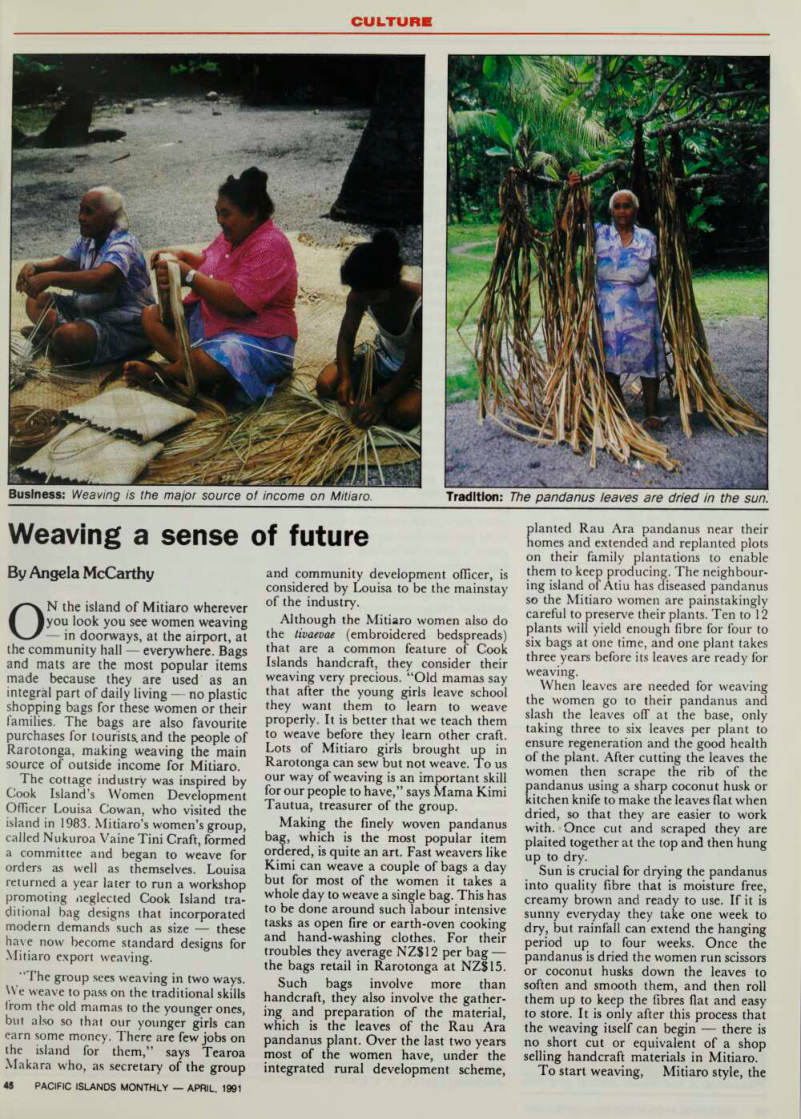
ON the island of Mitiaro wherever you look you see women weaving in doorways, at the airport, at the community hall everywhere. Bags and mats are the most popular items made because they are used as an integral part of daily living no plastic shopping bags for these women or their families. The bags are also favourite purchases for tourists, and the people of Rarotonga, making weaving the main source of outside income for Mitiaro.
The cottage industry was inspired by Cook Island’s Women Development Officer Louisa Cowan, who visited the island in 1983. Mitiaro’s women’s group, called Nukuroa Vaine Tini Craft, formed a committee and began to weave for orders as well as themselves. Louisa returned a year later to run a workshop promoting neglected Cook Island tra ditional bag designs that incorporated modern demands such as size these have now become standard designs for Mitiaro export weaving.
“ fihe group sees weaving in two ways.
We weave to pass on the traditional skills from the old mamas to the younger ones, but also so that our younger girls can earn some money. There are few jobs on the island for them,” says Tearoa Makara who, as secretary of the group
and community development officer, is considered by Louisa to be the mainstay of the industry.
Although the Mitiaro women also do the tivaevoe (embroidered bedspreads) that are a common feature of Cook Islands handcraft, they consider their weaving very precious. “Old mamas say that after the young girls leave school they wan, .hem tolearn ,o weave P r °P"ly- It » better that we teach them to weave before they leam other craft.
Lots of Mitiaro girls brought up in Rarotonga can sew but not weave. To us our way of weaving is an important skill for our people to hale,” says Mama Kimi T r t * urer lautua ’ treasur y of the § rou P- Making the finely woven pandanus bag, which is the most popular item ordered, is quite an art. Fast weavers like Kimi can weave a couple of bags a day for most of the women it takes a whole day to weave a single bag. This has to , done ar oimd such labour intensive 1 j S ? s °P en or earth-oven cooking f n , , and " w ashmg clothes. For their troubles they average NZ$l2 per bag the bagS retai ‘ m , Rarotonga at NZSIS ' Such bags involve more than handcraft, they also involve the gather mg an d preparation of the material, which is the leaves of the Rau Ara pandanus plant. Over the last two years most of the women have, under the integrated rural development scheme,
planted Rau Ara pandanus near their homes and extended and replanted plots on their family plantations to enable them to keep producing. The neighbour ing island of Atiu has diseased pandanus so the Mitiaro women are painstakingly careful to preserve their plants. Ten to 12 plants will yield enough fibre for four to six bags at one time, and one plant takes three years before its leaves are ready for
weaving.
When leaves are needed for weaving the women go to their pandanus and slash the leaves off at the base, only taking three to six leaves per plant to ensure regeneration and the good health of the plant. After cutting the leaves the women then scrape the rib of the pandanus using a sharp coconut husk or kitchen knife to make the leaves flat when dried, so that they are easier to work with. Once cut and scraped they are plaited together at the top and then hung up to dry.
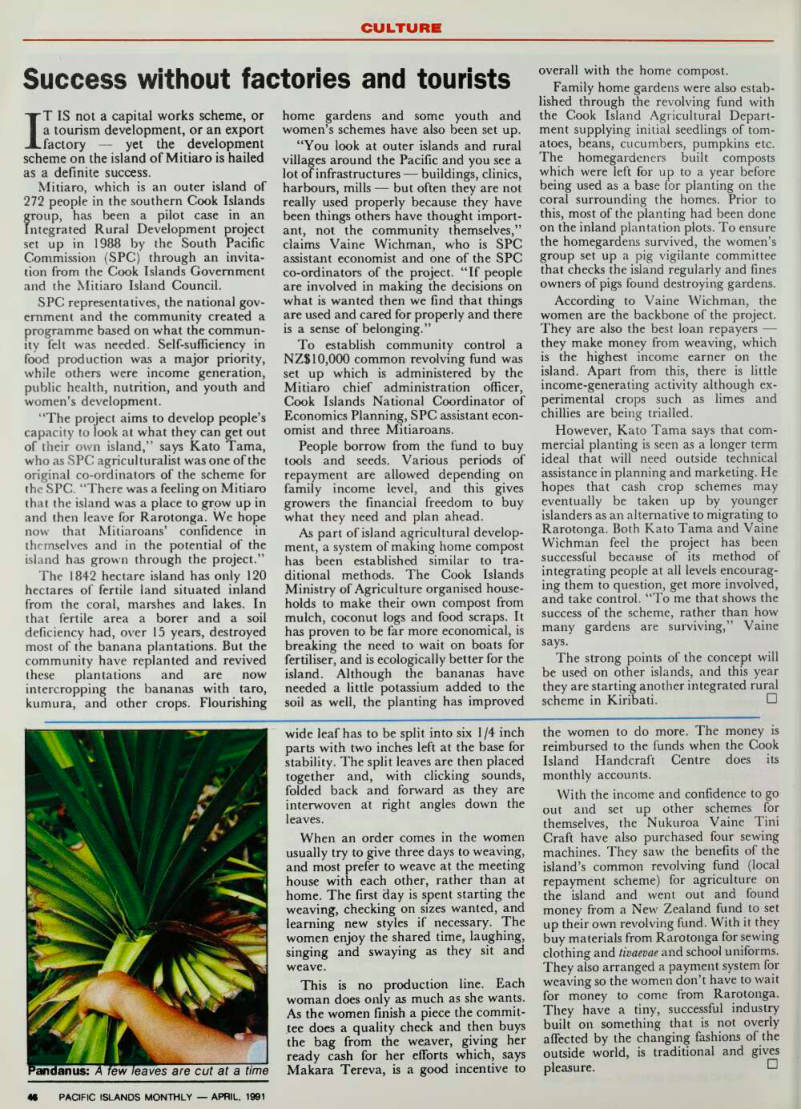
Sun is crucial for drying the pandanus into quality fibre that is moisture free, creamy brown and ready to use. If it is sunny everyday they take one week to dry, but rainfall can extend the hanging period up to four weeks. Once the pandanus is dried the women run scissors or coconut husks down the leaves to soften and smooth them, and then roll them up to keep the fibres flat and easy to store. It is only after this process that the weaving itself can begin there is no short cut or equivalent of a shop selling handcraft materials in Mitiaro.
To start weaving, Mitiaro style, the
Business: Weaving is the major source of income on Mitiaro.
Tradition: The pandanus leaves are dried in the sun.
wide leaf has to be split into six 1/4 inch parts with two inches left at the base for stability. The split leaves are then placed together and, with clicking sounds, folded back and forward as they are interwoven at right angles down the leaves.
When an order comes in the women usually try to give three days to weaving, and most prefer to weave at the meeting house with each other, rather than at home. The first day is spent starting the weaving, checking on sizes wanted, and learning new styles if necessary. The women enjoy the shared time, laughing, singing and swaying as they sit and weave.
This is no production line. Each woman does only as much as she wants.
As the women finish a piece the commit tee does a quality check and then buys the bag from the weaver, giving her ready cash for her efforts which, says Makara Tereva, is a good incentive to
the women to do more. The money is reimbursed to the funds when the Cook Island Handcraft Centre does its
monthly accounts.
With the income and confidence to go out and set up other schemes for themselves, the Nukuroa Vaine Tini Craft have also purchased four sewing machines. They saw the benefits of the island’s common revolving fund (local repayment scheme) for agriculture on the island and went out and found money from a New Zealand fund to set up their own revolving fund. With it they buy materials from Rarotonga for sewing clothing and tivaevae and school uniforms.
They also arranged a payment system for weaving so the women don’t have to wait for money to come from Rarotonga.
They have a tiny, successful industry built on something that is not overly affected by the changing fashions of the outside world, is traditional and gives
pleasure.
Pandanus: A few leaves are cut at a time