Pacific
pp. 30-31 · Read in the full issue
Islands
Monthly
Business
Preparing to tackle tough times ahead
After years of exploitation and press sympathy, Nauru is planning a hard line
By Robin Bromby
NAURU has attracted a lot of bad press over the years, and has been an easy target for writers who want to draw attention to the high level of wealth on the island and its concomitant social and
health problems.
It is not surprising, therefore, that the government on the island has tended to be secretive and unwelcoming of any foreign interest. The Nauruans also consider themselves badly done by at the hands of the Australians and New Zealanders who have had cheap phos phate for decades and as they see it have now failed to give something in return.
Canberra’s hard-nosed refusal to en tertain a compensation claim for the devastation caused in the area where the Australians mined in pre-independence times has left a bitter taste in the islanders’ mouths. The relationship was never an easy one or constructive for that matter, considering that for many years Canberra assumed that the Nauruans would follow the example of those who lived on other phosphate-rich islands in the Pacific and settled else where.
The hurt was accentuated by the fact that the Nauruans have always regarded Australia as their closest friend, have never asked for aid, and even paid SA2I million (SUSI 6.2 million) for the run down equipment when they took over the operation on independence.
The island’s past, and the present predicament it faces as its phosphate runs
out, have been thoroughly traversed.
Apart from its attempt to get Australia before the International Court of Justice, the Nauruan government is now turning its attention to the future.
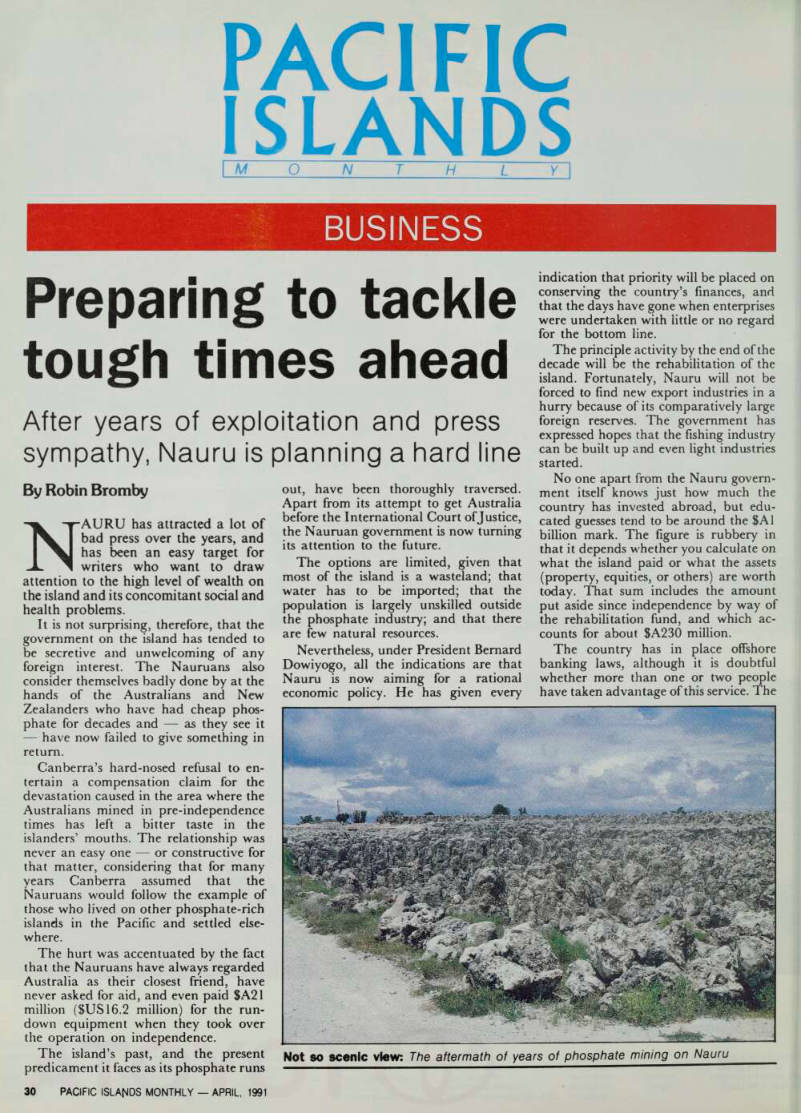
The options are limited, given that most of the island is a wasteland; that water has to be imported; that the population is largely unskilled outside the phosphate industry; and that there are few natural resources.
Nevertheless, under President Bernard Dowiyogo, all the indications are that Nauru is now aiming for a rational economic policy. He has given every
indication that priority will be placed on conserving the country’s finances, and that the days have gone when enterprises were undertaken with little or no regard for the bottom line.
The principle activity by the end of the decade will be the rehabilitation of the island. Fortunately, Nauru will not be forced to find new export industries in a hurry because of its comparatively large foreign reserves. The government has expressed hopes that the fishing industry can be built up and even light industries started.
No one apart from the Nauru govern ment itself knows just how much the country has invested abroad, but edu cated guesses tend to be around the SAI billion mark. The figure is rubbery in that it depends whether you calculate on what the island paid or what the assets (property, equities, or others) are worth today. That sum includes the amount put aside since independence by way of the rehabilitation fund, and which ac counts for about SA23O million.
The country has in place offshore banking laws, although it is doubtful whether more than one or two people have taken advantage of this service. The
Not so scenic view: The aftermath of years of phosphate mining on Nauru
immediate problem for Nauru is that it uses Australian dollars as its currency, and Canberra would frown on any tax haven in its currency area.
Anyway, such a small country derives enormous savings from using a major regional currency rather than having its own. Furthermore, there are already enough offshore banking centres in the region: those in Vanuatu, Western Samoa and the Cook Islands offer whatever services are required. And, on top of all that, legislation is now
becoming so tight in tax-gathering
countries that fewer and fewer people and companies are able to use the tax havens to their full advantage. Nauru’s offshore finance legislation is
theoretically an opportunity. In reality,
it means little.
The most pressing impediment to development is the shortage of space, with the island’s population compressed on to a narrow perimeter of the island.
Reference books tend to refer to a thin fertile strip around the edge of the island, but in reality this is being eaten up by the demand for living space. Housing space itself is now reaching a crisis point.
It is the sea around Nauru which holds the promise. So far, its 200 mile exclusive economic zone is used - legally, at least only by United States tuna boats fishing under their country’s multi lateral treaty with the member nations of the Forum Fisheries Agency. It is understood that Nauru is on the brink of signing a licensing agreement with an other fishing nation. The details are confidential but it almost certainly in volves one of the Asian big three and the fact that Nauru has diplomatic relations with Taiwan, and has been
looking to Taipei for development ad
vice, would suggest that country may be the one involved.
Nauru, which is right in the middle of the rich tuna waters of the western Pacific, would like to establish its own processing. The problem with that is finding the land for a cannery but even more daunting providing the water needed by such a factory. The island now imports much of its water to supplement what is caught from rain.
There has been talk of a desalination plant. The country could afford it, and it would remove at least part of a
significant ongoing shipping cost.
A possibility raised at one point was for Nauru to buy fishing boats and then build a cannery in a neighbouring island country, but the government has judged that employment rather than immedi ate export gains should be the priority, and does not favour exporting jobs. Employment before income, in other words.
Light industrial development seems
more problematic.
The most plausible suggestion has been using coral pinnacles left behind by the phosphate miners, and polishing these into a surface-finish similar in appearance to Italian marble. Nice idea, but the shipping cost would probably kill it even if it proved otherwise practicable.
Then there is Air Nauru, which suffers from the basic problem that its hub is Nauru itself. While it does well in transporting islanders abroad, particu-
It is the sea around Nauru which holds the promise, perhaps with an Asian partner
larly to Australia, it has faced problems in developing other sources of traffic. It flies to Sydney, Melbourne, Auckland, Manila, Tarawa, Nadi, Majuro, Kosrae, Truk, Ponape and Guam (it now being generally forgotten that Air Nauru in fact pioneered aviation links between Australia and Micronesia) what it needs is fifth freedom rights on some of the higher density Pacific routes. As Pacific Islands Monthly has pointed out on a number of occasions, the national car riers of the smaller states can develop only if they are allowed routes which offer the chance of generating a good profit, which can then be used to subsidise those flights which attract light traffic.
Back in the 19705, the airline wanted rights between Noumea and Melbourne.
It had technical rights because of the need to land at New Caledonia to refuel, but Air Nauru wanted fifth freedom traffic because it saw there was a demand for such a service which no one, not even
Qantas, was then offering. Apparently
the French agreed, but the Australian government would not budge.
Again, as we have also mentioned several times, allowing island carriers to become 'profitable and economic oper ators is far more effective aid than cash grants.
Shipping is a more intractable prob lem in that an island, which has a population smaller than the average Australian country town, also needs to maintain its own shipping service. The inate economic problems for the Nauru Pacific line have been compounded by shortcomings in management. The line is likely to be a drain on the national purse for some years to come.
So there is some hope that Nauru can become at least semi-viable other than living off its accumulated investments. As rehabilitation turns more of the island into a usable state, some buildings can be moved off the crowded coastal strip and more produce grown.
Nauru is trying again to join the Asian Development Bank. I*n the past, its requests to be considered a borrowing member have foundered on the bank’s view that the island more accurately fitted the profile of a lender. The real problems now facing the country, with the phosphate almost at an end, should make its case more persuasive with the
Adb. □
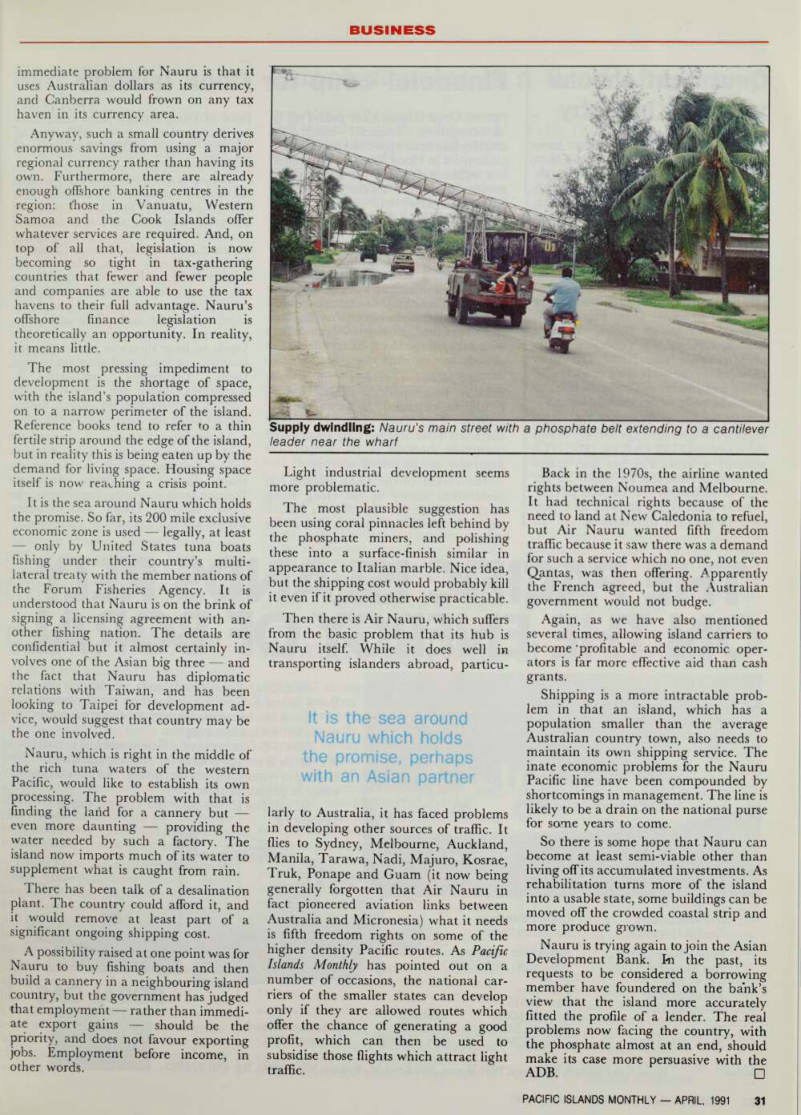
Supply dwindling: Nauru’s main street with a phosphate belt extending to a cantilever leader near the wharf