In search of Amelia Earhart
pp. 24-27 · Read in the full issue
Focus
By David North
AMELIA Earhart and her navi gator crash-landed on Nikumaroro Island in Kiribati, sent out radio signals on three successive nights, and then died of thirst and exposure.
That’s the theory of an American-led search team, based on extensive on-site research and on what they regard as a
relic of the missing plane. Earhart and Fred Noonan were on the last leg of what would have been a
record-setting trip
around the world on July 2, 1937, when
they disappeared
w hile flying from Lae, PNG, to Howland, a U.S. island south and west of Hawaii.
No one is sure what happened to the two American aviators, but theories abound, among them: Noonan handled the navi gation badly because he was hungover; Earhart has on a
secret U.S. mission to spy on Japanese fortifications in the Marshalls; Earhart and Noonan were captured by the Japanese and killed elsewhere, perhaps on Saipan; and the easiest to believe of all, the two crashed at sea. The current study splashed cold water on all of these notions.
The Nikumaroro theory to be tested in 1991 by a systematic divers’ search of the waters around the island has been
advanced by a team of researchers led by Richard Gillespie of Wilmington, Dela ware. The group is called The Interna tional Group for Historic Aircraft Recov ery (TIGHAR), and they spent a considerable amount of time and money exploring Nikumaroro and nearby McKean islands in late 1989; it was almost a year later before they digested what they found and announced their
findings.
The TIGHAR theory is based on a cluster of evidence and careful specu lation drawn from a variety of sources,
including:
• an analysis of the reports of radio messages heard by several different oper ators in the Pacific and in the U.S.; • the tracking of the apparent source of these messages, with six of the seven track ings pointing to the general area of Nikumaroro, in the Phoenic Islands; • the reports from Gilbertese colonisers of finding the bones of a woman, wearing American-style shoes, on Nikumaroro; and • the finding of a
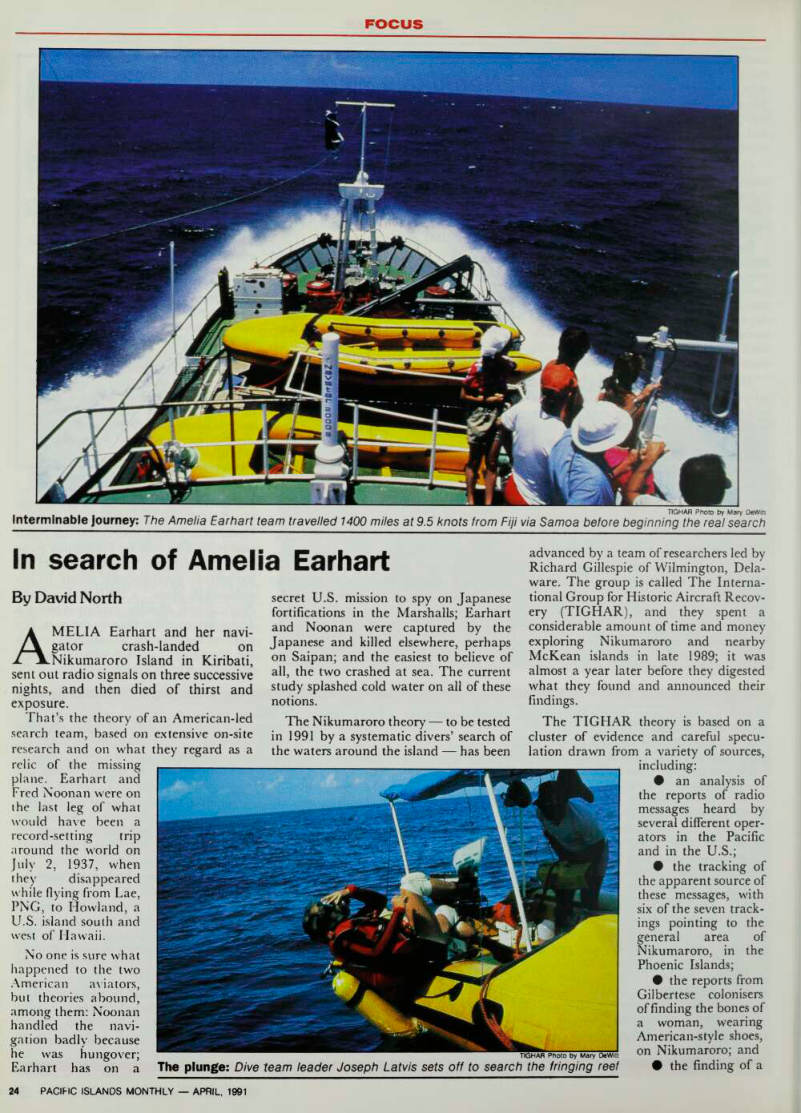
TIGHAR Photo by Mary DeWitr Interminable Journey: The Amelia Earhart team travelled 1400 miles at 9.5 knots from Fiji via Samoa before beginning the real search
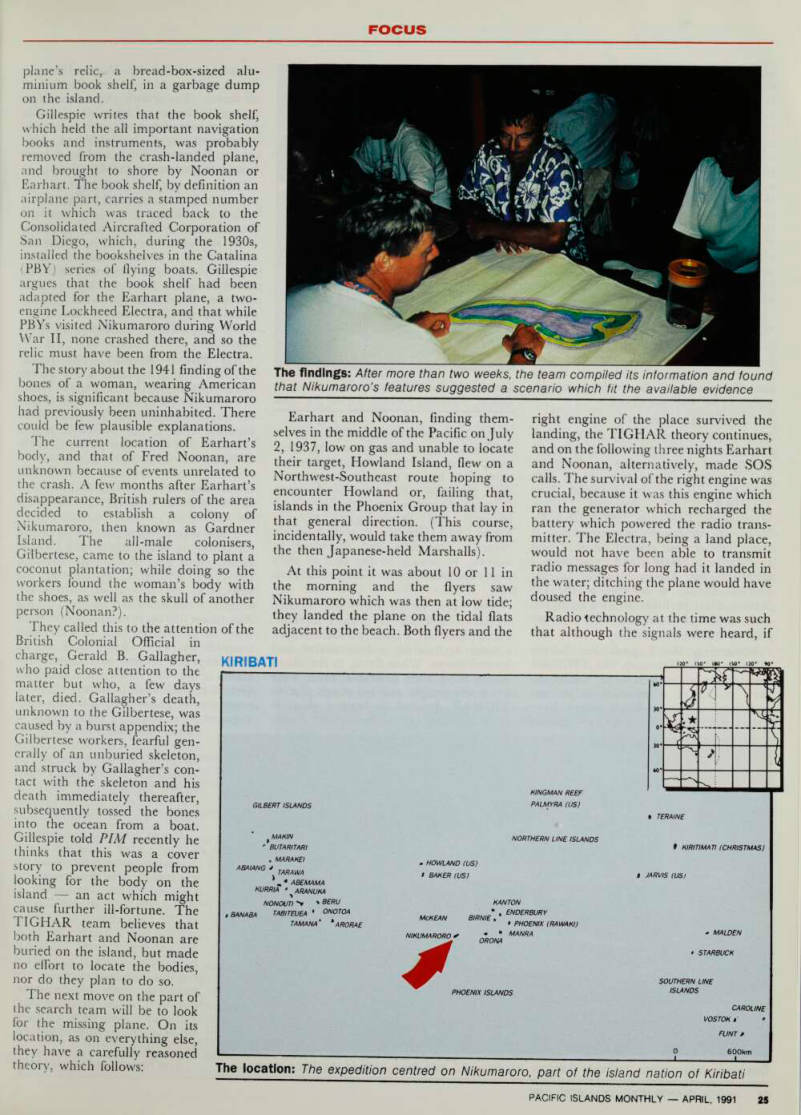
TIGHAR Photo by Mary DeWitr The plunge: Dive team leader Joseph Latvis sets off to search the fringing reef
plane’s relic, a bread-box-sized alu minium book shelf, in a garbage dump on the island.
Gillespie writes that the book shelf, which held the all important navigation books and instruments, was probably removed from the crash-landed plane, and brought to shore by Noonan or Earhart. The book shelf, by definition an airplane part, carries a stamped number on it which was traced back to the Consolidated Aircrafted Corporation of San Diego, which, during the 19305, installed the bookshelves in the Catalina (PBY) series of flying boats. Gillespie argues that the book shelf had been adapted for the Earhart plane, a two engine Lockheed Electra, and that while PBYs visited Nikumaroro during World War 11, none crashed there, and so the relic must have been from the Electra.
The story about the 1941 finding of the bones of a woman, wearing American shoes, is significant because Nikumaroro had previously been uninhabited. There could be few plausible explanations.
The current location of Earhart’s body, and that of Fred Noonan, are unknown because of events unrelated to the crash. A few months after Earhart’s disappearance, British rulers of the area decided to establish a colony of Nikumaroro, then known as Gardner Island. The all-male colonisers, Gilbertese, came to the island to plant a coconut plantation; while doing so the workers found the woman’s body with the shoes, as well as the skull of another
person (Noonan?).
They called this to the attention of the British Colonial Official in
charge, Gerald B. Gallagher, who paid close attention to the matter but who, a few days later, died. Gallagher’s death, unknown to the Gilbertese, was caused by a burst appendix; the Gilbertese workers, fearful gen erally of an unburied skeleton, and struck by Gallagher’s con tact with the skeleton and his death immediately thereafter, subsequently tossed the bones into the ocean from a boat.
Gillespie told PIM recently he thinks that this was a cover story to prevent people from looking for the body on the island an act which might cause further ill-fortune. The TIGHAR team believes that both Earhart and Noonan are buried on the island, but made no effort to locate the bodies, nor do they plan to do so.
The next move on the part of the search team will be to look for the missing plane. On its location, as on everything else, they have a carefully reasoned theory, which follows:
Earhart and Noonan, finding them selves in the middle of the Pacific on July 2, 1937, low on gas and unable to locate their target, Howland Island, flew on a Northwest-Southeast route hoping to encounter Howland or, failing that, islands in the Phoenix Group that lay in that general direction. (This course, incidentally, would take them away from the then Japanese-held Marshalls).
At this point it was about 10 or 11 in the morning and the flyers saw Nikumaroro which was then at low tide; they landed the plane on the tidal flats adjacent to the beach. Both flyers and the
right engine of the place survived the landing, the TIGHAR theory continues, and on the following three nights Earhart and Noonan, alternatively, made SOS calls. The survival of the right engine was crucial, because it was this engine which ran the generator which recharged the battery which powered the radio trans mitter. The Electra, being a land place, would not have been able to transmit radio messages for long had it landed in the water; ditching the plane would have doused the engine.
Radio technology at the time was such that although the signals were heard, if
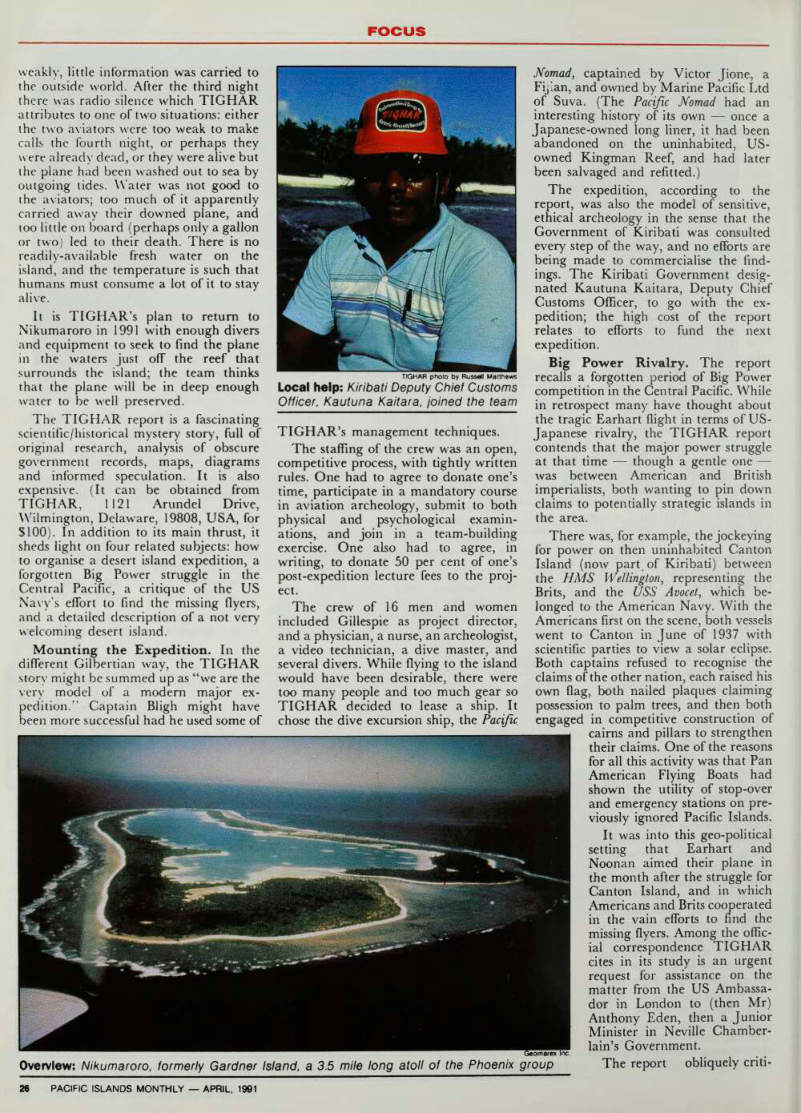
The findings: After more than two weeks, the team compiled its information and found that Nikumaroro’s features suggested a scenario which fit the available evidence
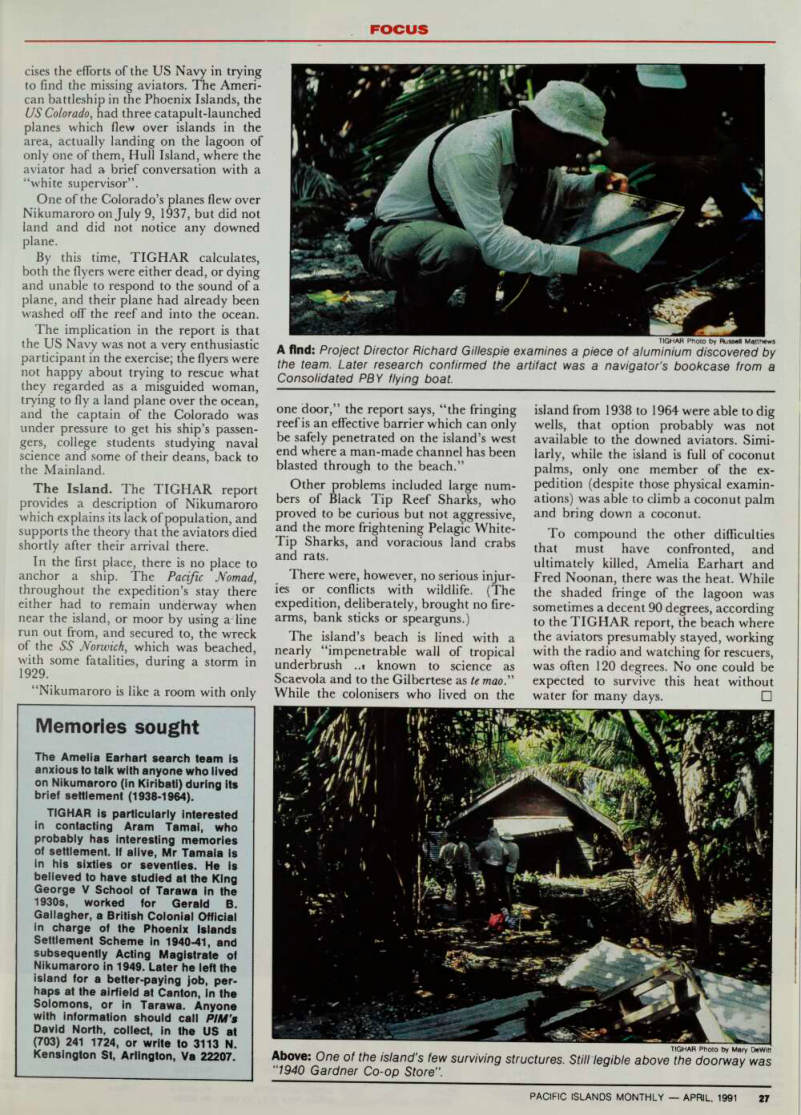
The location: The expedition centred on Nikumaroro, part of the island nation of Kiribati
Kiribati
weakly, little information was carried to the outside world. After the third night there was radio silence which TIGHAR attributes to one of two situations: either the two aviators were too weak to make calls the fourth night, or perhaps they were already dead, or they were alive but the plane had been washed out to sea by outgoing tides. Water was not good to the aviators; too much of it apparently carried away their downed plane, and too little on board (perhaps only a gallon or two) led to their death. There is no readily-available fresh water on the island, and the temperature is such that humans must consume a lot of it to stay alive.
It is TIGHAR’s plan to return to Nikumaroro in 1991 with enough divers and equipment to seek to find the plane in the waters just off the reef that surrounds the island; the team thinks that the plane will be in deep enough water to be well preserved.
The TIGHAR report is a fascinating scientific/historical mystery story, full of original research, analysis of obscure government records, maps, diagrams and informed speculation. It is also expensive. (It can be obtained from TIGHAR, 1121 Arundel Drive, Wilmington, Delaware, 19808, USA, for SI00). In addition to its main thrust, it sheds light on four related subjects; how to organise a desert island expedition, a forgotten Big Power struggle in the Central Pacific, a critique of the US Navy's effort to find the missing flyers, and a detailed description of a not very welcoming desert island.
Mounting the Expedition. In the different Gilbertian way, the TIGHAR story might be summed up as “we are the very model of a modern major ex
pedition.’* Captain Bligh might have
been more successful had he used some of
TIGHAR’s management techniques.
The staffing of the crew was an open, competitive process, with dghdy written rules. One had to agree to donate one’s time, participate in a mandatory course in aviation archeology, submit to both physical and psychological examin ations, and join in a team-building exercise. One also had to agree, in writing, to donate 50 per cent of one’s post-expedition lecture fees to the proj ect.
The crew of 16 men and women included Gillespie as project director, and a physician, a nurse, an archeologist, a video technician, a dive master, and several divers. While flying to the island would have been desirable, there were too many people and too much gear so TIGHAR decided to lease a ship. It chose the dive excursion ship, the Pacific
Nomad, captained by Victor Jione, a Fijian, and owned by Marine Pacific Ltd of Suva. (The Pacific Nomad had an interesting history of its own once a Japanese-owned long liner, it had been abandoned on the uninhabited, US owned Kingman Reef, and had later been salvaged and refitted.) The expedition, according to the report, was also the model of sensitive, ethical archeology in the sense that the Government of Kiribati was consulted every step of the way, and no efforts are being made to commercialise the find ings. The Kiribati Government desig nated Kautuna Kaitara, Deputy Chief Customs Officer, to go with the ex pedition; the high cost of the report relates to efforts to fund the next
expedition.
Big Power Rivalry. The report recalls a forgotten period of Big Power competition in the Central Pacific. While in retrospect many have thought about the tragic Earhart flight in terms of US- Japanese rivalry, the TIGHAR report contends that the major power struggle at that time though a gentle one was between American and British imperialists, both wanting to pin down claims to potentially strategic islands in the area.
There was, for example, the jockeying for power on then uninhabited Canton Island (now part of Kiribati) between the HMS Wellington , representing the Brits, and the USS Avocet , which be longed to the American Navy. With the Americans first on the scene, both vessels went to Canton in June of 1937 with scientific parties to view a solar eclipse.
Both captains refused to recognise the claims of the other nation, each raised his own flag, both nailed plaques claiming possession to palm trees, and then both engaged in competitive construction of
cairns and pillars to strengthen their claims. One of the reasons for all this activity was that Pan American Flying Boats had shown the utility of stop-over and emergency stations on pre viously ignored Pacific Islands.
It was into this geo-poliucal setting that Earhart and Noonan aimed their plane in the month after the struggle for Canton Island, and in which Americans and Brits cooperated in the vain efforts to find the missing flyers. Among the offic ial correspondence TIGHAR cites in its study is an urgent request for assistance on the matter from the US Ambassa dor in London to (then Mr) Anthony Eden, then a Junior Minister in Neville Chamber lain’s Government.
The report obliquely criti
Overview: Nikumaroro, formerly Gardner Island, a 3.5 mile long atoll of the Phoenix group
TIGHAR photo by Rossell Matthews Local help: Kiribati Deputy Chief Customs Officer, Kautuna Kaitara, joined the team
Geomarex Inc.
cises the efforts of the US Navy in trying to find the missing aviators. The Ameri can battleship in the Phoenix Islands, the US Colorado , had three catapult-launched planes which flew over islands in the area, actually landing on the lagoon of only one of them, Hull Island, where the aviator had a brief conversation with a “white supervisor”.
One of the Colorado’s planes flew over Nikumaroro on July 9, 1937, but did not land and did not notice any downed plane.
By this time, TIGHAR calculates, both the flyers were either dead, or dying and unable to respond to the sound of a plane, and their plane had already been washed off the reef and into the ocean.
The implication in the report is that the US Navy was not a very enthusiastic participant in the exercise; the flyers were not happy about trying to rescue what they regarded as a misguided woman, trying to fly a land plane over the ocean, and the captain of the Colorado was under pressure to get his ship’s passen gers, college students studying naval science and some of their deans, back to the Mainland.
The Island. The TIGHAR report provides a description of Nikumaroro which explains its lack of population, and supports the theory that the aviators died shortly after their arrival there.
In the first place, there is no place to anchor a ship. The Pacific Nomad, throughout the expedition’s stay there either had to remain underway when near the island, or moor by using a line run out from, and secured to, the wreck of the SS Norwich , which was beached, with some fatalities, during a storm in 1929.
“Nikumaroro is like a room with only
one door,” the report says, “the fringing reef is an effective barrier which can only be safely penetrated on the island’s west end where a man-made channel has been blasted through to the beach.”
Other problems included large num bers of Black Tip Reef Sharks, who proved to be curious but not aggressive, and the more frightening Pelagic White- Tip Sharks, and voracious land crabs and rats.
There were, however, no serious injur ies or conflicts with wildlife. (The expedition, deliberately, brought no fire arms, bank sticks or spearguns.) The island’s beach is lined with a
nearly “impenetrable wall of tropical
underbrush ..» known to science as Scaevola and to the Gilbertese as te mao”
While the colonisers who lived on the
island from 1938 to 1964 were able to dig wells, that option probably was not available to the downed aviators. Simi larly, while the island is full of coconut palms, only one member of the ex
pedition (despite those physical examin
ations) was able to climb a coconut palm and bring down a coconut.
To compound the other difficulties that must have confronted, and ultimately killed, Amelia Earhart and Fred Noonan, there was the heat. While the shaded fringe of the lagoon was sometimes a decent 90 degrees, according to the TIGHAR report, the beach where the aviators presumably stayed, working with the radio and watching for rescuers, was often 120 degrees. No one could be expected to survive this heat without water for many days. □
TIGHAR Photo by Russell Matthews A find: Project Director Richard Gillespie examines a piece of aluminium discovered by the team. Later research confirmed the artifact was a navigator’s bookcase from a Consolidated PBY flying boat.
TIGHAR Photo by Mary DeWitt Above: One of the island's few surviving structures. Still legible above the doorway was "1940 Gardner Co-op Store”.