Samoan intrigue, betrayal and surprises
pp. 16-17 · Read in the full issue
Elections
By Ulafala Aiavao
WHEN Samoans talk about in trigue, betrayal and jaw gripping surprises, they look no further than their elections, held every three years. In three of the last four elections, the incoming government has won office by a margin of just one seat.
The busiest year politically was 1982 when there were three governments.
This month, on the fifth, Western Samoans will take part in their most historic vote yet an election open for the first time to all citizens 21 years and over. Universal suffrage has been intro duced for all 47 seats in Parliament, but only rnatai or chiefs will be elegible as candidates in 45 of the seats. Two constituencies are set aside for those of non-Samoan ancestry who practise uni versal suffrage for both voters and candidates.
The reform has boosted the electoral roll from about 20,000 mostly male chiefs, to about 60,000 of whom half are females. Another change is that voters must now present identity cards which carry their photographs before they get their ballot papers.
Even after votes are cast and a provisional result comes out mid-April, Samoans may not know until late this month or early May who has actually won office. The Constitution allows a maximum of 45 days after an election before Parliament meets to elect a new Speaker, That period gives the political parties time for intense lobbying to capture the minimum 24 seats needed to win power.
To capture in spirit or in person, is
serious business. The ruling Human
Rights Protection Party (HRPP) kept
their members inside a fenced property in the lead-up to the 1982 election. The fences have come down, but HRPP candidates now sign contracts to make them think twice about defecting. The leader of the Opposition Samoan Na
tional Development Party (SNDP),
Tupua Tamasese, criticises the idea of contracts, saying SNDP relies on a supporter’s word of honour, “and if he doesn’t keep it, good riddance.”
The SNDP is still bitter about a curucial defection after the 1988 elections on the night before Parliament had to meet to elect a Speaker. A grateful
HRPP wel comed the defector with a
prayer meeting
and gave the first-time MP a Cabinet port folio, for giving them the one seat majority they needed.
The suspense didn’t end there.
Electoral pet itions after the
1988 elections changed the numbers held by the HRPP and the SNDP until both parties held the same number of seats 23 and there was a tie in the 47th constituency with two rivals each receiv ing 146 ballots. When the matter went to court, the first judge withdrew as he was related to another MP. The second judge made little headway as neither party was prepared to give way. Finally, a third
judge who was brought over from New Zealand awarded an extra ballot to one of the candidates who joined the HRPP, and let them win office by a single ballot in his constituency.
Both major political parties believe such close results are unlikely in future due to the tripling of the electoral roll.
Wider margins are also expected in the 47 constituencies. Nearly 25 per cent of the past parliament was made up of members who had won their seats by fewer than 10 votes.
Even so, history shows that landslide victories cannot guarantee a party a full term in office. In 1985, for example, the HRPP finished the election with three quarters of parliament in their hands.
But defections over the leadership and personality differences forced the party out of government when they did not have the numbers to pass a budget.
Depending on who is talking, Western Samoa is either on the road to recovery (government view) or it is in a crisis that needs new policies and a new govern
ment (Opposition view).
The country is making a comeback from the devastation caused by Cyclone Ofa a year ago. Local food are maturing and in plentiful supply, and foreign aid has helped to rebuild facilities damaged by Ofa. Yet despite some of the most far reaching reforms yet made by a Samoan government, old problems remain.
Exports are stagnant, the brain drain of skilled people overseas continues and the lack of natural resources hinders the options for development. Water short ages still plague parts of the capital Apia with the National Hospital having to cancel treatment except for emergency cases because the occasional lack of water threatens hygiene. Consumers and
businesses are only just get
ting over
power failures that inter rupted
supplies
through much
of last year.
The new riddle is: “What do
Iraq and
Western Samoa have in
common?” Answer: “Big holes in the roads.” That is an exaggeration. Roads are being repaired through a multi million dollar aid programme.
SNDP leader Tupua Tamasese wants an Anti-Corruption Tribunal to monitor the integrity of the politicians and bureaucrats. The Opposition has criti cised alleged favouritism in the awarding of government contracts and in the
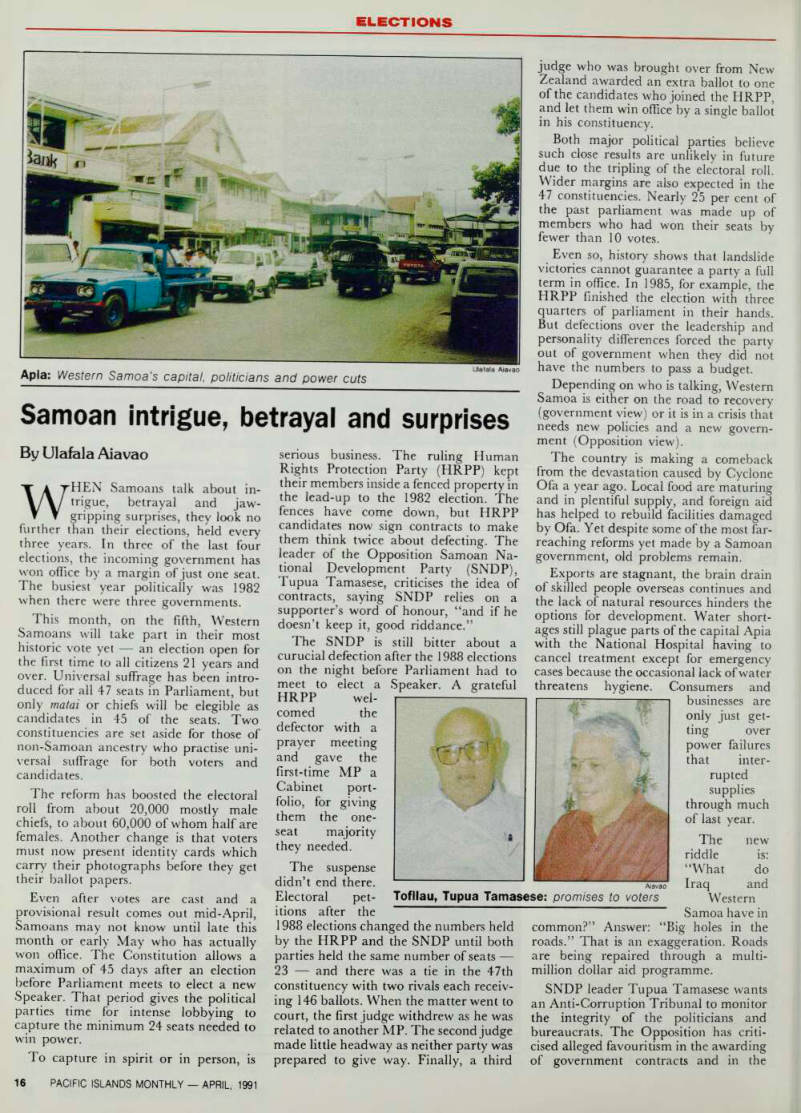
Ulafala Aiavao Apia: Western Samoa's capital, politicians and power cuts
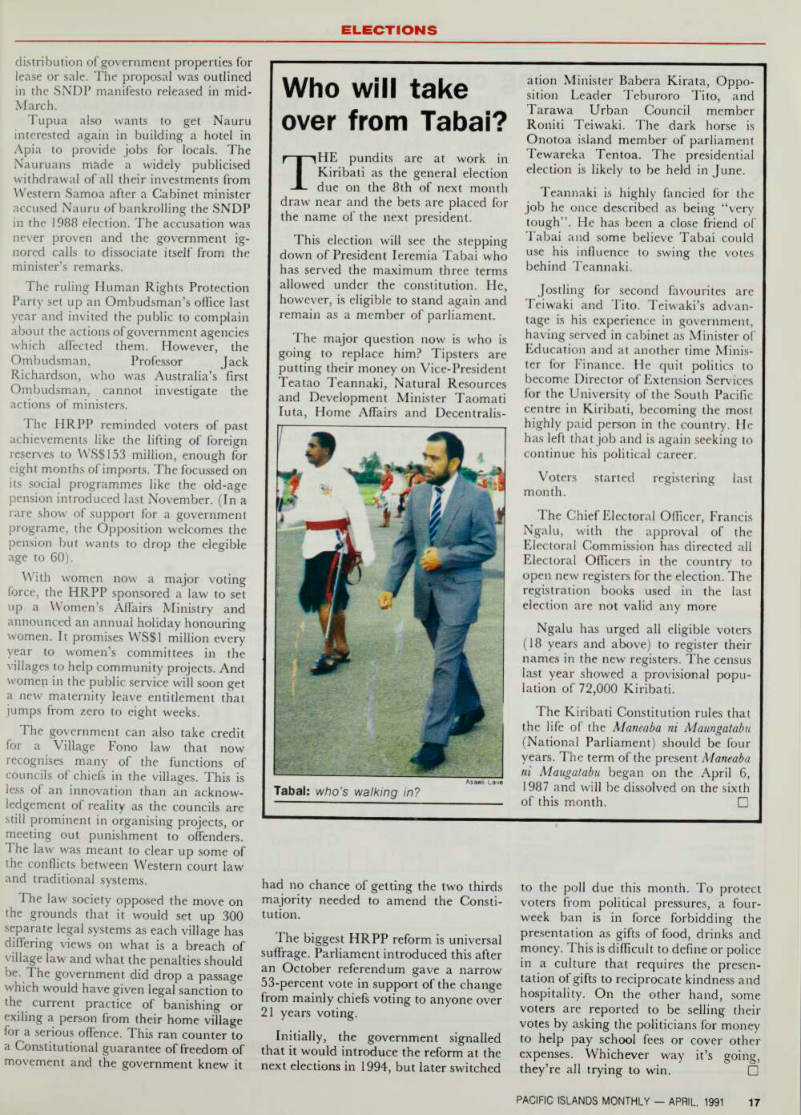
Aiavao Tofilau, Tupua Tamasese: promises to voters
distribution of government properties for lease or sale. The proposal was outlined in the SNDP manifesto released in mid- March.
Tupua also wants to get Nauru interested again in building a hotel in Apia to provide jobs for locals. The Nauruans made a widely publicised withdrawal of all their investments from Western Samoa after a Cabinet minister accused Nauru of bankrolling the SNDP in the 1988 election. The accusation was never proven and the government ig nored calls to dissociate itself from the minister’s remarks.
The ruling Human Rights Protection Party set up an Ombudsman’s office last year and invited the public to complain about the actions of government agencies which affected them. However, the Ombudsman, Professor Jack Richardson, who was Australia’s first Ombudsman, cannot investigate the actions of ministers.
The HRPP reminded voters of past achievements like the lifting of foreign reserves to WSSIS3 million, enough for eight months of imports. The focussed on its social programmes like the old-age pension introduced last November. (In a rare show' of support for a government programe, the Opposition welcomes the pension but wants to drop the elegible age to 60).
With women now a major voting force, the HRPP sponsored a law to set up a Women’s Affairs Ministry and announced an annual holiday honouring women. It promises WSSI million every year to women’s committees in the villages to help community projects. And women in the public service will soon get a new' maternity leave entitlement that jumps from zero to eight weeks.
The government can also take credit for a Village Fono law that now recognises many of the functions of councils of chiefs in the villages. This is less of an innovation than an acknow ledgement of reality as the councils are still prominent in organising projects, or meeting out punishment to offenders.
The law' was meant to clear up some of the conflicts between Western court law and traditional systems.
The law society opposed the move on the grounds that it w'ould set up 300 separate legal systems as each village has differing views on w'hat is a breach of village law and what the penalties should be. The government did drop a passage which would have given legal sanction to the current practice of "banishing or exiling a person from their home village for a serious offence. This ran counter to a Constitutional guarantee of freedom of movement and the government knew it
had no chance of getting the two thirds majority needed to amend the Constitution.
The biggest HRPP reform is universal suffrage. Parliament introduced this after an October referendum gave a narrow 53-percent vote in support of the change from mainly chiefs voting to anyone over 21 years voting.
Initially, the government signalled
that it would introduce the reform at the next elections in 1994, but later switched
to the poll due this month. To protect voters from political pressures, a four week ban is in force forbidding the presentation as gifts of food, drinks and money. This is difficult to define or police in a culture that requires the presen tation of gifts to reciprocate kindness and hospitality. On the other hand, some voters are reported to be selling their votes by asking the politicians for money to help pay school fees or cover other expenses. Whichever way it’s going, they’re all trying to win. □