Working on
pp. 52-53 · Read in the full issue
Relations
Working on the differences
In Guam, two sets of officials haggle over self-determination
THERE was significant forward
movement on the issues of immi gration policy and court systems during February’s meeting in Washing ton on Guam’s relations with the Mainland.
The meeting between the Guam Commission on Self Determination, headed by newly re-elected Governor Joseph Ada (Rep.) and a task force of federal officials is one of a series.
The sessions, which were set in motion last year at the suggestion of Congress, are designed to narrow the differences between island leaders and those of the Bush Administration of Guam’s relations with the US.
Guam wants to remain under the US flag, but desires a lot more explicit independence than the Administration seems willing to accept; Congress has told the two groups to reach as much agreement as possible before the House and the Senate make their own decisions about the proposed Guam Common wealth Act.
The courts question provides a good
example of both the inherently difficult process faced by the two sets of officials, and of the progress that was made in February.
Guam wants direct access to the US Supreme Court, and the Bush Adminis
tration (and presumably the Supreme
Court, which, in its Olympian way has not joined the discussions) wants to give Guam’s judges and lawyers a 15-year long rehearsal before having direct access to the highest of the Mainland Courts.
The current situation is that a legal dispute (dealing with Guam’s law or its constitution) is first heard in a territorial court, and then can be appealed to the appellate divisions of the Guam Superior Court.
If one of the litigants want to take the case further up the judicial ladder, it goes to the US District Court for Guam, where it is likely to be heard by a visiting hoale judge. The next step is the Federal 9th Circuit Court of Appeals in San Francisco, and finally, to the Supreme Court in Washington.
That clearly is a long expensive process. Further, as Guam’s lawyers say vigorously, had the same issue started in, say, Texas Courts, the US District and
Circuit Courts would play no role; the case would go directly from the Texas Supreme Court to the US Supreme Court. Guam, they say, should be treated in the same manner the lesser federal courts should stay out of the business of interpreting Guam law. (There’s a Pacific precedent that has not yet surfaced in these dis cussions: before the coup a disputed case in Fiji could go directly from that nation’s highest court to the Privy Council in Great Britain, without being heard in any lesser British Court).
Guam has nothing against the role of the 9th
Circuit if the question is a federal one, involving, for example, a customs or federal drug matter. But if it’s a question of Guam law, Guam wants direct access to the Supremes (as the nine judges, with their life-long appointments, are some times known in Washington).
The Mainland position on the matter was spelled out by the Congress in the
Guam’s menu includes some demands the Mainland finds hard to swallow
Omnibus Territorial Act of 1984, which gave Guam the right to establish its own Supreme Court but said that the decisions of that Court had to be appealed through the current process, of Federal District and Circuit Court, for 15 years.
During this time, presumably, Guam’s courts would mature to the point where they were not sending an undue load of cases to the already overburdened Su preme Court in Washington. (The Su premes, however, have a defence mech-
anism of thir own; unless at least four of the nine judges sign a paper saying that they want to hear a case, they simply accept the decision below without further ado).
Guam did not like the idea of a 15-year-old training period for its court system, and has never established a Supreme Court on the island.
What the US Department of Justice is now proposing is a shorter waiting period, not to exceed 10 years. If, at any
time during that period the presiding
judge of the 9th Circuit concludes that the quality of decisions in Guam is appropriate, then the island gets direct access to the Supreme Court.
While the new federal position is not quite what Guam wants, it is a major improvement on the previous one, and is another sign of incremental progress in
these negotiations.
The proposed Commonwealth Act is, of course, of much greater interest to the Ada Administration than to the Bush Administration.
Ada and his fellow Commissioners (including island Senators Pilar Lujan (Dem.) and Marilyn Manibusan (Rep.) sit all day with a rotating cast of Federal officials, with Assistant interior Secretary Stella Guerra representing Bush, but
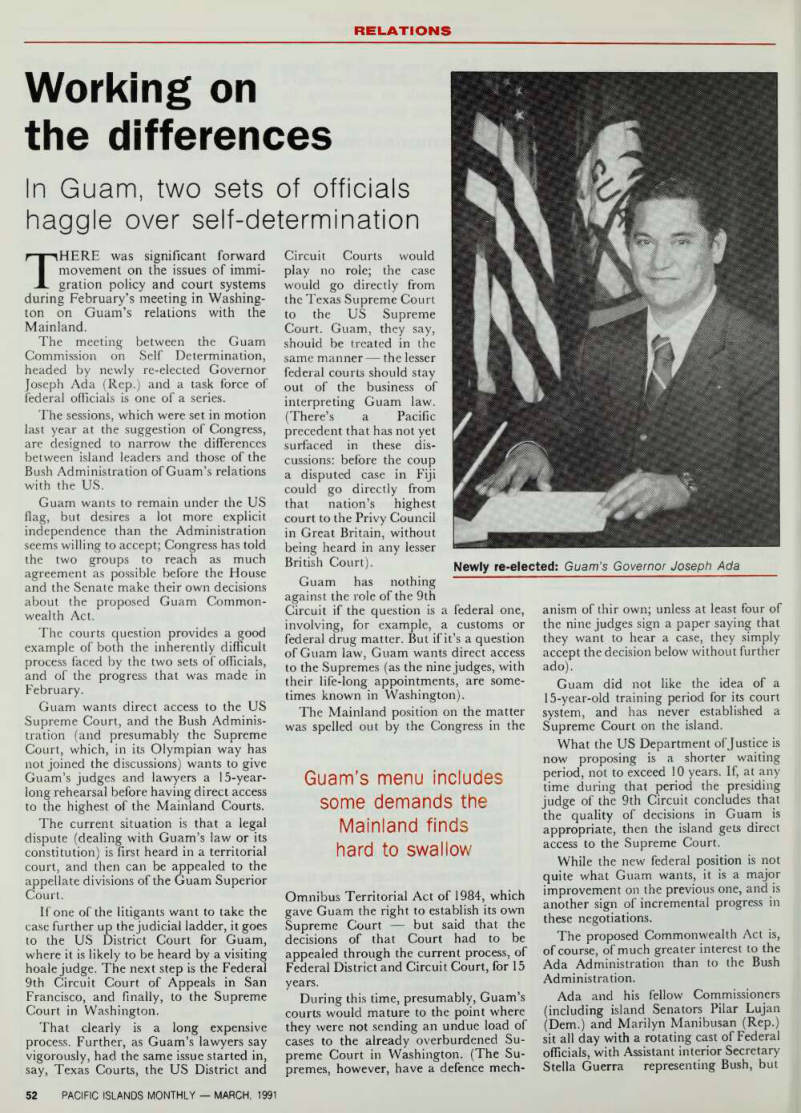
Newly re-elected: Guam's Governor Joseph Ada
presumably rarely in touch directly with the President.
Ms Guerra’s boss, Secretary of Interior Manuel Lujan, although he has visited Guam in the past, does not spend much time in the sessions either; in recent weeks he has been distracted by a personal tragedy, his son’s conviction on a rape charge. The son lives with his parents in an apartment building near Washington.
Not only is the level of interest different, but Guam’s menu of demands includes some that are inherently hard for Mainland officials to swallow, short of granting Guam independence, which it is not now seeking.
For example, there is the question of immigration policy. Guam especially wants to follow the CNMI example, which the Mainland Immigration Ser vice regards as a disaster.
Guam wants to control its own immigration, and, were it to do so, it would create a more relaxed policy on the admission of temporary workers than the Mainland permits, and it would make it harder for immigrants to become citizens.
Guam argues, on one hand, that its tourist business needs more workers, yet, on the other, it does not want to allow those workers to become citizens of the island (There are unspoken worries about too many Filipine immigrants).
This runs directly in the face of long held American notions of immigrants
and immigration. Many Mainlanders
think of America as “The Land of Immigrants.” If it needs workers, it lets them in as immigrants, and lets them becomes a few years later, if they apply,
full-fledged citizens.
Guam’s still predominantly Chamorro political leadership looks at how such policies have worked in Hawaii, and shudder. Currently Guam, Puerto Rico and Virgin Islands are covered by US immigration and naturalisation laws; American Samoa and CNMI, for differ ent reasons, and under different laws, are not.
While some of the Guam-type desires for local control of immigration policy have emerged in the Virgin Islands in the past, there has been little such pressure from Puerto Rico, the Mainland’s largest offshore territory. That is because Puerto Rico, unlike Guam and Hawaii, is not very prosperous; if you can immigrate to poverty-stricken Puerto Rico, you can move on the Mainland, so few immi grants linger on that Caribbean island.
It is within this setting that the Mainland Immigration Service has made a suggestion that Guam is con sidering. Without saying so in the
immigration law, let’s administratively
give the Governor of Guam more power on both admitting temporary workers
and on screening immigrants.
Further, there could be adjustments to the naturalisation law to “break the chain” of continuing immigration so that newly-arrived aliens on Guam could not use their time on the island to secure US citizenship, and the rights to bring in more family members that go to citizens.
Guam would rather see all of these provisions written into law, rather than simply in the regulations, but again it is a step toward the island’s position.
Whether the Congress, given Saipan’s grim experience with guestworkers, would buy the Guam proposal is still an
open question.
The two-day meeting of the Com mission and the task force dealt with other issues as well. Guam wants the US State Department to be helpful, or at the very least, passive, as it goes about the business of setting up its own set of overseas offices; Guam wants to work out some wrinkles in the Mainland tax system it now uses; and Guam would like the Mainland government to fund,
through the Supplement Security In
come (SSI) Program, the cash assistant payments for Guam’s poor who are also elderly, disabled, or blind.
The last-named issue, which is not a terribly important one in these talks, is one of the few that involves money. As a matter of fact, one of the striking things about these negotiations as opposed to those with Palau and with Puerto Rico, is the almost total absence of money issues. While the tax breaks currently made to Puerto Rico, and the heavy subsides of Palau by the Mainland, are central to those relationship discussions, * such matters are almost completely missing in the Guam-Mainland talks.
The difference is that Guam is prosper
ous (because of its tourist business) and does not need Uncle Sam’s dollar. The dispute is over civics not economics, r> , , r , , „ . . ? erha P s tbe mos ‘ fundamental of the civics issues facing the two sets of officials definition of self-government. The Guam Commission members argue that the is and , hough it has f ts own constitution> ancl a S n elected Governor, is no , trul S elf.g o verning. This is the cse because the Congresf of the United , uu 5 . ... , .
S,ate , s could (altho^ h that UHhkely) S, " l P l >' reverse ‘. tself > an J d abol ‘ sh tbe island constitution, and decide the Governor should deselected in a different way So one of the principal elements in the proposed Guam Commonwealth Act is the concept of Mutual Consent. Guam wants the Congress to devise a new political system acceptable to Guam, and then deny itself the power to change that system without the consent of the people of Guam, and to do all that without cutting Guam adrift as an independent entity.
Are there ™dels such a system?
How about Puerto Rico, or CNMI? How about FSM and the Marshalls? the reporter asks the islanders. No, they are a u different.
How about the Cooks? At the mention of New Zealand’s associated State Guamanian smiles appear, “It’s an associated state with full citizenship an d New Zealand goes out of its way to help the Cooks.”
I, may be a gre at model, but it does not resonate, yet, in Washington. Few in thu city know ? about , he Cooks, and its relations with Wellington. □