Tackling the growth dilemma
pp. 49-50 · Read in the full issue
Pacific nations have been invited to share problems and plan for growth
THE time has come for Pacific Island nations to talk about their past mistakes as a basis for planning culturally-sensitive growth, according to president of the Maui Economic Development Board Inc, David Malcolm.
According to Malcolm, who has worked as an engineer, businessman and university lecturer and who is now vice president of the Kapalua Pacific Centre on Maui, Hawaii has made some mis takes. It was important to admit this, and start dialogue which would help Pacific island nations avoid similar problems and plan positively for growth.
In recognition of this, the Kapalua Centre will host a week-long workshop in June for 40 Pacific delegates to discuss problems of coping with tourism growth, introduction of new technology, and preserving cultural heritage and identity.
Malcolm said that every island nation faced the dilemma which Hawaii had faced balancing the need to develop against the need to maintain their
cultural identity.
“The real dilemma of the island nations is they do need to have economic growth because most island nations have a negative balance in their accounts, and it would be desirable to improve that and get a desirable standard of living,” he said. “... but on the other hand that has a real impact on the way of life, the culture and the values that we have.”
Malcolm said Maui was trying to protect its cultural identity.
“We haven’t done as good a job as we could have and we’re trying to do more on it than we have in the past 10 or 15 years,” he said. “All approaches toward working on that are being taken to preserve the language, to preserve the places of worship, the places of burial, the places of communities which do exist.
Ours has deteriorated quite a bit with the growth of the 1960 s and 1970 s and it’s a matter of concern to us.”
Malcolm said that nations in the early stages of tourism growth should look ahead to the impact of each proposal.
“And be certain that you have some understanding with the developer who is
building the area that they pay their fair share of the infrastructure ... that is something that we’ve learned pretty well the hard way,” he said.
“Reckon that you’ll have more ar rivals than your airport can handle.
You’ve got to think broader than just the hotel and the land it’s on, to how the people relate and how they get to the rest of the community, and make sure that the developer pays his fair share.”
Malcolm said that impact fees were one way to make a developer contribute to the impact of his development.
“That’s kind of hard to define, but it’s well worth doing,” he said.
Malcolm said local involvement in tourism development had also been stepped up in Hawaii, with each project
requiring community approval.
Have such measures come too late to protect Hawaiian culture?
According to Malcolm, “Culture is always a dynamic situation no matter what you do ... It’s a question oflearning to live with what we call improvements and not letting them change your self respect and personal values and the like, and I think all around we have to continue to learn to feel good about the interaction of growth and technology.
“We want more power in our powerplants and we want more lights
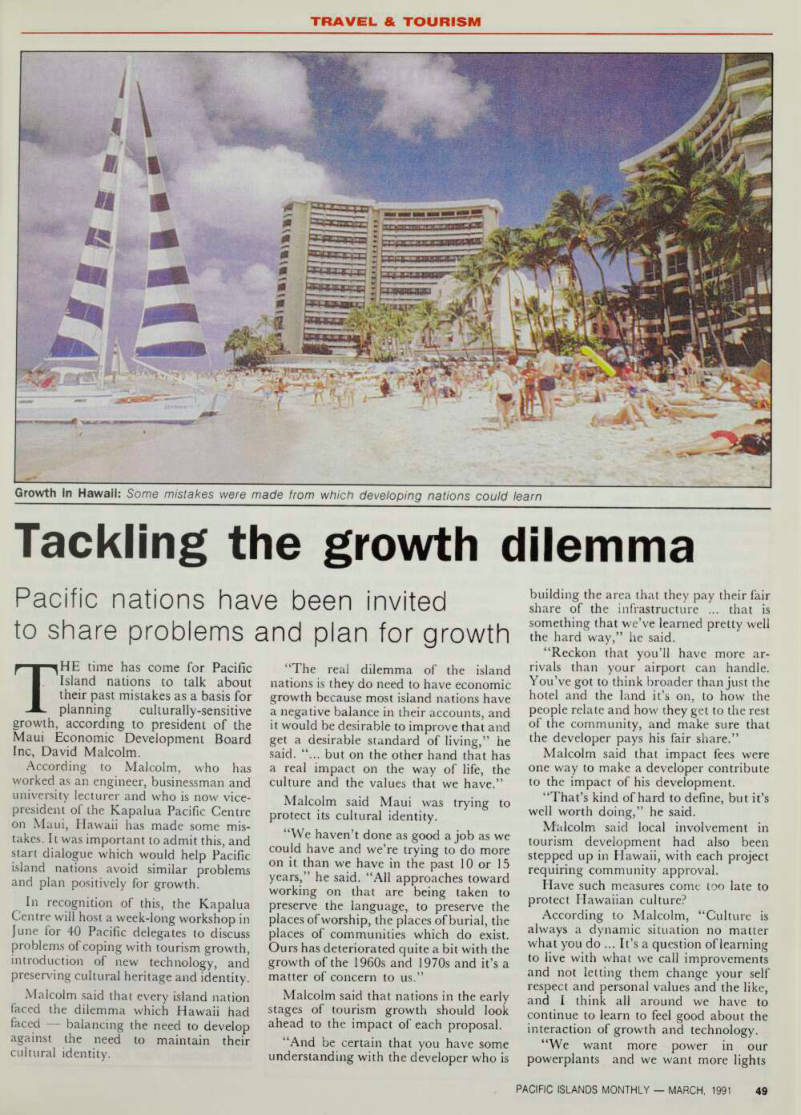
Growth In Hawaii: Some mistakes were made from which developing nations could learn
and we want more communications and we want better education all of those things cost. And I think if you look at the state of the workers in Hawaii in the days when plantations were in their heyday, the quality of life for the agricultural worker is considerably better than it was.
While in truth some of the habits of those times are not there anymore, who would want to go back to that any more?”
Malcolm said Fiji had similar attri butes to Hawaii, but that it was in the early stages of tourism development.
Hawaii was 16,600 square kilometres in size; Fiji was 18000 plus square kilometres. Hawaii had just over 1 million people; Fiji had just over 700,000.
“The main difference is you have so many more islands (Hawaii has only
132), and that can be a real asset in your ability to deal with the question of tourism ... you can keep it under control here. You can develop some for visitors and keep others aside.”
Malcolm said Fiji could still expand considerably without posing a serious threat to culture.
“It seems to me with the ration of visitors that you have now that you have a long way to go before it becomes a problem under the policies that you do have. If you make sure the resort area you have is built correctly, that the infrastructure requirements to support it are taken care of in the permissions to do the building, you can expand your industry two or three times and you would not notice the difference
particularly.” □
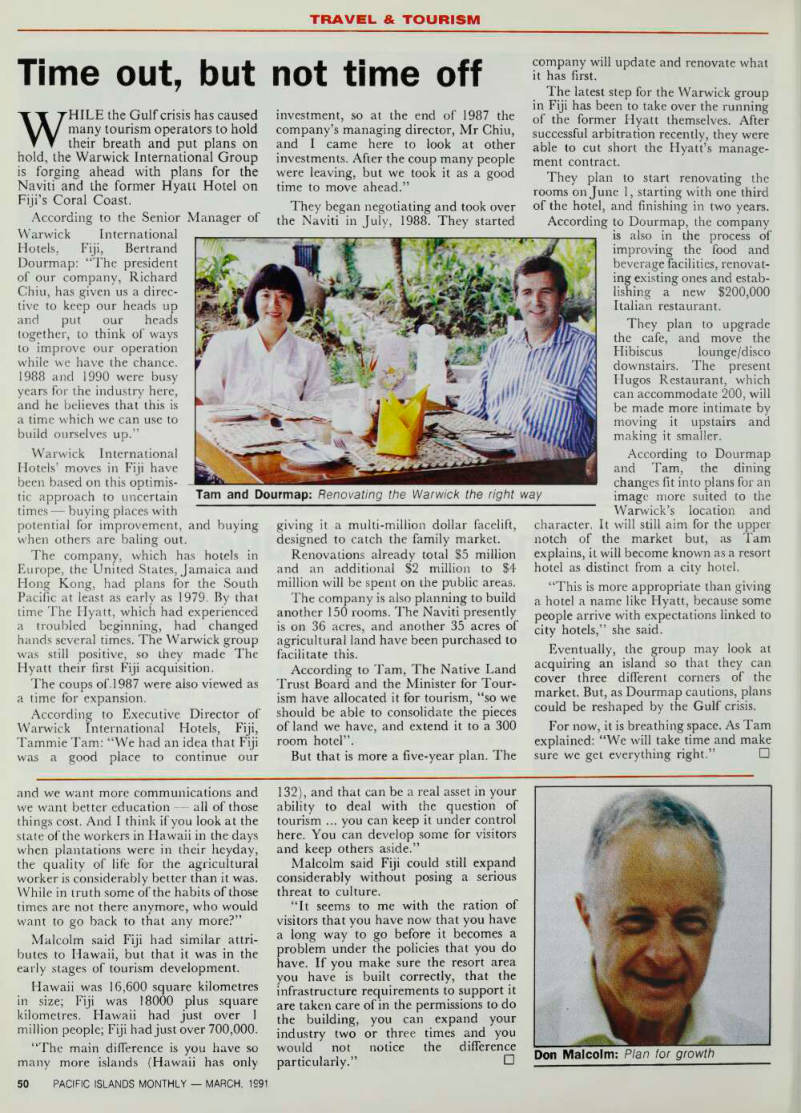
Don Malcolm; Plan for growth