Turning the tide for clams
p. 25 · Read in the full issue
Aquaculture
In Tonga, a community effort restores a food supply and boosts the environment
By Richard H. Chesher
Ph D. Marine Research Foundation In an era when everyone is becom ing increasingly alarmed by degra dation of natural resources and the environment, Tonga may have a lesson to teach its Pacific neighbours.
As early as 1979, New Zealand marine biologist J.L McKoy warned the govern ment of Tonga that one giant clam species, Hippopus, was probably extinct and another, Tridacna derasa, was on the brink of extinction. They were vanishing because giant clams must have a popu lation of old adults, close together in shallow water, so they can spawn and replenish the reefs with young. Overfish ing had eliminated stocks of adults.
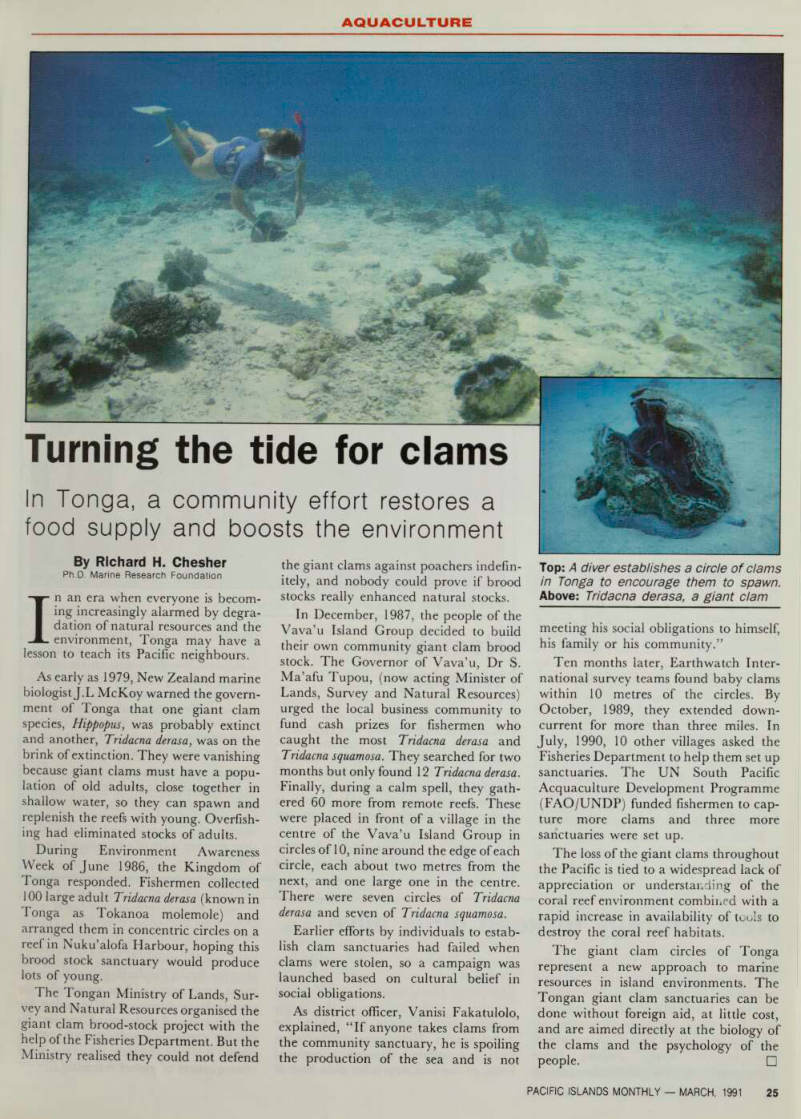
During Environment Awareness Week of June 1986, the Kingdom of Tonga responded. Fishermen collected 100 large adult Tridacna derasa (known in Tonga as Tokanoa molemole) and arranged them in concentric circles on a reef in Nuku’alofa Harbour, hoping this brood stock sanctuary would produce lots of young.
The Tongan Ministry of Lands, Sur vey and Natural Resources organised the giant clam brood-stock project with the help of the Fisheries Department. But the Ministry realised they could not defend
the giant clams against poachers indefin itely, and nobody could prove if brood stocks really enhanced natural stocks.
In December, 1987, the people of the Vava’u Island Group decided to build their own community giant clam brood stock. The Governor of Vava’u, Dr S.
Ma’afu Tupou, (now acting Minister of Lands, Survey and Natural Resources) urged the local business community to fund cash prizes for fishermen who caught the most Tridacna derasa and Tridacna squamosa. They searched for two months but only found 12 Tridacna derasa.
Finally, during a calm spell, they gath ered 60 more from remote reefs. These were placed in front of a village in the centre of the Vava’u Island Group in circles of 10, nine around the edge of each circle, each about two metres from the next, and one large one in the centre.
There were seven circles of Tridacna derasa and seven of Tridacna squamosa.
Earlier efforts by individuals to estab lish clam sanctuaries had failed when clams were stolen, so a campaign was launched based on cultural belief in
social obligations.
As district officer, Vanisi Fakatulolo, explained, “If anyone takes clams from the community sanctuary, he is spoiling the production of the sea and is not
meeting his social obligations to himself, his famil Y or his community.”
Ten months later, Earth watch Inter national survey teams found baby clams within 10 metres of the circles. By October, 1989, they extended down current for more than three miles. In July, 1990, 10 other villages asked the Fisheries Department to help them set up sanctuaries. The UN South Pacific
Acquaculture Development Programme
(FAO/UNDP) funded fishermen to cap ture more clams and three more sanctuaries were set up.
The loss of the giant clams throughout the Pacific is tied to a widespread lack of appreciation or understanding of the coral reef environment combined with a rapid increase in availability of tools to destroy the coral reef habitats, The giant clam circles of Tonga represent a new approach to marine resources in island environments. The Tongan giant clam sanctuaries can be done without foreign aid, at little cost, and are aimed directly at the biology of the clams and the psychology of the people. □
Top: A diver establishes a circle of clams in Tonga to encourage them to spawn.
Above: Tridacna derasa, a giant clam