Fiji ’91
pp. 10-14 · Read in the full issue

Cover Stories
It is the game of possibles and impossibles as time runs short on the election deadline
By Jale Moala
THE calendar on the wall showed February in its last two days. John Apted, into his second cup of black tea with no sugar, didn’t seem to notice. He was lighting another cigarette and talking about his job as Fiji’s new Supervisor of Elections. The calendar said he was two months into a 12-month deadline - and running out of time.
Apted’s appointment in January this year pointed Fiji more in the direction of its first post-coup general election. Every one’s trying to guess when the election will be held. Interim Prime Minister
Ratu Sir Kamisese Mara and the President, Ratu Sir Penaia Ganilau, have said that the election will be this year. Many, like Dr Balwant Singh Rakha, the outspoken president of the Indian-dominated National Federation Party, do not believe that. “I doubt it very much,” he said. “There are no boundaries, there is nothing. But then, politics is a game of pissibles and
impossibles.”
Rakha’s comment underscores the
difficulties facing the 27-year-old Apted
as he takes up the toughest job in the Fiji civil service. He started work on Febru ary 21 and by the end of the month he was still moving in equipment and setting up office. What sort of deadline
has he got? “It’s a constitutional timeframe,” he said, “the writ of election should be issued by January 1992 (at the latest) 18 months from the date of the promulgation of the new constitution (on July 25, 1990).”
Apted, who comes from one of Fiji’s prominent sporting families, knows he is into a different ball game. On paper, .he is well qualified for the job. He acquired a Bachelor of Law degree from Auckland University in 1985. In 1989 he did post graduate studies at Fletcher School, Boston, the United States’ oldest foreign affairs school which has had students like US Ambassador to the United Nations Thomas Pickering. There Apted did a master in international law and diplo macy. Last year he was at Harvard Law School, on an Asia Foundation grant, and acquired a Master in Law. He has been in the civil service for six years and was closely involved at secretariat level with post-coup constitutional reviews. “I am familiar with the terms of compro mise involved,” he said. He was sitting behind an old desk below a poster of Ratu Sir Kamisese meeting US President George Bush. He didn’t seem to fit the picture. With his baby face, he looked too young and vulnerable for a job that is always going to lawyers but which really needs an experienced administrator. But Apted was confident: “It’s a challenge.”
Help for Apted has come from the Native Lands and Fisheries Commission at the Ministry of Fijian Affairs. The Commission has been updating its Fijian Registry (Vola ni Kawa Bula) which lists every indigenous Fijian according to his or her clan or land-owning units ( yavusa).
Last year the Commission visited each yavusa and updated the Vola ni Kawa Bula.
It expects to have a provisional Fijian roll by June or July which will again be taken to individual yavusa for inspection.
When approved, the roll will be given to the Supervisor of Elections for adoption as the Fijian electoral roll.
While the commission’s work will give Apted some breathing space, it will not solve his problems. Basically he is starting from nothing. The election he is prepar ing for will have new rules, new boundaries and new voters. The compli cations of rural and urban Fijian regis trations will have to be solved. The General Electors’ roll has been largely expanded by the inclusion of Pacific Islanders who used to vote on the Fijian roll but who now do not qualify as indigenous Fijians under the new consti tution.
Apted said he is starting all over again.
And many people are saying he will not be able to hold the election this year because of that. For the 1982 general election, for example, when many things were in place, it took Suva lawyer Peter Howard the most part of three years to have it ready. “Voter registration is the biggest job,” Apted said. “We have more voters now.” Towards the end of Febru ary he was just getting started by asking the Bureau of Statistics for projected
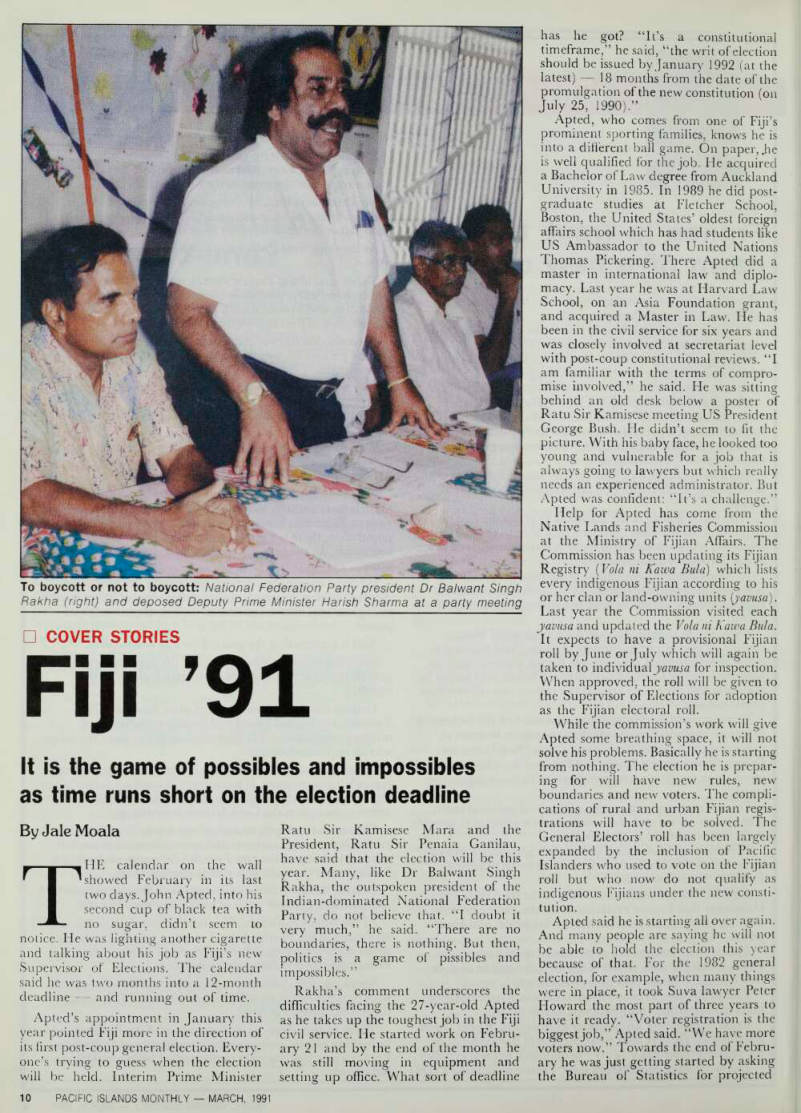
To boycott or not to boycott: National Federation Party president Dr Balwant Singh Rakha (right) and deposed Deputy Prime Minister Parish Sharma at a party meeting
1991 population figures to help the Boundaries Commission determine pro visional boundaries. With 10 months to go, he was quickly running out of time.
“It’ll take a good part of this year to finalise the boundaries,” said Howard, now of the Suva-based Howards law firm. “Registration alone in 1982 took about three months.”
The basic process in volves first the drawing up of provisional boundaries which must try as much as possible to evenly distrib ute the voters. This work by the Boundaries Com mission will take several months. Only after the boundaries have been agreed upon can the regis tration of voters begin.
This will again take more months by a large workforce, possibily con sisting of school teachers and university students, going from house to house throughout the country.
The registration books will have to be made available for public scru
tiny. Only after that can the writ of election be issued.
The election will take nearly a week.
Its timing is important. It is “logistic reality”, said Apted, for it to be held during the school holidays, when the schools are free for use as polling and counting stations, and the teachers are available to work as election officials.
This year there hasn’t been enough work done for the election to be held either in the first term school holiday in May or the second term holiday in August.
Christmas is out because too many people will be travelling in the country.
Many people are betting on the election being held next year. Some say it’ll be May 1992, five years after the
ousted Coalition gov ernment of Dr Timoci Bavadra came into power, and some say it’ll be later in the year, probably August 1992.
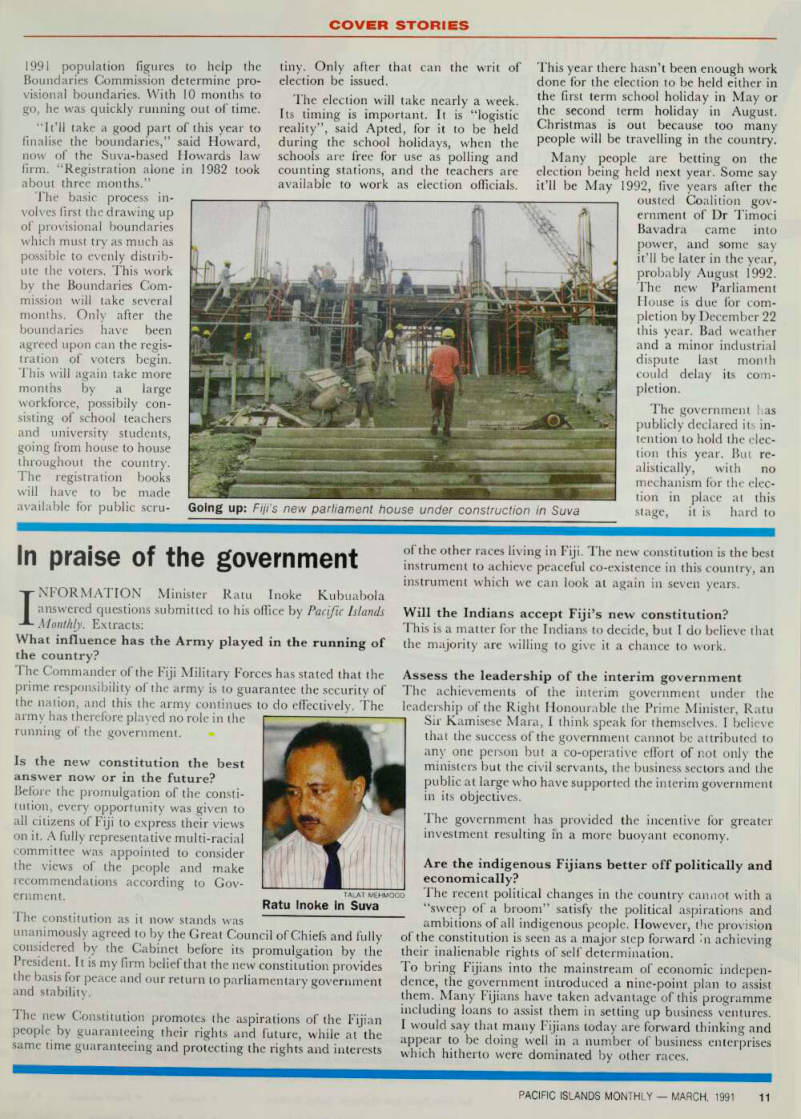
The new Parliament House is due for com
pletion by December 22
this year. Bad weather and a minor industrial dispute last month could delay its com pletion.
The government lias publicly declared its in tention to hold the elec tion this year. But re alistically, with no mechanism for the elec tion in place at this stage, it is hard to
Going up: Fiji's new parliament house under construction in Suva
believe that it is possible this year. Some observers see it wise to delay a political confrontation, like the election, in the hope that time will heal the wounds of the 1987 military coups. While the government insists things are normal in Fiji, Information Minister Ratu Inoke Kubuabola told Pacific Islands Monthly the country’s political problems cannot be said to have all been solved. “No country in the world has solved its political problems,” he said. “Every country has its own problems and I would say that the Interim Govern ment’s objectives in returning the
country to parlia mentary govern ment and econ omic recovery should be achieved by the end of the year.”
One major issue in this election is the decision by the National Feder
ation Party-Fiji
Labour Party Co alition, whose month-old gov ernment was over thrown in 1987, not to participate as a protest against the new constitution. The constitution, said a book titled A Fraud on the Nation produced by the
Coalition and released on February 28, is racist and unnecessarily weighted in favour of the indigenous Fijians. The Coalition will follow up A Fraud on the Nation with the production of an alterna tive constitution. But its decision not to participate in the election seems to be causing a split in the ranks of the party.
The Labour Party is behind the move for a boycott, seeing participation as an acceptance of the new constitution. The voice of dissent is coming from some members of the National Federation Party (NFP) who want to take part in the election to avoid having the 27 Indian seats taken up by “any Tom, Dick and Harry”. There was even a suggestion for the NFP to break away from the Coalition and concentrate on being an Indian party fighting for the 27 Indian seats in parliament and concen trating on Indian welfare. “The marjority of the Indians feel that way,” said Rakha. “It is natural for a person to look after his house first before looking after his village. NFP has always been an Indian party and although we’ve tried to give it a multiracial identity, it didn’t work.”
Rakha said the decision to boycott or not to boycott should be made by the people who support the parties and not by the party leaders: “If the people want us to contest then we contest. We shouldn’t give a ready-made idea to the people.” The final decision will be made after the NFP convention in May and the Labour convention in July.
The question that is being asked is why should the NFP remain in the Coalition.
While the Coalition was necessary in 1987 to topple the ruling Alliance Party of Ratu Sir Kamisese, Rakha sees little good in it for the NFP in a post-coup
election where numerical dominance is guaranteed for
the indigenous
Fijians. Asked
if there is a
possibility of
the Coalition
breaking up,
Rakha said; “If it doesn’t serve the inter est of the people then it can be poss ible.” But he pointed out
that contesting
the election on party lines still provides an
advantage for
the Coalition, especially with
Labour’s strong support in the urban areas.
Labour Party spokesman Tupeni
Baba, a senior lecturer at the University of the South Pacific in Suva, contends that the Coalition has very strong
chances of gaining parliamentary
marjority should it decide to contest the election. Said he: “We will pick up the 27 Indian seats, we will split the General Electors, we will win the urban Fijian seats and we will pick up one or two or
three provincial Fijian seats. But there is no guarantee that we can bring about a change in the constitution even if we hold the majority in parliament.” There is also no guarantee they will produce the prime minister, who must have the support of the majority of the Fijian members.
The Coalition’s uniting force is its total rejection of the new constitution. Apart from that there are few similarities between the two parties that comprise it.
The NFP began as an association for canefarmers in the late 1950 s and early 19605. By 1963 it has evolved into a full
‘lt’s natural for a person to look after his house first before looking after his village.
NFP has always been an Indian party . We’ve tried to give a multiracial identity, it didn’t work’
political party, led by A.D. Patel, an accomplished and
eloquent lawyer
who came to Fiji from his home of Gujerat in India.
Patel identified ef fectively with the aspirations and insecurities of a
majority of Fiji’s
Indian people.
Patel died in 1969 and the NFP has never been able to find an other leader with his appeal and wis dom. The party,
always dominated
by Indians, experi
enced its first split in late 1977. It broke up into
Flower and Dove factions, and saw the emergence of the leadership of Lautoka lawyer Jai Ram Reddy who headed NFP Flower. Reddy’s finest hour was in 1987 when he became the influential force behind the triumph of the Coalition.
Now, his war machine is in tatters and he remains mostly behind the limelight.
Labour was formed in the bosom of trade unionism, a reaction in 1985 by the Fiji Trades Union Congress to a government-imposed wage freeze. They
Asaeli Lave
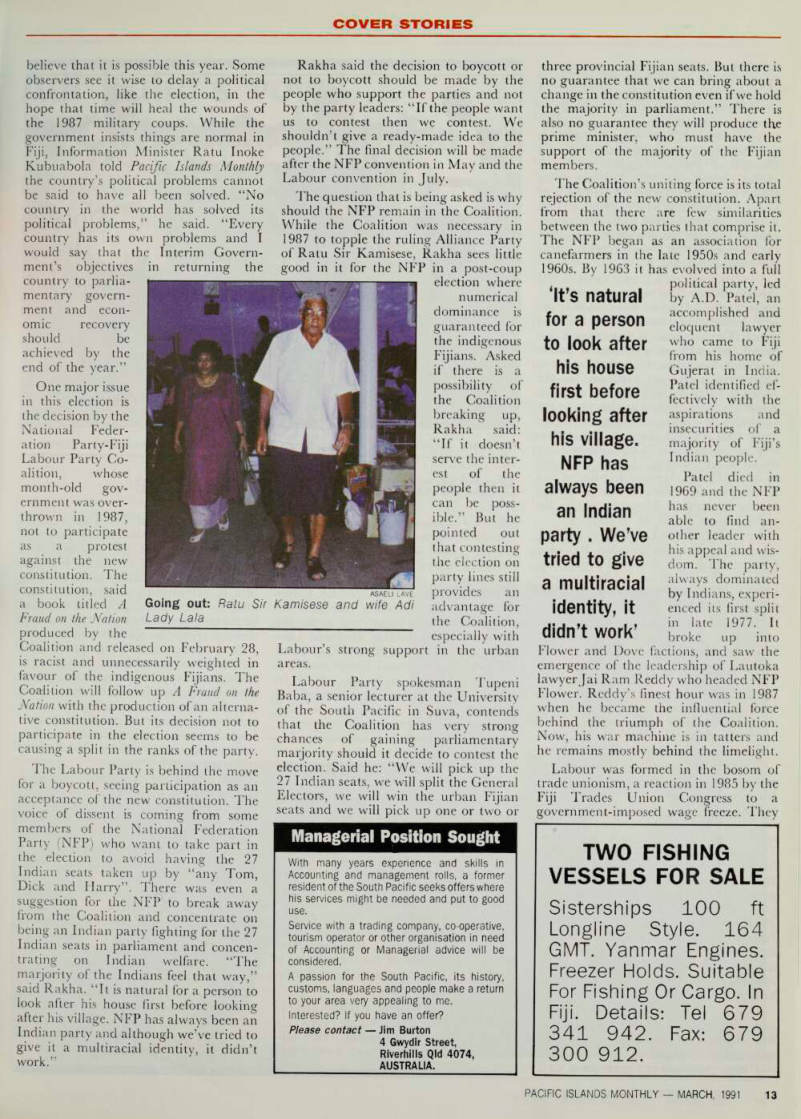
Going out: Ratu Sir Kamisese and wife Adi Lady Lala
call themselves social democrats and won appeal in the urban centres where the problems of unemployment and poverty were present. The party has lost some key members since the coup: general secre tary Krishna Datt resigned and is working as general secretary of the Council of Pacific Teachers Organis ations; former cabinet minister Joeli Kalou has joined the Suva City Council; Labour’s first Lord Mayor of Suva, Bob Kumar has migrated to Australia; former cabinet minister Jo Nacola has rejoined the civil service as a government secon dary school teacher.
Leadership is now a new crisis facing the Coalition. The announcement by party leader Adi Kuini Bavadra that she will marry again next month shocked many. The new man is Australian Clive Speed (see p!5) who became a public figure in Fiji when he helped chart a controversial election platform for the Alliance Party in 1982. Rakha said Adi Kuini’s private life is of no concern to the Coalition. But Baba, who engineered the move that led Adi Kuini to the leader ship, is dismayed. “Clive Speed is a major image problem,” he said. “She has to decide that marrying Clive Speed and holding the leadership of the party will not be in conflict. Many people in the party believe it will be in conflict.”
Nevertheless, the Coalition is meeting regularly to revive its branches. Baba has been meeting with potential Fijian can didates. The Coalition, while currently having an election boycott policy, is still preparing to fight the election.
And the interim government? The new rules give it an advantage over the Coalition. There has been talk of a Fijian party, supported by the Great Council of Chiefs in the hope of continuing to unite the indigenous Fijians. But there have been criticism on the attempt to involve the chiefs in politics which some say will lower the dignity of the chiefly system and abuse the authority of the chiefs.
The Fijian party also seems to be encountering a leadership crisis. Ratu Sir Kamisese has said he will not be available for this election. That has left the leadership position wide open, giving speculators a chance to make some bets.
The top contender is Deputy Prime Minister Josevata Kamikamica, who has always seemed a reluctant participant in politics. From here on it’s a guessing game: Education Minister Filipe Bole, Trade Minister Beranado Vunibobo, Infrastructure and Public Utilities Min ister Apisai Tora, etc, etc. Army Com mander Major-General Sitiveni Rabuka remains the dark horse, but the odds are heavily stacked against him.
It is easier to look outside the current administration for a new prime minister.
But that is another story. For now the spotlight is on Apted. The betting has started election or no election. □