No happy mix, just
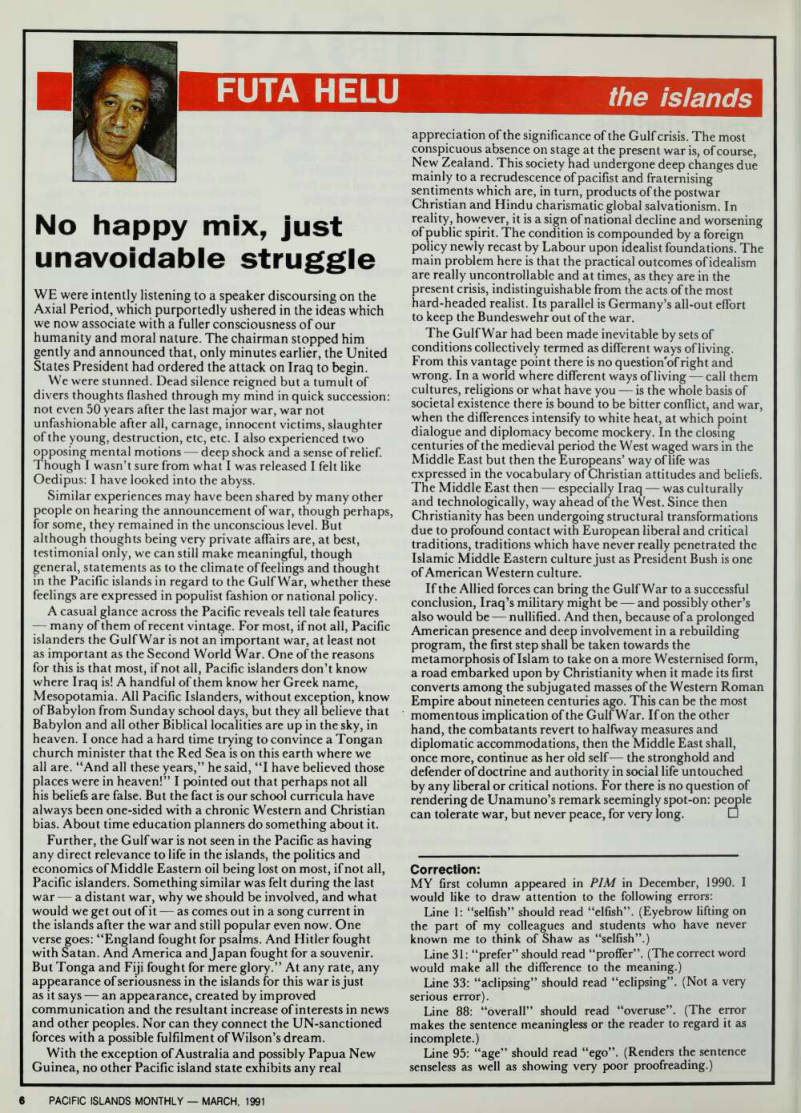
Futa Helu
No happy mix, just unavoidable struggle
the islands
WE were intently listening to a speaker discoursing on the Axial Period, which purportedly ushered in the ideas which we now associate with a fuller consciousness of our humanity and moral nature. The chairman stopped him gently and announced that, only minutes earlier, the United States President had ordered the attack on Iraq to begin.
We were stunned. Dead silence reigned but a tumult of divers thoughts flashed through my mind in quick succession: not even 50 years after the last major war, war not unfashionable after all, carnage, innocent victims, slaughter of the young, destruction, etc, etc. I also experienced two opposing mental motions deep shock and a sense of relief.
Though I wasn’t sure from what I was released I felt like Oedipus: I have looked into the abyss.
Similar experiences may have been shared by many other people on hearing the announcement of war, though perhaps, for some, they remained in the unconscious level. But although thoughts being very private affairs are, at best, testimonial only, we can still make meaningful, though general, statements as to the climate offeelings and thought in the Pacific islands in regard to the Gulf War, whether these feelings are expressed in populist fashion or national policy.
A casual glance across the Pacific reveals tell tale features many of them of recent vintage. For most, if not all, Pacific islanders the Gulf War is not an important war, at least not as important as the Second World War. One of the reasons for this is that most, if not all, Pacific islanders don’t know where Iraq is! A handful of them know her Greek name, Mesopotamia. All Pacific Islanders, without exception, know of Babylon from Sunday school days, but they all believe that Babylon and all other Biblical localities are up in the sky, in heaven. I once had a hard time trying to convince a Tongan church minister that the Red Sea is on this earth where we all are. “And all these years,” he said, “I have believed those places were in heaven!” I pointed out that perhaps not all his beliefs are false. But the fact is our school curricula have always been one-sided with a chronic Western and Christian bias. About time education planners do something about it.
Further, the Gulf war is not seen in the Pacific as having any direct relevance to life in the islands, the politics and economics of Middle Eastern oil being lost on most, if not all, Pacific islanders. Something similar was felt during the last war a distant war, why we should be involved, and what would we get out of it as comes out in a song current in the islands after the war and still popular even now. One verse goes: “England fought for psalms. And Hitler fought with Satan. And America and Japan fought for a souvenir.
But Tonga and Fiji fought for mere glory.” At any rate, any appearance of seriousness in the islands for this war is just as it says an appearance, created by improved communication and the resultant increase of interests in news and other peoples. Nor can they connect the UN-sanctioned forces with a possible fulfilment of Wilson’s dream.
With the exception of Australia and possibly Papua New Guinea, no other Pacific island state exhibits any real
appreciation of the significance of the Gulf crisis. The most conspicuous absence on stage at the present war is, of course, New Zealand. This society had undergone deep changes due mainly to a recrudescence of pacifist and fraternising sentiments which are, in turn, products of the postwar Christian and Hindu charismatic global salvationism. In reality, however, it is a sign of national decline and worsening of public spirit. The condition is compounded by a foreign policy newly recast by Labour upon idealist foundations. The main problem here is that the practical outcomes of idealism are really uncontrollable and at times, as they are in the present crisis, indistinguishable from the acts of the most hard-headed realist. Its parallel is Germany’s all-out effort to keep the Bundeswehr out of the war.
The Gulf War had been made inevitable by sets of conditions collectively termed as different ways of living.
From this vantage point there is no question of right and wrong. In a world where different ways of living call them cultures, religions or what have you is the whole basis of societal existence there is bound to be bitter conflict, and war, when the differences intensify to white heat, at which point dialogue and diplomacy become mockery. In the closing centuries of the medieval period the West waged wars in the Middle East but then the Europeans’ way of life was expressed in the vocabulary of Christian attitudes and beliefs.
The Middle East then especially Iraq was culturally and technologically, way ahead of the West. Since then Christianity has been undergoing structural transformations due to profound contact with European liberal and critical traditions, traditions which have never really penetrated the Islamic Middle Eastern culture just as President Bush is one of American Western culture.
If the Allied forces can bring the Gulf War to a successful conclusion, Iraq’s military might be and possibly other’s also would be nullified. And then, because of a prolonged American presence and deep involvement in a rebuilding program, the first step shall be taken towards the metamorphosis of Islam to take on a more Westernised form, a road embarked upon by Christianity when it made its first converts among the subjugated masses of the Western Roman Empire about nineteen centuries ago. This can be the most momentous implication of the Gulf War. If on the other hand, the combatants revert to halfway measures and diplomatic accommodations, then the Middle East shall, once more, continue as her old self — the stronghold and defender of doctrine and authority in social life untouched by any liberal or critical notions. For there is no question of rendering de Unamuno’s remark seemingly spot-on: people can tolerate war, but never peace, for very long. □
Correction: MY first column appeared in PIM in December, 1990. I would like to draw attention to the following errors: Line 1; “selfish” should read “elfish”. (Eyebrow lifting on the part of my colleagues and students who have never known me to think of Shaw as “selfish”.) Line 31: “prefer” should read “proffer”. (The correct word would make all the difference to the meaning.) Line 33: “aclipsing” should read “eclipsing”. (Not a very serious error).
Line 88: “overall” should read “overuse”. (The error makes the sentence meaningless or the reader to regard it as incomplete.) Line 95: “age” should read “ego”. (Renders the sentence senseless as well as showing very poor proofreading.)