High price to pay for US nuclear policy
pp. 48-49 · Read in the full issue
Books
Day of Two Suns. By Jane Dibblin. New Amsterdam Books. New York, 1990. $24.95 hardcover, $12.95 paperback.
Reviewed by James Brooks THE most frightening aspect of Jane Dibblin’s study of nuclear weapons tests in the Marshall Islands is her implication that the United States deliberately permitted the people of Rongelap and Utrik to be exposed to fallout from the March 1, 1954, bomb test code-named Bravo.
The author’s evidence of such a horrendous and unconscionable act is not inconsequential. She notes first that this particular test, an explosion whose force was 1300 times the power of the atomic bomb dropped on Hiroshima, was intended to create significant fallout.
This was achieved by detonating the bomb relatively close to the ground so that the fireball sucked up massive quantities of coral. A Department of Defense publication she quotes admits that Bravo “produced the worst extensive local fallout yet recorded.”
Her second critical piece of evidence is the failure of the Americans who were in
charge to have the inhabitants of the atolls evacuated prior to the tests, a routine followed before previous ex plosions. This fact is worse because the w u ind had been blowing for days prior to the test in the direction ot Rongelap and Utrik, which lie about 100 and 300 miles respectively from B.kmt, site of the test, Ms Dibblin supports this fact with the statement of a senior weather technician who participated in the test and in a 1984 re P or * of the Defence Nuclear A ? enc >'' “The first the islanders knew of Bravo,” she writes, “was an intense light, like a strange sun dawning in the west.”
The false dawn, which gave rise to the expression and now the title, Day of Two Suns, was followed by the sound of the explosion and then, tragically, the silent shower of radiation-laden coral dust, Children played in it like snow.
Two days after the explosion the Rongelapese were loaded on a US Navy vessel and taken to Kwajalein. Those on Utrik weren’t picked up rescued would hardly be the appropriate word un til 72 hours had passed. By the time the victims got to Kwajalein many were dizzy, weak, nauseated, suffering from burns and rapidly losing hair, all signs of
significant radiation exposure. Treat ment seemed to consist primarily of repeated showers, blood tests and fre quent questioning about their symptoms.
While not quite lodging her own indictment against the United States for intentionally exposing the islanders to radiation, Ms Dibblin permits Araji Balos, a senator in the Nitijela or parliament of the Republic of the Marshalls, to do so. His quoted statement is that the US “knowingly and con sciously allowed (ed) the people of Rongelap to be exposed so that the United States could use them as guinea pigs in the development of its medical capabilities to treat its citizens who might be exposed to radiation in the event of a war with an enemy country.”
The continuing consequences of the nuclear weapons tests in the Marshalls are examined in much of the rest of the book.
Frequent miscarriages and severely
deformed foetuses are among the con stant price paid by women exposed at Rongelap and Utrik. Some of the births are so deformed they are called “jellyfish babies”. Thyroid tumors and cataracts afflict both sexes. There have also been instances of leukemia.
Another result was the displacement of all of the Marshallese from Bikini and Enewetak (expropriated as sites for the 66 explosions conducted between 1946 and 1958), Kwajalein (reserved for the exclusive use of Americans engaged in the bomb tests and, since 1959 until now, in monitoring missiles launched from Vandenberg Air Base in California into the lagoon enclosed by the atoll) and Roi and Namur, islets on which missile
monitoring equipment was erected.
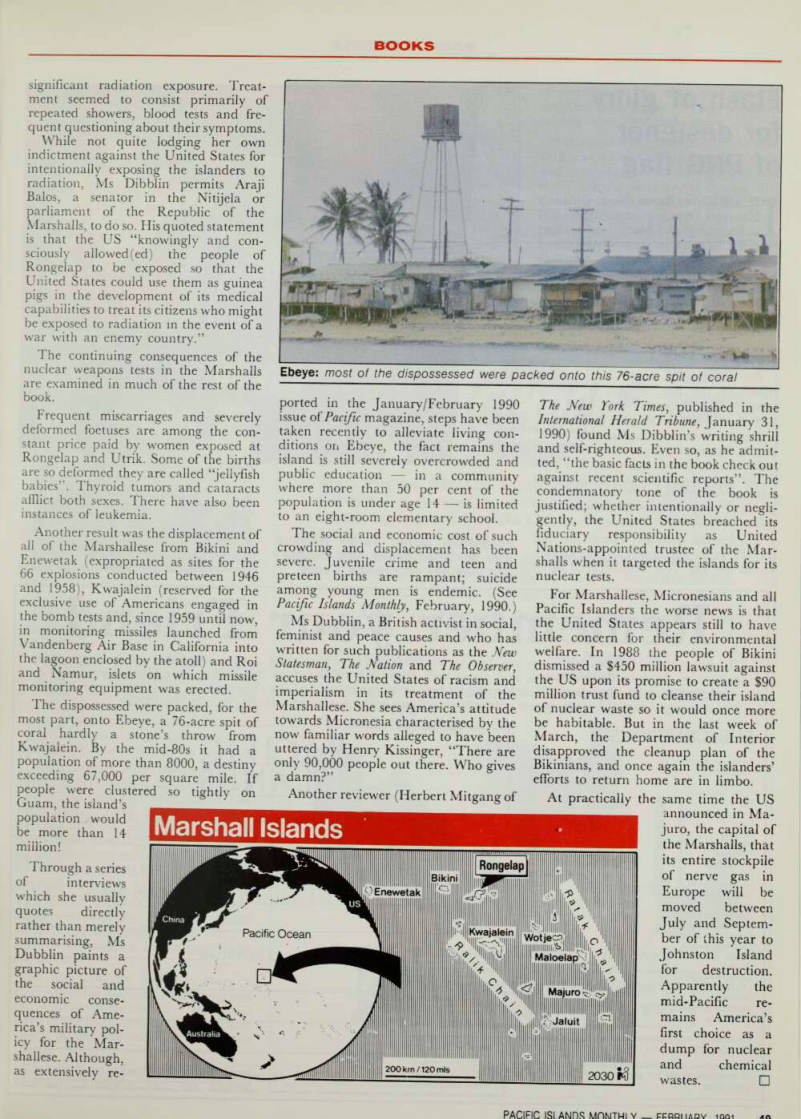
The dispossessed were packed, for the most part, onto Ebeye, a 76-acre spit of coral hardly a stone’s throw from Kwajalein. By the mid-80s it had a population of more than 8000, a destiny exceeding 67,000 per square mile. If people were clustered so tightly on
Guam, the island’s population would be more than 14 million!
Through a series of interviews which she usually
quotes directly
rather than merely summarising, Ms Dubblin paints a graphic picture of the social and economic conse quences of Ame rica’s military pol icy for the Mar
shallese. Although,
as extensively re-
ported in the January/February 1990 issue of Pacific magazine, steps have been taken recently to alleviate living con ditions on Ebeye, the fact remains the island is still severely overcrowded and public education in a community where more than 50 per cent of the population is under age 14 is limited to an eight-room elementary school.
The social and economic cost of such crowding and displacement has been severe. Juvenile crime and teen and preteen births are rampant; suicide among young men is endemic. (See Pacific Islands Monthly , February, 1990.) Ms Dubblin, a British activist in social, feminist and peace causes and who has written for such publications as the New Statesman, The Nation and The Observer, accuses the United States of racism and imperialism in its treatment of the Marshallese. She sees America’s attitude towards Micronesia characterised by the now familiar words alleged to have been
uttered by Henry Kissinger, “There are
only 90,000 people out there. Who gives a damn?”
Another reviewer (Herbert Mitgang of
The New York Times , published in the International Herald Tribune, January 31, 1990) found Ms Dibblin’s writing shrill and self-righteous. Even so, as he admit ted, “the basic facts in the book check out against recent scientific reports”. The condemnatory tone of the book is justified; whether intentionally or negli gently, the United States breached its
fiduciary responsibility as United
Nations-appointed trustee of the Mar shalls when it targeted the islands for its nuclear tests.
For Marshallese, Micronesians and all Pacific Islanders the worse news is that the United States appears still to have little concern for their environmental welfare. In 1988 the people of Bikini dismissed a $450 million lawsuit against the US upon its promise to create a $9O million trust fund to cleanse their island of nuclear waste so it would once more be habitable. But in the last week of March, the Department of Interior disapproved the cleanup plan of the Bikinians, and once again the islanders’ efforts to return home are in limbo.
At practically the same time the US
announced in Ma juro, the capital of the Marshalls, that its entire stockpile of nerve gas in Europe will be moved between July and Septem ber of this year to Johnston Island for destruction.
Apparently the
mid-Paciflc re mains America’s first choice as a dump for nuclear and chemical wastes. □
Ebeye: most of the dispossessed were packed onto this 76-acre spit of coral