Budget blow-out meets the mark
pp. 45-46 · Read in the full issue
By Samisoni Kakaivalu
WHEN the Ligue De Nouvelle Caledonie De Football, New Caledonia’s governing soccer body, lost over 3 million francs hosting the Third Melanesian Cup last Novem ber, not many eyebrows were raised.
The organisers had expected to lose money. They were aware of that when they asked, at a meeting of team officials in Suva in 1989, to be hosts.
They had been bid ding hard to have the games played at the Stade De Magenta since the first Melanesian Cup at the Lawsom Tama stadium in Honiara in 1988.
The motive behind their earnest bid was seen by some as having a more political overtone than sports. The native Kan aks want to identify themselves with the Mel-
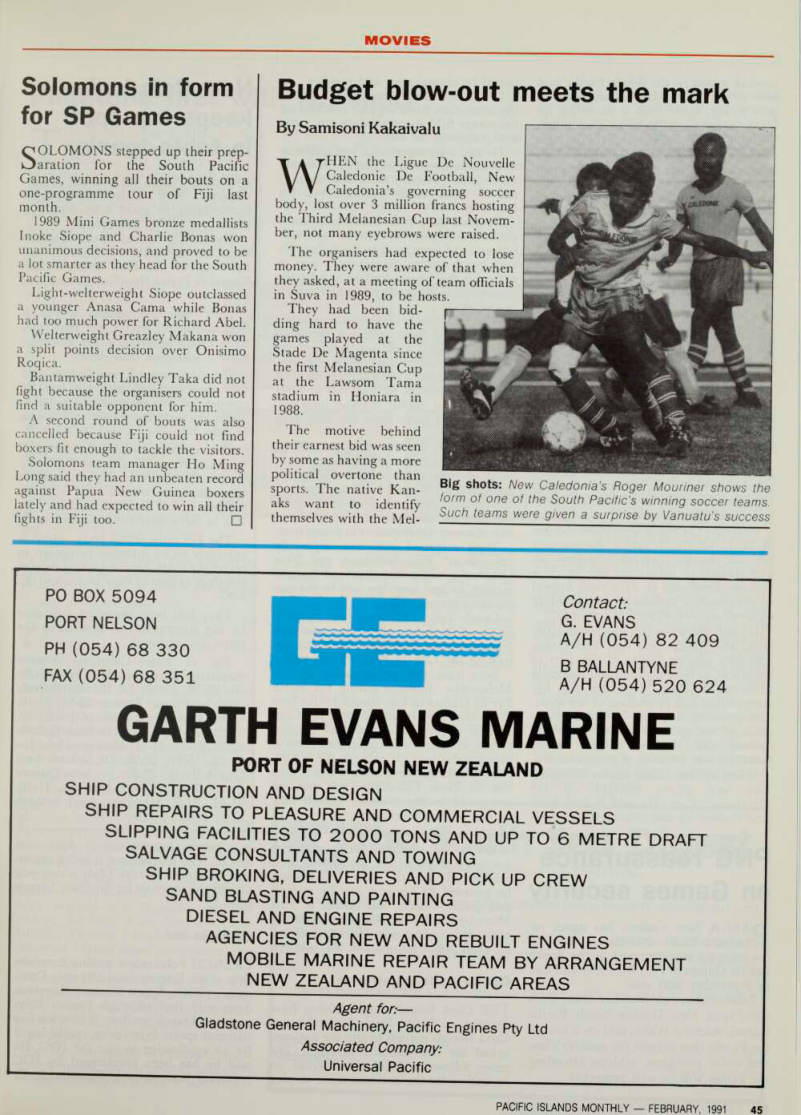
Big shots: New Caledonia's Roger Mouriner shows the form of one of the South Pacific's winning soccer teams.
Such teams were given a surprise by Vanuatu's success
anesian group in the South Pacific and love to see fellow Melanesians come to play soccer, apart from it providing an ideal chance to get to know each other.
Guy Elmour, vice president of the New Caledonian soccer, said after the tourna ment that the loss did not worry them much. He hinted that, after all, the government had salvaged them out of similar situations in the past.
The Ligue De Nouvelle Caledonie became the first host not to make money out of the three-year-old championship.
Solomons soccer president Alan Boso, one of the founders of the Cup, said the initial aims had been to: • consolidate the support of the Melanesian soccer playing countries in the Oceania Football Confederation, • financially assist host countries in funding soccer development in their countries.
While the first aim had been achieved overwhelmingly, the second was not. It did not, however, cool the enthusiasm to carry on with the championship.
In fact, Vanuatu and Solomons are bidding wildly to host the 1992 tourna ment after teams officials decided to skip 1991 because of the South Pacific Games in Papua New Guinea.
Boso said the Solomons almost did not make it to the Noumea tournament because the government withdrew an undertaking to help them out on their airfares. Boso said an 11th hour appeal to the business community in Honiara received an overwhelming response.
He said there was still much sympathy with the plight of the Melanesian countries playing soccer in this part of the world, as New Zealand and Australia preferred to look elsewhere for top competition and promotion of the sport.
The yawning disparity in the develop ment of the game between the island nations and the two bigger soccer countries was a matter of great concern.
When not much help was forthcoming, Boso and others thought up the Melanesian Cup. He said it had been time to stand up and do something which
would be constructive and positive.
“We had to form a united front and at the same time have regular contacts on the soccer field to consolidate our cause and position,” he said.
He said a stronger voice and influence in Oceania now meant that FIFA would value their presence more and channel aid on equal terms with the two big countries.
Boso said that, in the Solomons, money raised and donated towards soccer devel opment had been used to the fullest. He said youth soccer development was so extensive that he was looking at a Pacific champion team coming out of Honiara in five years.
New Caledonia, while not a member of FIFA, has been receiving extensive help, financial and otherwise, from mother France. Papua New Guinea, which missed the 1988 games because of financial problems, finished last in Nou mea but had shown marked improve ment in their game since the 1989 Cup in Suva.
Indications are that the hosts, PNG, will be no pushover when they play in front of their home crowd during the South Pacific Games later this year.
Vanuatu, the best success story at the Noumea tournament, exhibited the ben efits of soccer development in young men.
They surprised everyone, especially “big shots” Fiji, Solomons and New Caledonia, when they deprived them of victory, as had been the case in the two
previous tournaments.
Coach Terry O’Donnell was optimis tic about the future of the team and said Vanuatu were looking forward to de fending the Cup at Port Vila in 1992.
Boso said the performance of the Melanesian countries during the South Pacific Games in Lae should reflect how much they had benefited from the Cup.
It had offered more national compe titions, and exposed and elevated them to new standards of the game in the region.
Boso said the three million francs they lost in New Caledonia was nothing compared to the immense benefit they reaped of that tournament. U