Japan enters Samoa tourism market
p. 38 · Read in the full issue
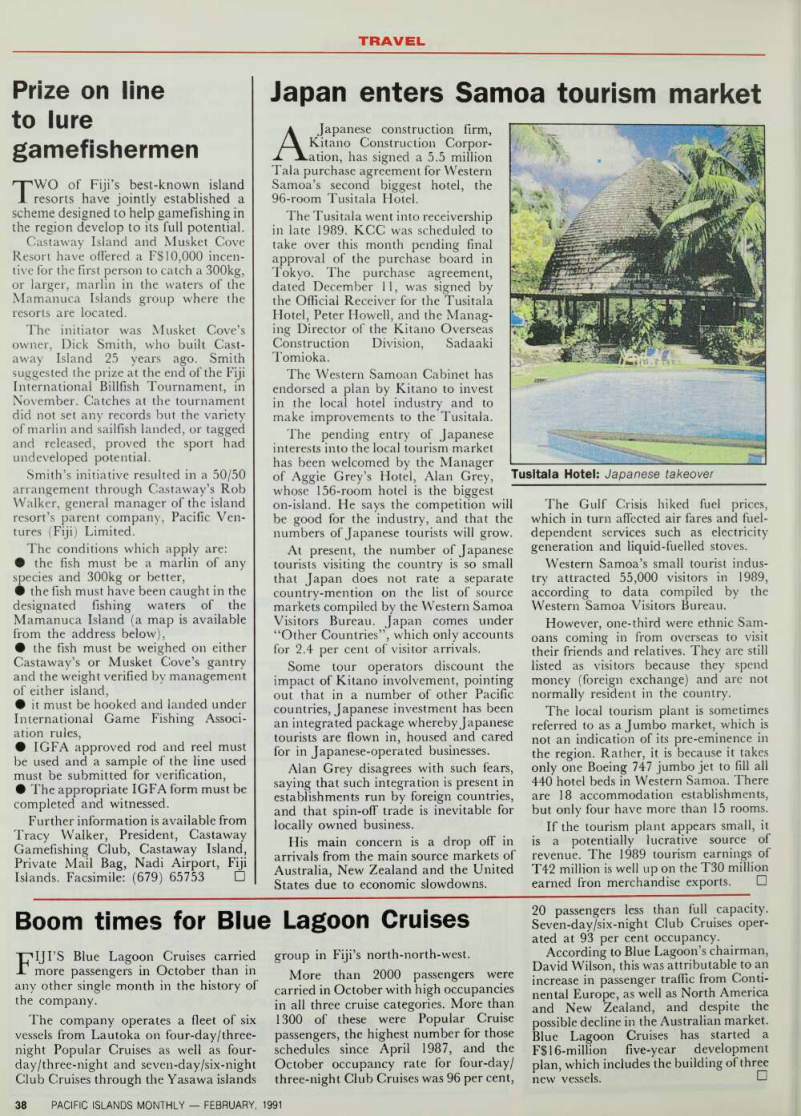
A Japanese construction firm, Kitano Construction Corpor ation, has signed a 5.5 million Tala purchase agreement for Western Samoa’s second biggest hotel, the 96-room Tusitala Hotel.
The Tusitala went into receivership in late 1989. KCC was scheduled to take over this month pending final approval of the purchase board in
Tokyo. The purchase agreement,
dated December 11, was signed by the Official Receiver for the Tusitala Hotel, Peter Howell, and the Manag ing Director of the Kitano Overseas Construction Division, Sadaaki Tomioka.
The Western Samoan Cabinet has endorsed a plan by Kitano to invest in the local hotel industry and to make improvements to the Tusitala.
The pending entry of Japanese interests into the local tourism market has been welcomed by the Manager
of Aggie Grey’s Hotel, Alan Grey,
whose 156-room hotel is the biggest
on-island. He says the competition will be good for the industry, and that the numbers of Japanese tourists will grow.
At present, the number of Japanese tourists visiting the country is so small that Japan does not rate a separate country-mention on the list of source markets compiled by the Western Samoa Visitors Bureau. Japan comes under “Other Countries”, which only accounts for 2.4 per cent of visitor arrivals.
Some tour operators discount the impact of Kitano involvement, pointing out that in a number of other Pacific countries, Japanese investment has been
an integrated package whereby Japanese
tourists are flown in, housed and cared for in Japanese-operated businesses.
Alan Grey disagrees with such fears, saying that such integration is present in establishments run by foreign countries, and that spin-off trade is inevitable for locally owned business.
His main concern is a drop off in arrivals from the main source markets of Australia, New Zealand and the United States due to economic slowdowns.
The Gulf Crisis hiked fuel prices, which in turn affected air fares and fuel dependent services such as electricity
generation and liquid-fuelled stoves.
Western Samoa’s small tourist indus try attracted 55,000 visitors in 1989,
according to data compiled by the
Western Samoa Visitors Bureau.
However, one-third were ethnic Sam oans coming in from overseas to visit their friends and relatives. They are still listed as visitors because they spend money (foreign exchange) and are not normally resident in the country.
The local tourism plant is sometimes referred to as a Jumbo market, which is not an indication of its pre-eminence in the region. Rather, it is because it takes only one Boeing 747 jumbo jet to fill all 440 hotel beds in Western Samoa. There are 18 accommodation establishments, but only four have more than 15 rooms.
If the tourism plant appears small, it is a potentially lucrative source of revenue. The 1989 tourism earnings of T 42 million is well up on the T3O million earned fron merchandise exports. □
Tusitala Hotel: Japanese takeover