Where a
pp. 26-32 · Read in the full issue
Focus
Where a secret slumbers
By Helen Averley
TO THE south of Viti Levu, Fiji, a secret silently slumbers at one time grand enough to be con sidered as the site for the new capital.
Kadavu (pronounced Kandavu) now has even escaped some of the maps.
The fourth largest island, it is one of the most traditional, visited mainly by government officials, divers seeking to unlock the treasures of the Astrolabe Reef and the odd medical student. The last landfall before New Zealand, it slips astern, hardly noticed by the passing cargo ships. Few outsiders have any interest in Kadavu.
With passengers and baggage weighed to the last kilo, the Fiji Air flight is called.
Taking off from Nausori Airport and rising to 6000 feet, the little plane flies over the Rewa delta, Suva to the left and the reefs stretched out in a ragged fringe round Viti Levu’s southern shore, the plane strikes out due south, over the deep blue of Bligh Strait.
Far below, late, the ferry, Princess
Ashika, a mere speck, ploughs doggedly
on for Suva, its wake lost in the massive blue.
The Astrolabe Reef drops out of the droning haze. At its eastern end, Solo lighthouse stands sentinel on a rock and is ringed by a perfect circle of reef; next a scatter of small islands, and then the urchin, Ono island.
Then Kadavu, with its three volcanic sections, at last comes into view. The three parts are linked, only just, by two narrow strips. Far to the west, Kadavu abruptly ends with the distant blue of Nabukelevu (Mt Washington).
We drop lower, the turquoise rushes under our wings as we approach the little airstrip of Vunisea which straddles the island at its narrowest point. We hang in the air, poised. The hairy arm of the Australian pilot reaches up to control the flaps.
Slipping smoothly on to the soft grass, we bounce to a halt outside the white wooden shed, Kadavu Airport, with sleepy dogs and the next load of pass-
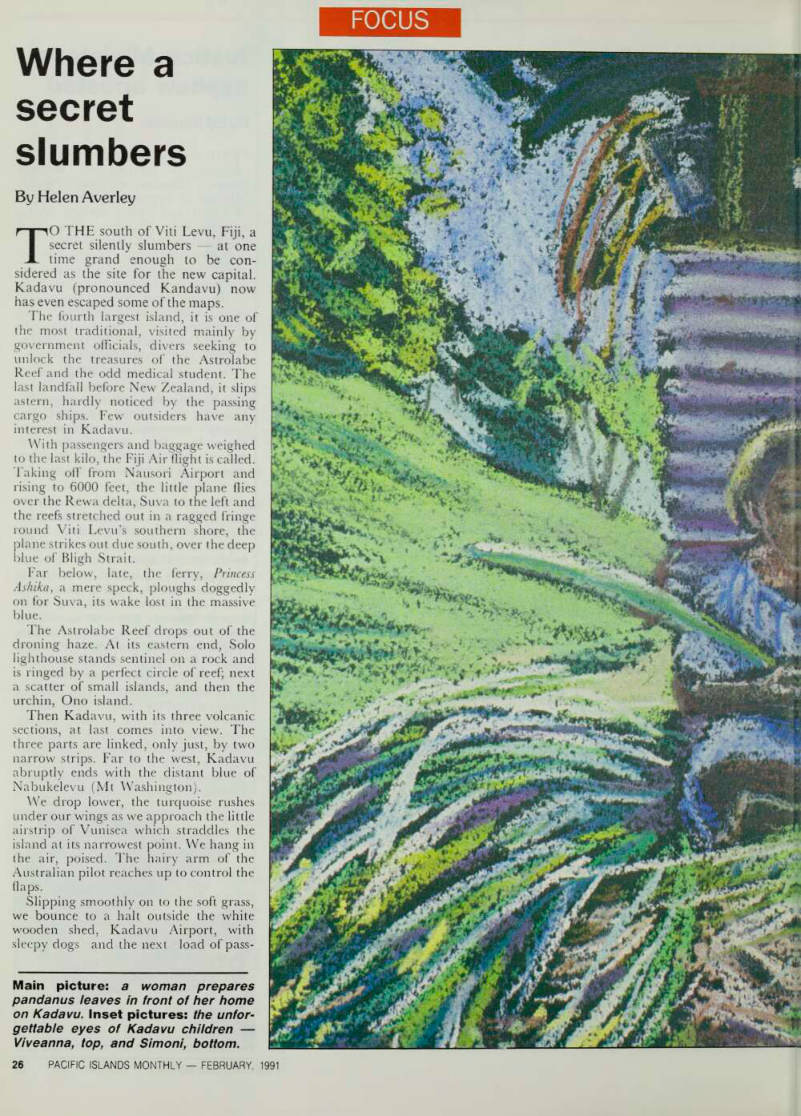
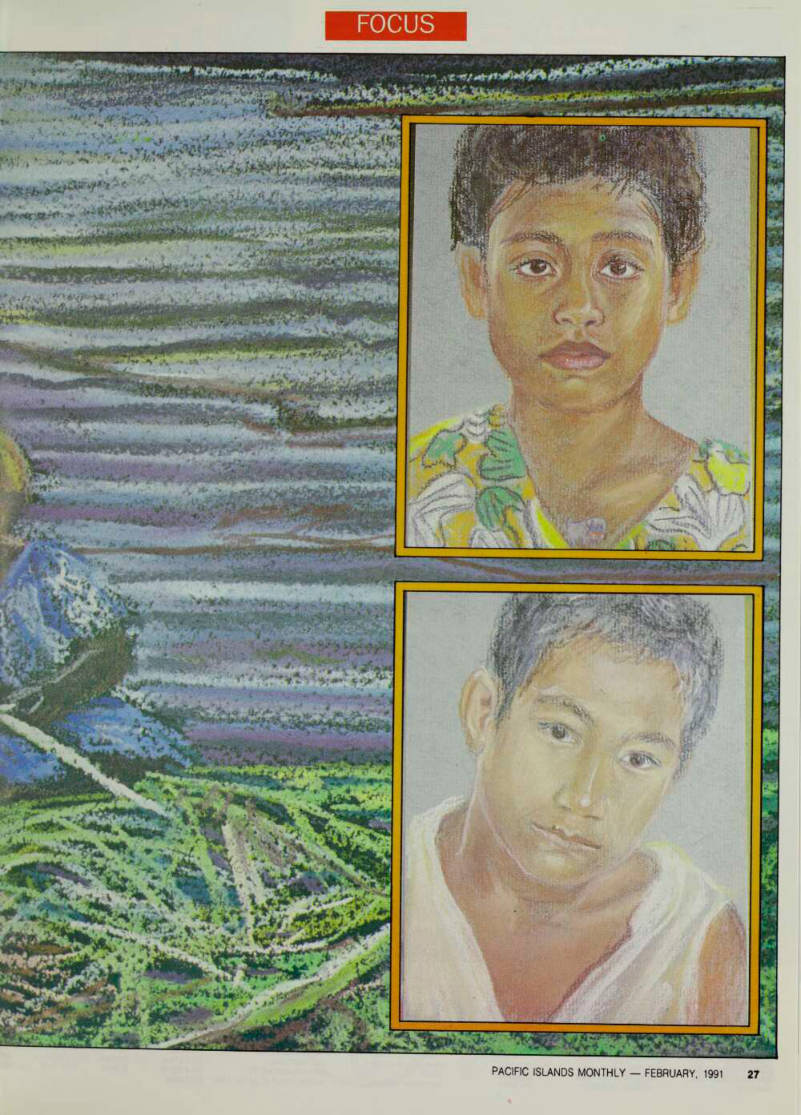
Main picture: a woman prepares pandanus leaves in front of her home on Kadavu. Inset pictures: the unfor gettable eyes of Kadavu children- Viveanna, top, and Simoni, bottom.
engers waiting beside a stack of luggage.
Everyone helps unload while chickens return to their scratching on the strip.
Matai drives one of the dozen or so trucks on Kadavu. In his brilliant green shirt he clashes violently with the new red
truck. He has driven all his life, in the Malaysian campaign, and now for the government office at Tavuki, his broad feet are splayed across the pedals.
The dirt road to Tavuki rises out of Vunisea. It snakes, a pink scar cut deep
into the verdant, steep hills, and we catch glimpses of Nabukelevu and snatches of the sea to the sound of Ron Pickering singing You drive me crazy. We slip down towards the seven villages of Tavuki district.
How is it that, knowing Ka davu so well from maps, that in her three dimensions she should so surprise and overwhelm me it is thrilling and it is indeed hilly.
The hills are old, wild, and some razor sharp, yet meeting the people of Kadavu you find them warm and hospitable, unhurried by it all, as they get on with life.
Their villages dotted along the coast, nestled between forest and sea, on the few flat pieces of land; at times having to resort to
gentler slopes as the lapping
waters forced them to abandon the shore.
Life goes on here much as it must always have done. When
the tide is out the people fish; when it is light, and food needs to be harvested someone is sent to the plantations, where Dalo (Taro), Cassava and Yaqona (Kava) are grown.
When a mat is wanted for a gift or for personal use, the business of mat making seems to incorporate the whole village.
Often village greens are littered with
drying pandanus leaves, blanched.
When dry, a man may help prepare the leaves, rolling them ready for his wife to weave.
A woman lifts down her almost completed mat from the rafters, where it is stored alongside fishing spears, planks, other mats and the occasional children’s tricycle. She has just finished weaving a mat to cover the bed, fringed with bright nylon wool.
But this new one is for the floor, and is not so fine. The wooden walls are painted a United Nations blue; a special deal must have been done on this particular batch of paint as it is found everywhere in the Pacific, but it is a perfect background to the pictures of sons in uniform as part of peace-keeping forces for the United Nations.
They hang alongside other family
portraits, depictions of the Last Supper,
a painting of a Sunderland flying boat, part of the New Zealand navy in the
The Chief: Ratu Aca, Daviqele, Kadavu
Tradition lives on at Kadavu: Ralure weaves mats as her mother, and as her mother's mother, had done
Relaxing: Ateca takes a break from her day's work
Serious: the level gaze of an elder commands respect
Questioning: a Kadavu woman scrutinises the artist
Patient: Kataloni sits, motionless, for her portrait
19505, and of course pride of place goes to the Royals Prince Charles on his engagement to Lady Diana, and so on.
These are nailed on to the tapa (bark cloth), painted in dense geometric pat terns in black and brown, and strung across the room from the main beam. It sets the scene for the important display of brightly coloured patchwork cushions and elaborately draped suite which is placed centre stage.
When the work is done and the sun has
set, the people will gather round the tanoa (Kava bowl). The men hitch up their mlus, sit crosslegged, and they too are set for the night. The women come later and slip in quietly through one of the three doors, which look out into the blackness thick, unlit, vast space.
It is cosy inside, comfortable and friendly. Pairs of eyes peep in through every gap and chink of the corrugated walls, and people stand round in hoardes at the doors, quietly shoving each other for a good view. , ... j „ , . u .
J h£ children of Kadavu watch as their Elders sit sharing the Yaqona, and the events of the day. It is round the tanoa that stories are told, where important decisions are made, where age old ceremonies are practiced. Indeed nothing, no matter how large or small, can escape the seal of approval of th t yaqona ceremony.
If you want something you must share a bowl o {yaqona. It is serious, yet at the same time it is relaxing. It is when jokes are told, and where the ladies shrilly echo the low tones of the men as the village joins in a meke, a celebration of life in dance and song. The subject can be anything from a Russian Crown Prince to a rugby match, or a singer’s love at
first sight.
The conversation is ordinary too the finer points of fishing, rugby and
women are once again exhausted. The nights are long, and stiff legs are stretched. It feels like little can have changed, save of course for the introduction of T-shirts, sunglasses and packs of playing cards.
There are many bush tracks which criss-cross Ka davu. The postman takes a week to cover the western bulge as he walks from one village postal station to the next. Some of the paths connect villages, others go inland to plantations. From the northern shore, at Ta vuki, there is a track, if you know it exists, to the southern side and Cevai (Thevai).
Out of Tavuki, past the government offices, crossing a small creek, the bridge consists of two felled coco nut trees, under mango trees, past a small cemetery, and along to the inland village of Baidamudamu.
The village has some of the traditional thatched bures, which have survived the hurricanes and progress, but like most of Kadavu,
the houses are wooden, with tin roofs.
Some are built on the old mounds, and a f ew are hybrids with thatched walls anc i tin roofs. Rising out of Baidamudamu, the track cuts through long sharp grasses, before crossing a creek full of fresh water prawns, and enters the
plantations,
Not long after rain the paths are treacherous, steep, slippery; the forest
dripping with vines, large pods and
buttress roots, tree ferns and wild hibiscus. Creeks flow into the harlequin pattern of taro terraces (different to the da|o beds below) nood; them , ;ke dd fie|ds r . , Crossing the island the path gets tangled up and tries to find the easiest route if not the most direct, along the spine-hke ridges or resorts to the rocky stream floor.
There is no sign of people ever having
been here. Everything seems newly discovered, like views of the other side of the island, and the unexpected and spectacular 40 feet drop of Vasuvu falls, where a needle of rock detached from the main cliff leans as if pulled down the valley, unable to stop itself falling onto the ruin of rocks below. The boulders are the size of trucks, straddled by creepers, and licked by cool whisps of misty spray.
A raw interior gives way once more to plantations worked by villagers from the southern side. Shortly the track joins the road, and leads at last to Cevai. The villagers say it takes them only three quarters of an hour, whereas it took me three or more perhaps there is an alternative route!
A story is told that the people of Cevai are direct descendants of Benjamin, Jacob’s twelfth son, and if they worship anyone other than God they will bring down a curse on the village.
But come Sunday, the life on Kadavu, like most of Fiji, revolves round the Church. For several Sundays in Tavuki I awoke to the deceptive palm leaves which rustle like falling rain. The cockerels crow whilst the church bell prompts the Lali (drum) to beat, calling the faithful to the first service.
A stream of people pass, dressed in their best the women in bright dresses over long plain sulus, the boys like little men, their sulus too large worn with tidy shirts and ties. No-one hurries.
The large church is decorated with wild and silk flowers. The children are made to sit in the front, on the floor. A fidgeting mass of little polished bodies, hair glistening, smoothed with coconut oil.
Elbowing each other during prayers, whacking their friends over the head when they think no-one is looking, but the Sunday School policeman is on
patrol.
With his long pole he reaches out and
prods them into shape, wagging his
finger the squirming child looks up with huge black eyes and is told to “Sit up straight ... fix your sulu ... fold your arms ... stop hitting him ...”
But the sermon is long and those elder members of the congregation donh escape. The man slumped sleepily too is poked, startled into wakefulness. The children stifle a snigger. Their mischiev ous eyes will remain with me a long time.
The Princess Ashika , fully laden with Yaqona, dried sea cucumbers, plantains and some familiar faces, turns and steams out through the reef from Vunisea past the rock from which the villagers of Namuana call the turtles from the sea.
Kadavu begins to slip away. With a mirror’s piercing light, Tavuki blinks a farewell, the last gleam as Kadavu sinks below the horizon.
Passing the time: Mary waits for a friend