Futa Helu
Tonga and the chosen ones
the islands
TONGA is unique in the Pacific. She is the sole survivor of the many South Seas kingdoms, all of them swallowed by that colossal wave of imperialism which swept across the Pacific in the 17th and 18th centuries. By conservative dating, she has had a continuous kingly line since the 10th century AD.
And spared of the traumatic experience of being colonised, in the strict sense of the term, by a great power, her people do not have the Caucasian-phobia and inferiority complex witnessed everywhere else in Oceania especially in Micronesia and north-western Melanesia at least not to the same irrational and ridiculous degree. If anything, Tongans really look down on, and even pity, the white man.
That is why Tongans and Europeans get on very well they both feel sure of being the greatest guys on earth.
This is a mentality I call feudal, i.e., when at home and amongst his fellows, such a person usually cuts a pathetic, grovelling, cringing little chap, but when among foreigners and in other lands, he becomes lordly and supercilious. It is understandable in Tongans but surprising in Europeans who, one would think, should have shaken it off a long time ago.
It must be one of those things that joins the blood. Given time though, it is an unconscious, socially-induced penchant for revenge on an unknown (and unknowable) target.
During those long centuries when Tongan society was evolving towards its classic form, it also was becoming rigidly heirarchical. And although there are many different groupings and sub-groupings in Tongan society, we can be
justinect irom a purely political point of view, i.e., from the power struggle point of view in dividing society here into the chiefly and the commoner classes. Further, political intrigue being the normal occupation of chiefly classes, they saw to it that commoners learnt well to know their place.
This was achieved not merely by the use of superior physical force, but also by an evolving body of religious and social psychology. The chiefly classes’ success here was so complete that most commoners today really feel in themselves a passion to be pushed around (and even abused) by a chief or
chiefs. To them it would constitute the rarest ofhonours and give significance to their lives. This accepted submissiveness is really a socialised and time-honoured wretchedness which underlies every aspect of the traditional Tongan character.
But as all things shall be made new,” many things were changing in Tonga. In fact, it’s only recently that they’ve been discovered to be changing. First, the missionaries and a minor group of chiefs began to work together, in the first two decades of last century, for their mutual benefit. Their coalition brought a revolution which swept away the old polity and established Tonga as a sovereign nation along
modern lines. Yet, important “feudalist” traditions similar to vassalage and fealty persisted and modified the modernist (capitalist) undisturbed enjoyment of private property, for instance impact of the changes.
The important result, however, was the devolution of power on to the church new monarch alliance. The monarchy, legally a constitutional one, became, in practice, well-nigh absolute, albeit beneficient, finding an ideal locus behind a bulwark of feudalist nobility. And the church (in this case, the Wesleyan) has been the major influence on government policy. But the proportion of power held by each party has never been in doubt the church holds the lion’s share.
Let us mention some of the major factors contributing to the new Tonga; the opening up ofTonga to the outside world and vice versa with the concomitant implications of migration, the fastly expanding cash sector and corresponding shrinking subsistance sector in the economy, a growing educated elite group, and the emergence of a middle class made up substantially by a salaried class of very highly paid government officials. The growing divergence between monarchy, aristocracy on one side and the churches on the other, in certain areas of policy and other matters of public concern is probably not a cause of the change but a manifestation of it. But it is still replete with significance from a historical point of view since modern Tonga was only possible through an alliance between chiefs and church. To say it in a clumsy pun: the chiefs cannot burn their boat, for in Tonga, the ship ofstate was the church.
And there is also the matter of structural changes sponsored and pushed by young representatives of the people in our parliament. Their style of politics is white man’s (New Zealand, Australian, British) as opposed to Tonga parliamentry behaviour where a commoner is bound by Tongan custom to go along with whatever the chiefs and authorities say. These young MPs, however, would like to see a more democratic situation in parliament in particular and government in general, though they forcefully stress they would never want to see the monarchy go.
But one cannot help but believe in the genius of a people that has
managed to remain unimpaired
and serene admist all the anguish and terrifying ordeals that other Oceanic communities had to go
through. It is a truly unique
history. Moreover, Tonga
compared superbly favorably
with other Pacific islands in matters of free speech and general human rights. For example, one wonders how a Samoan parliament would react to a vitriolic ‘Akilisi Pohiva in their Fate Fono we know he wouldn’t
last one minute in the Fiji parliament. And yet, I also believe that the whole destiny of this ‘chosen race’ now rests with how the authorities fmetune the changes, the new attitudes, and the new demands of the people.
It might come as a surprise to Tongans that ‘chosen’ or not, they too have, like other ‘chosen races’ of history, to go through natural (as opposed to idealised) steps in their evolution, that in history also there is no such thing as a free lunch. Most important of all, we must heed two particular lessons of history which are: we cannot do what we like, and, we do not know what we are doing. □
Tonga Chronicle
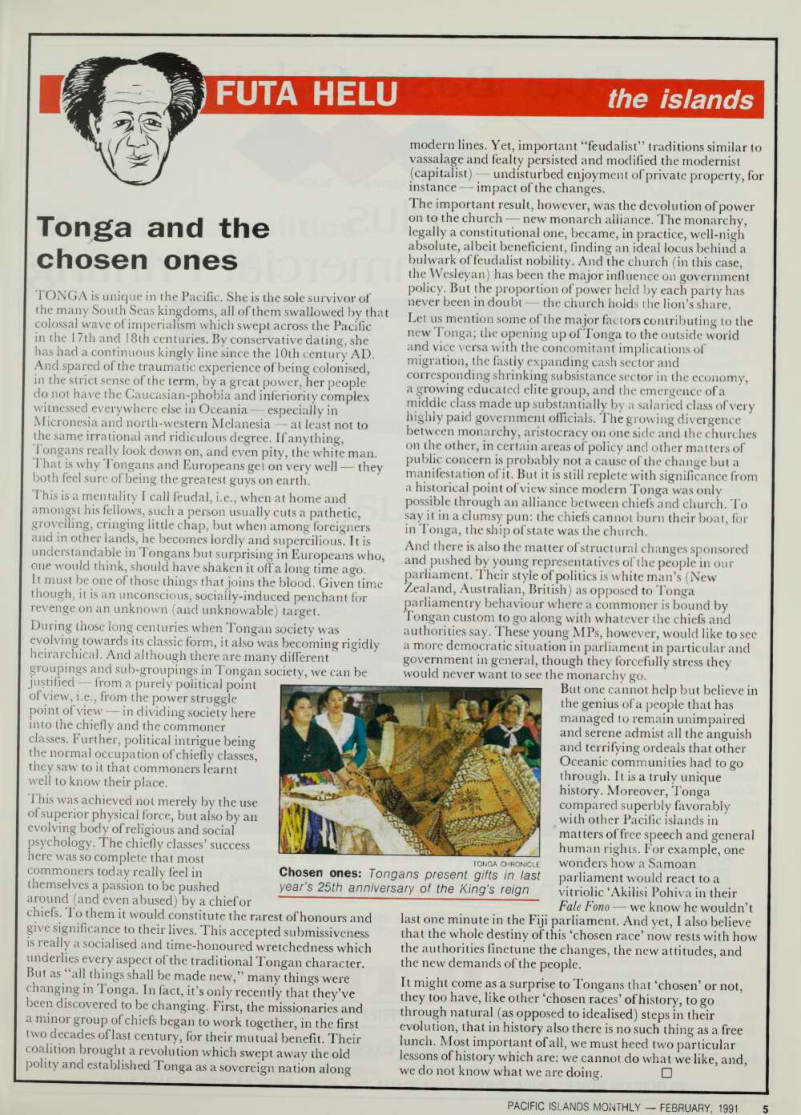
Chosen ones: Tongans present gifts in last year's 25th anniversary of the King's reign