Man of peace dies
p. 53 · Read in the full issue
Kanak father figure, Roch Pidjot, foresaw a bloody independence battle
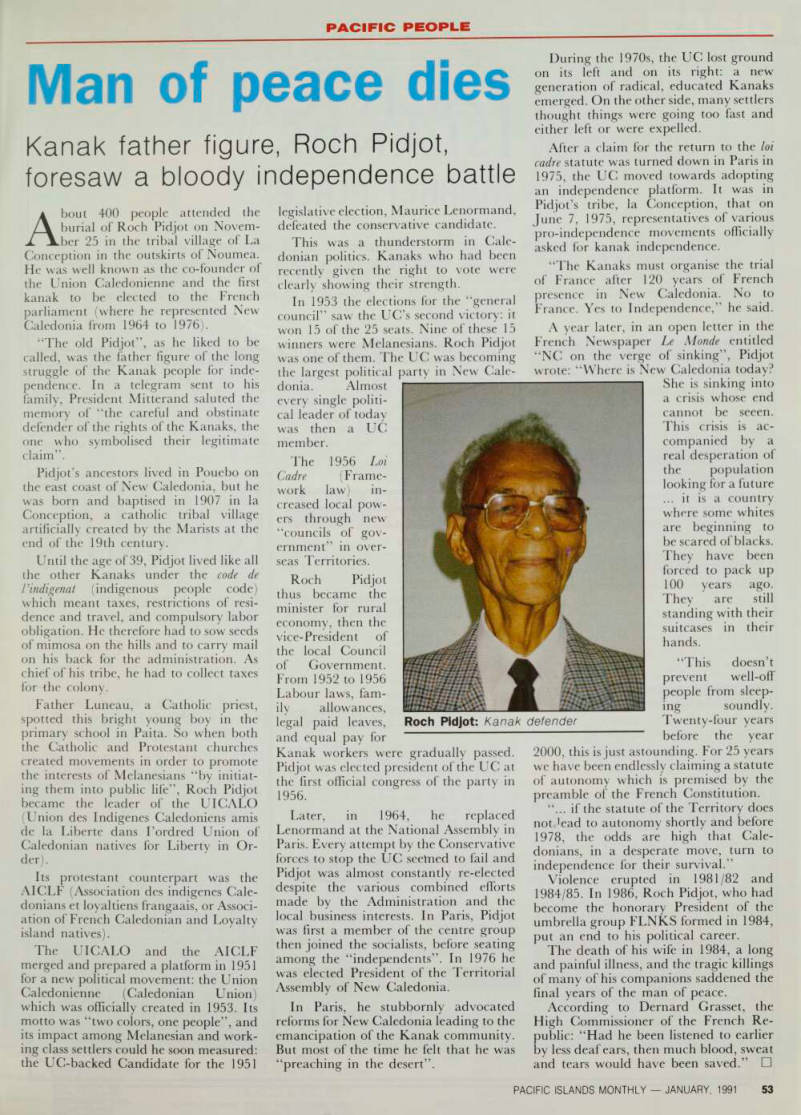
About 400 people attended the burial of Roch Pidjot on Novem ber 25 in the tribal village of La Conception in the outskirts of Noumea.
He was well known as the co-founder of the Union Caledonienne and the first kanak to be elected to the French parliament (where he represented New Caledonia from 1964 to 1976).
“The old Pidjot”, as he liked to be called, was the father figure of the long struggle of the Kanak people for inde pendence. In a telegram sent to his family, President Mitterand saluted the memory of “the careful and obstinate defender of the rights of the Kanaks, the one who symbolised their legitimate claim”.
Pidjot’s ancestors lived in Pouebo on the east coast of New Caledonia, but he was born and baptised in 1907 in la Conception, a catholic tribal village artificially created by the Marists at the end of the 19th century.
Until the age of 39, Pidjot lived like all the other Kanaks under the code de
Vindigenat (indigenous people code)
which meant taxes, restrictions of resi dence and travel, and compulsory labor obligation. He therefore had to sow seeds of mimosa on the hills and to carry mail on his back for the administration. As chief of his tribe, he had to collect taxes for the colony.
Father Luneau, a Catholic priest, spotted this bright young boy in the primary school in Paita. So when both the Catholic and Protestant churches created movements in order to promote the interests of Melanesians “by initiat ing them into public life”, Roch Pidjot became the leader of the UICALO (Union des Indigenes Caledoniens amis de la Liberte dans I’ordred Union of Caledonian natives for Liberty in Or der).
Its protestant counterpart was the AICLF (Association des indigenes Cale donians et loyaltiens frangaais, or Associ ation of French Caledonian and Loyalty
island natives).
The UICALO and the AICLF merged and prepared a platform in 1951 for a new political movement: the Union Caledonienne (Caledonian Union) which was officially created in 1953. Its motto was “two colors, one people”, and its impact among Melanesian and work ing class settlers could he soon measured: the UC-backed Candidate for the 1951
legislative election, Maurice Lenormand, defeated the conservative candidate.
This was a thunderstorm in Cale donian politics. Kanaks who had been recently given the right to vote were clearly showing their strength.
In 1953 the elections for the “general council” saw the UC’s second victory: it won 15 of the 25 seats. Nine of these 15 winners were Melanesians. Roch Pidjot was one of them. The UC was becoming the largest political party in New Cale
donia. Almost every single politi cal leader of today was then a UC member.
The 1956 Loi Cadre (Frame work law) in creased local pow ers through new “councils of gov ernment” in over seas Territories.
Roch Pidjot thus became the minister for rural economy, then the vice-President of the local Council of Government.
From 1952 to 1956 Labour laws, fam ily allowances, legal paid leaves, and equal pay for
Kanak workers were gradually passed.
Pidjot was elected president of the UC at the first official congress of the party in 1956.
Later, in 1964, he replaced Lenormand at the National Assembly in Paris. Every attempt by the Conservative forces to stop the UC seehied to fail and Pidjot was almost constantly re-elected despite the various combined efforts made by the Administration and the local business interests. In Paris, Pidjot was first a member of the centre group then joined the socialists, before seating among the “independents”. In 1976 he was elected President of the Territorial Assembly of New Caledonia.
In Paris, he stubbornly advocated reforms for New Caledonia leading to the emancipation of the Kanak community.
But most of the time he felt that he was “preaching in the desert”.
During the 19705, the UC lost ground on its left and on its right: a new generation of radical, educated Kanaks emerged. On the other side, many settlers thought things were going too fast and either left or were expelled.
After a claim for the return to the loi cadre statute was turned down in Paris in 1975, the UC moved towards adopting an independence platform. It was in Pidjot’s tribe, la Conception, that on June 7, 1975, representatives of various pro-independence movements officially asked for kanak independence.
“The Kanaks must organise the trial of France after 120 years of French presence in New Caledonia. No to France. Yes to Independence,” he said.
A year later, in an open letter in the French Newspaper Le Monde entitled “NC on the verge of sinking”, Pidjot wrote: “Where is New Caledonia today?
She is sinking into a crisis whose end cannot be seeen.
This crisis is ac companied by a real desperation of
the population
looking for a future ... it is a country where some whites are beginning to be scared of blacks.
They have been forced to pack up 100 years ago.
They are still standing with their suitcases in their hands.
“This doesn’t prevent well-off people from sleep ing soundly.
Twenty-four years before the year
2000, this is just astounding. For 25 years we have been endlessly claiming a statute of autonomy which is premised by the preamble of the French Constitution. if the statute of the Territory does to autonomy shortly and before 1978, the odds are high that Cale donians, in a desperate move, turn to independence for their survival.”
Violence erupted in 1981/82 and 1984/85. In 1986, Roch Pidjot, who had become the honorary President of the umbrella group FLNKS formed in 1984, put an end to his political career.
The death of his wife in 1984, a long and painful illness, and the tragic killings of many of his companions saddened the final years of the man of peace.
According to Bernard Grasset, the High Commissioner of the French Re public: “Had he been listened to earlier by less deaf ears, then much blood, sweat and tears would have been saved.” □
Roch Pidjot: Kanak defender