Fiji harvests
pp. 37-38 · Read in the full issue
sweet deal on US sugar
FIJI fared considerably better than Papua New Guinea in the latest round of American decision
making on sugar imports.
A metric ton (2,205 pounds) of raw sugar in the closed American market was worth US$494 at mid-December prices, about $275 more per ton than the free, world price. Since this is the case, competition to secure as big a share of the American sugar import quota as possible is always hot.
Similarly, American sugar growers exert strong political pressures on Wash ington to minimise imports of foreign sugar.
The same political scenario is played out, with different numbers, in Europe and elsewhere, with the commercial sugar users (and sometimes the Foreign
Ministries) of developed nations wanting
to buy sugar from the Third World and the Agricultural Ministries wanting the sales for their own farmers. (Sugar beets can be grown in very cold climates.) As a result of these competing interests, a complex pricing global structure for sugar has emerged.
This time around, in the American market, the decision was that Fiji would get to ship 18,307 metric tons to the States during the US financial year (October 1990-September 1991) while PNG would have the opportunity to ship 8030 tons during the same period. There is no tariff on these shipments, and since the US price was (in mid-December) 22.41 cents a pounds, versus a world
price of only 9.84 cents a pound, the US decision represented a better then $5 million break for Fiji, and a $2.2 million advantage for PNG. (In fact, undermost circumstances, relatively little South Pacific sugar is sold at the world price; it usually goes for higher levels as a result of bilateral deals with Europe, Japan, China and the US O In the recent past PNG’s share of the American market has been lower than that of Fiji, but close to it. During the 21-month period which ended on September 30, 1990, Fiji had an allocation of 23,490 tons while PNG got 17,305 tons. Now Fiji has more than twice the quota of PNG.
Is the Bush Adminisration happy with Suva and mad at Port Moresby? Hardly, It seems that Washington’s legislators and bureaucrats decided to allocate sugar quotas on a new basis using the flow of sugar to the States in the period 1975-1981 as the basis for most of the allocations; Fiji sent the US about 1.1 per cent of its im P ort needs in those years, so S ets about 1.1 per cent of the total imports in the year to come.
Meanwhile, there are 10 nations who export sugar, who signed the Interna tional Sugar Agreement, but who did not export to the US in the base period, Among these counties are Mexico, America’s neighbour to the South; the
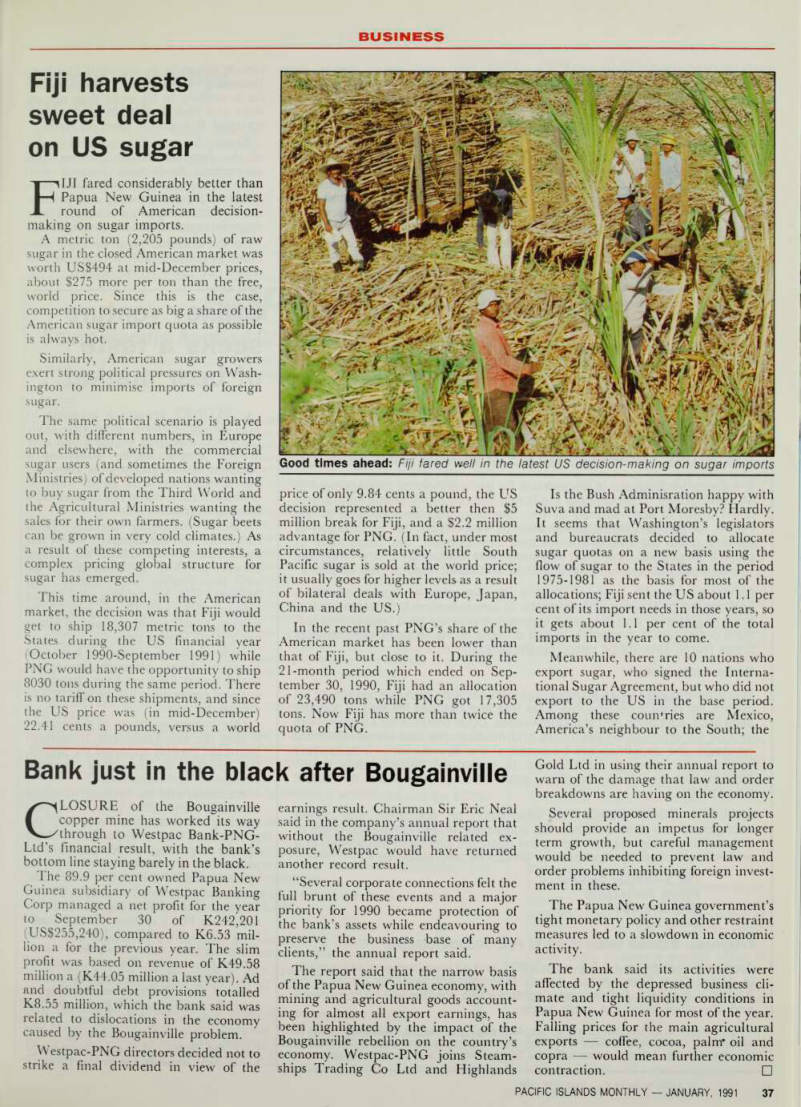
Good times ahead: Fiji fared well in the latest US decision-making on sugar imports
sorely troubled island of Haiti; and PNG.
The US State Department did not want these nations left out of the action, and set aside 80,300 metric tons for these 10 nations. Since it does not make economic sense to ship less than a boatload of sugar, these 10 nations are, in the eyes of Washington sugar people, the “boatload countries.” (A freighter can carry more than 8,030 tons of sugar, but this is the size of a boatload as defined
through governmental compromises.)
The new US sugar programme con tains another provision which might be useful to South Pacific sugar exporters.
Until this year, sugar quotas were absolute. From now on there will be an additional feature to the system sugar exporters can ship to the US if they are willing to pay a 16-cent a pound tariff.
Thus, if a 17-cent gap shows up between US and world prices, it would make sense for exporters to start shipping to the American market. (It costs about a penny a pound to ship and unload raw sugar.) The current price gap is about 12.5 cents.
A gloomy note: a serious crop failure, which would open the market wider to
South Pacific imports, is unlikely. Sugar
cane is grown in six scattered locations (including Hawaii), and a natural disas ter is unlikely to hit more than one of these at a time; further, sugar beets are scattered through the lower 48 states.
Finally, because of the political power of the American sugar growers, the government funds basic research and extensive technical assistance pro grammes for the growers, and permits the Florida cane growers to bring in low wage, foreign workers for manual labour.
So the domestic sugar industry con tinues to produce more product, and to crowd out Third World imports. □