Mums and daughters tackle politics
p. 16 · Read in the full issue
THERE are two intriguing sets of mothers and daughters prominent in public affairs in Micronesia.
In one case the mother is an elected member of the legislature and her daughter, a lawyer, is fighting against her mother’s own legislation in the courts. In the other, both women quietly run different kinds of social service organisations.
The first story is about Guam and the Arriola family, and the second is about Chuuk and the Mori family. The stories reflect the two quite different worlds of cosmopolitan Guam and less cosmopoli
tan Chuuk (formerly Truk).
Elizabeth Arriola, a Democrat, is one of Guam’s 21 senators. Re-elected to another two-year term in November, she is a senior member of the majority party.
Early in 1990 she introduced a com prehensive and drastic bill which would make all abortions illegal on Guam.
Among its provisions was one stating that it was a crime even to inform a pregnant woman that an abortion was one of the possibilities open to her. Urged on by the vigorous island Archbishop, the largely
Catholic Legislature passed Senator
Arriola’s bill unanimously.
Although Governor Joseph Ada’s
Attorney-General, Elizabeth Barrett- Andcrson, told him that the bill was unconstitutional, he signed it anyway, and the resulting furor was duly reported from Agana to New York City.
Enter Anita Arriola, the Senator’s Mainland-trained lawyer daughter. She called the bill to the attention of the American Civil Liberties Union, in New York, and with the help of that agency sued in federal district court to have her mother’s bill ruled unconstitutional.
Attorney Arriola beat Senator Arriola at the district court level abortions continue at the rate of about one per week on the island while the decision is being appealed to the US Circuit Court of Appeals in San Francisco. The case may wind up before the US Supreme Court, which has been showing signs of reversing its long-standing sup
port of abortion rights. Meanwhile, mother and daughter get along fine, but probably avoid talk on the abortion law.
Women are not only becoming ac tively involved in public policy issues, they are also becoming involved in the
political process.
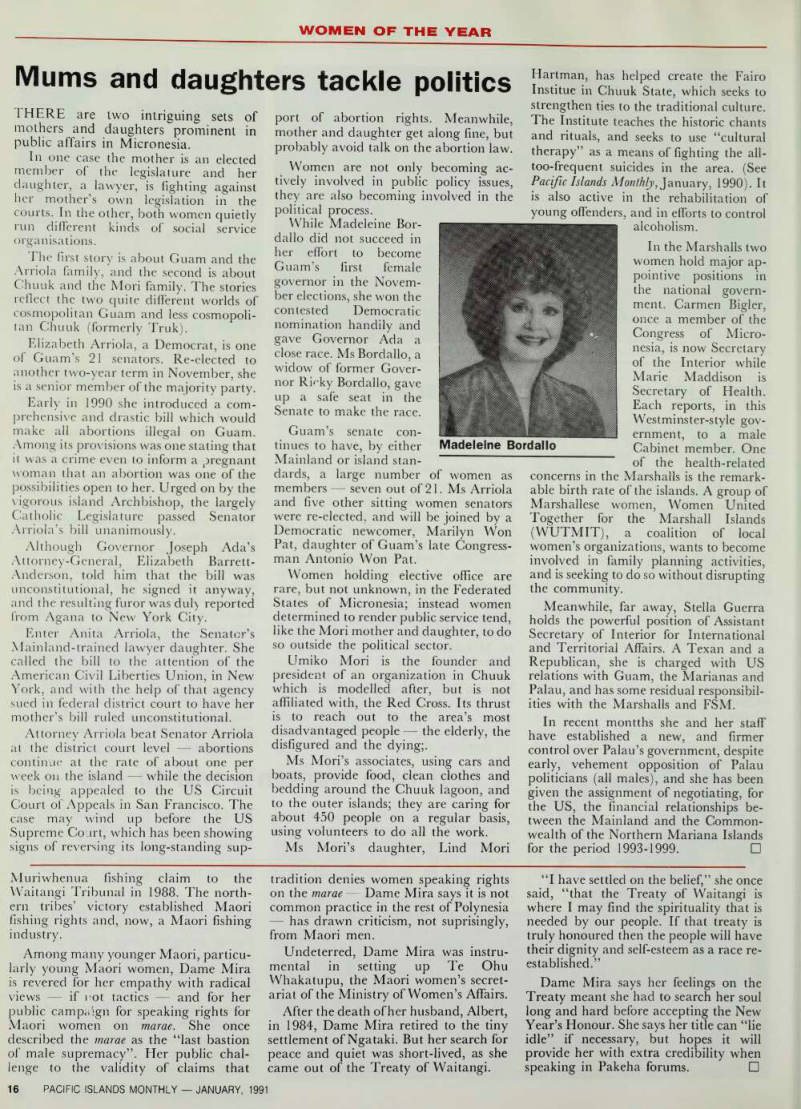
While Madeleine Bor dallo did not succeed in her effort to become Guam’s first female governor in the Novem ber elections, she won the contested Democratic nomination handily and gave Governor Ada a close race. Ms Bordallo, a widow of former Gover nor Bordallo, gave up a safe seat in the Senate to make the race.
Guam’s senate con tinues to have, by either Mainland or island stan
dards, a large number of women as members seven out of 21. Ms Arriola and five other sitting women senators were re-elected, and will be joined by a Democratic newcomer, Marilyn Won Pat, daughter of Guam’s late Congress man Antonio Won Pat.
Women holding elective office are rare, but not unknown, in the Federated States of Micronesia; instead women determined to render public service tend, like the Mori mother and daughter, to do so outside the political sector.
Umiko Mori is the founder and president of an organization in Chuuk which is modelled after, but is not affiliated with, the Red Cross. Its thrust is to reach out to the area’s most disadvantaged people the elderly, the disfigured and the dying;.
Ms Mori’s associates, using cars and boats, provide food, clean clothes and bedding around the Chuuk lagoon, and to the outer islands; they are caring for about 450 people on a regular basis, using volunteers to do all the work.
Ms Mori’s daughter, Lind Mori
Hartman, has helped create the Fairo Institue in Chuuk State, which seeks to strengthen ties to the traditional culture.
The Institute teaches the historic chants and rituals, and seeks to use “cultural therapy” as a means of fighting the all too-frequent suicides in the area. (See Pacific Islands Monthly, January, 1990). It is also active in the rehabilitation of young offenders, and in efforts to control
alcoholism.
In the Marshalls two women hold major ap pointive positions in the national govern ment. Carmen Bigler, once a member of the Congress of Micro nesia, is now Secretary of the Interior while Marie Maddison is Secretary of Health.
Each reports, in this
Westminster-style gov
ernment, to a male Cabinet member. One of the health-related
concerns in the Marshalls is the remark able birth rate of the islands. A group of Marshallese women, Women United Together for the Marshall Islands (WUTMIT), a coalition of local women’s organizations, wants to become involved in family planning activities, and is seeking to do so without disrupting the community.
Meanwhile, far away, Stella Guerra holds the powerful position of Assistant Secretary of Interior for International and Territorial Affairs. A Texan and a Republican, she is charged with US relations with Guam, the Marianas and Palau, and has some residual responsibil ities with the Marshalls and FSM.
In recent montths she and her staff have established a new, and firmer control over Palau’s government, despite early, vehement opposition of Palau politicians (all males), and she has been given the assignment of negotiating, for the US, the financial relationships be tween the Mainland and the Common wealth of the Northern Mariana Islands for the period 1993-1999. □
Madeleine Bordallo