Pacific
pp. 35-36 · Read in the full issue
Islands
Monthly
Business
Building a tax heaven
Vanuatu reviews its tax laws
VANUATU is about to bring its offshore financial laws up to date.
The country pioneered the tax haven role in the Pacific back in 1971 when it was still the British-French condo minium of New Hebrides. The legislation enacted then remains largely intact. The problem is the international finance mar ket has grown and has become far more sophisticated.
The laws governing offshore financial transactions through Port Vila cannot cope with
subsequently developed
financial instruments such as dividend stripping or interest rate swaps. There are also substantial changes in the
European Community as 1992
approaches. For example, the French civil code changes in clude the provision for trusts to exist.
The tax haven business is also a lot more competitive these days, and Vanuatu has to
keep pace with the Cayman Islands, Turk and Caicos Islands, Bermuda, Luxembourg, Gibralter, Isle of Man, Leichtenstein and closer to home the Cook Islands, Tonga, Western Samoa and Nauru.
The other South Pacific offshore centres are far more recent creations than Vanuatu, and their laws are conse quently more up to date. They are also Vanuatu’s main competitors, being in the same general time zone (although the
Cook Islands did come in for some bad publicity when an Australian television programme linked it to the tottering Bond Corporation, of Perth), The island states are best placed to service Asian customers, as the Carribean and European havens have the advantage in Europe and North America, simply because of their time zones.
Vanuatu’s Finance Minister, Sela
Molisa, has announced that the govern ment in Port Vila has begun a compre hensive review of the country’s offshore finance centre legislation. He said the time was right for a fundamental review of the entire legislative framework, in consultation with the local business community. The minister said the out come of the review would be a new and up to date package introduced in stages over the next 12 to 18 months, and would be designed to make Vanuatu competi
tive and attractive as an offshore financial centre for the 19905. The package is likely to include an Inter national Trust Act, an International Business Companies Act and new off shore banking and insurance legislation.
It is also expected that the legislation will include new provisions relating to con fidentiality.
Port Vila’s offshore finance centre now includes about 1400 companies and 100 banks. Those which conduct their busi ness activities outside the country pay no personal or corporate taxes, no estate or gift duties, no capital gains taxes.
Vanuatu has no exchange controls nor tax treaties. The centre employs about 400 people and accounts for about 12 per cent of Vanuatu’s gross domestic prod uct.
The country’s shipping registry has
done especially well since the two main flag-of convenience nations Liberia and Panama became embroiled in war and civil disorder. In the last few years, the number of vessels registered in Port Vila has jumped from 100 to about 600.
The executive chairman of Vanuatu’s largest trust company said the problem there is that all the nation’s corporate laws are bound up in one act. Pacific Inter
national Trust Company Ltd’s Tom Bayer told Pacific Islands Monthly that the new laws would separate local and offshore business regulations. He said that Vanuatu would be looking to attract more Asian business and, despite the time zone problem, a bigger share of European offshore business. The appeal would be for investors to distribute their wealth in different parts of the world.
Finding new business is important since the Australian and New Zealand
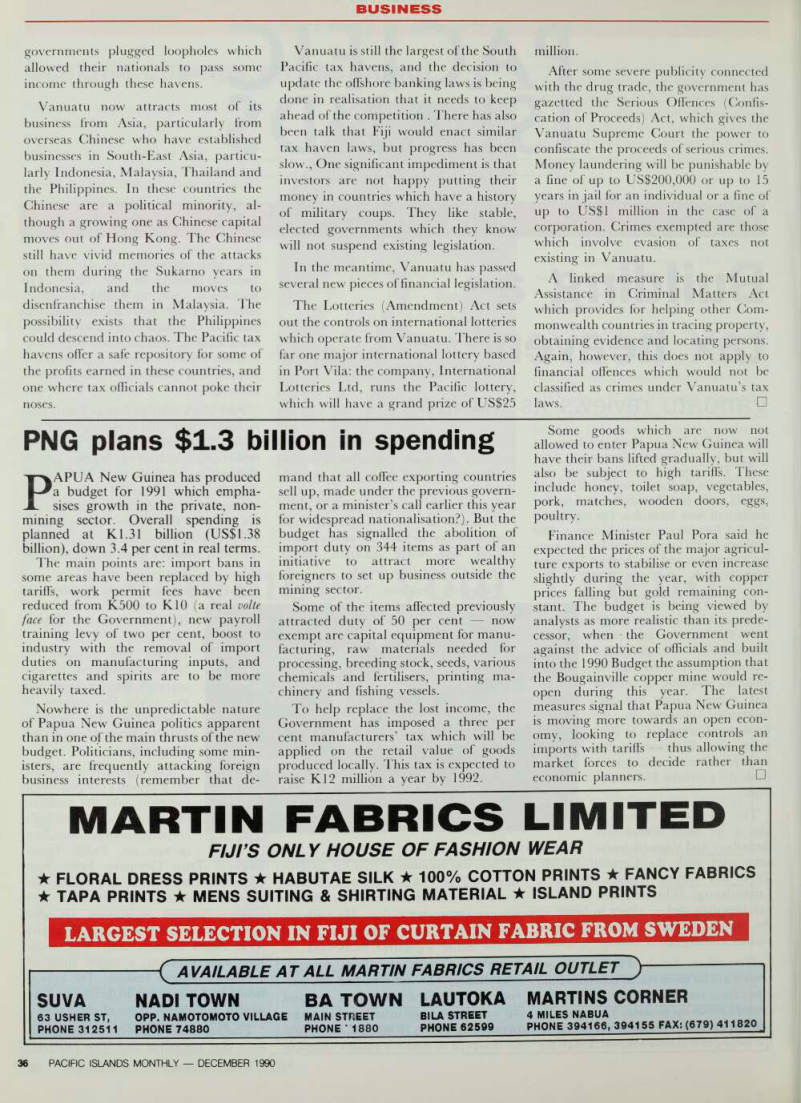
Port Vila: biggest tax haven in the Pacific
Philippe Metois
governments plugged loopholes which allowed their nationals to pass some income through these havens.
Vanuatu now attracts most of its business from Asia, particularly from overseas Chinese who have established businesses in South-East Asia, particu larly Indonesia, Malaysia, Thailand and the Philippines. In these countries the Chinese are a political minority, al though a growing one as Chinese capital moves out of Hong Kong. The Chinese still have vivid memories of the attacks on them during the Sukarno years in Indonesia, and the moves to disenfranchise them in Malaysia. The possibility exists that the Philippines could descend into chaos. The Pacific tax havens offer a safe repository for some of the profits earned in these countries, and one where tax officials cannot poke their noses.
Vanuatu is still the largest of the South Pacific tax havens, and the decision to update the offshore banking laws is being done in realisation that it needs to keep ahead of the competition . There has also been talk that Fiji would enact similar tax haven laws, but progress has been slow., One significant impediment is that investors are not happy putting their money in countries which have a history of military coups. They like stable, elected governments which they know
will not suspend existing legislation.
In the meantime, Vanuatu has passed several new pieces of financial legislation.
The Lotteries (Amendment) Act sets out the controls on international lotteries which operate from Vanuatu. There is so far one major international lottery based in Port Vila: the company, International Lotteries Ltd, runs the Pacific lottery, which will have a grand prize of US$25
million.
After some severe publicity connected with the drug trade, the government has gazetted the Serious Offences (Confis cation of Proceeds) Act, which gives the Vanuatu Supreme Court the power to confiscate the proceeds of serious crimes.
Money laundering will be punishable by
a fine of up to US$2OO,OOO or up to 15 years in jail for an individual or a fine of up to US$l million in the case of a corporation. Crimes exempted are those which involve evasion of taxes not existing in Vanuatu.
A linked measure is the Mutual Assistance in Criminal Matters Act which provides for helping other Com monwealth countries in tracing property, obtaining evidence and locating persons.
Again, however, this does not apply to financial offences which would not be classified as crimes under Vanuatu’s tax laws. □