Amazing
pp. 25-33 · Read in the full issue
Papua New Guinea
BtfChris Ashton
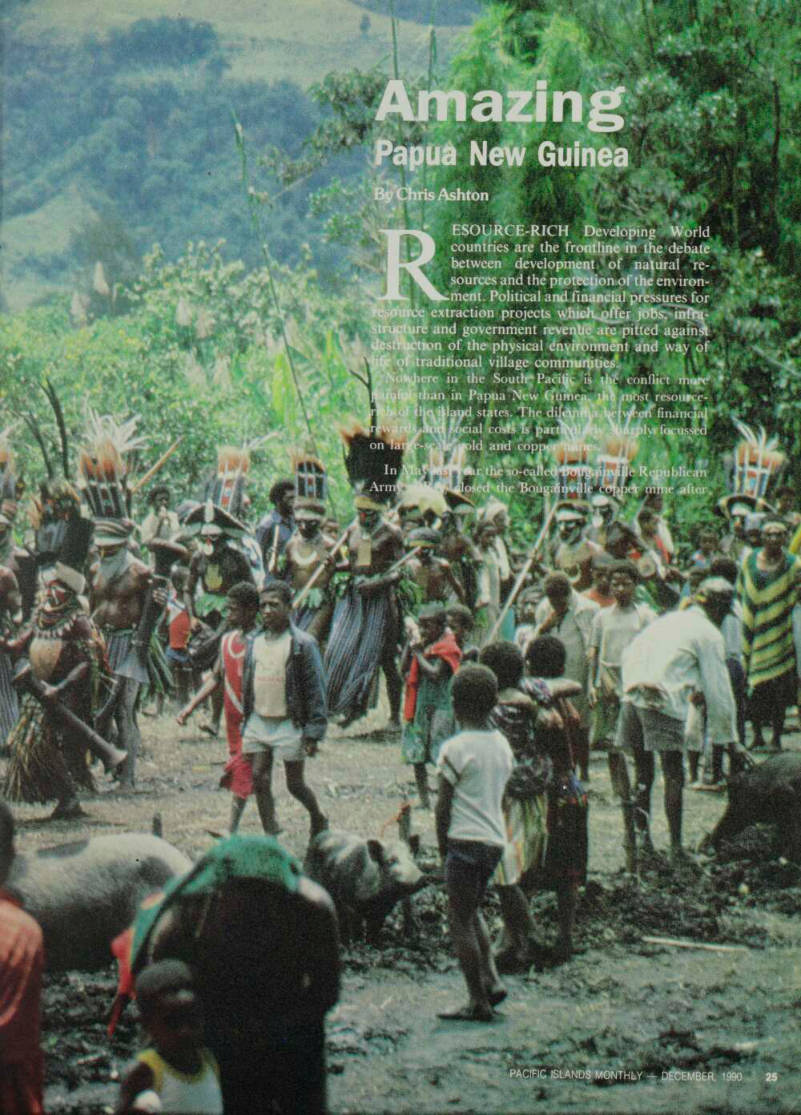
ESOURCE-RICH Developing World r £M countries are the frontline in the debate between development of natural re sources and the protection of the environ- Political and financial pressures for extraction projects jbBs;Miifh|wernment revenue are pitted against ic physical dnvironment and way of il village com murti ties* 4 \ 1 ie South* PaciJ|£ is conflict apua New ffumca, the mbst resoupce states. The financja| il cosfS fs Ic^usscd
ecNtlje aft or J'
17 years’ operation. It was expected to contribute 19 per cent of the PNG Government’s revenue and 36 per cent of export income in 1989. Its loss has forced the Government to pare back spending programmes to the bone.
The anger of Bougainvillean land owners at the despoliation of the Jaba River, into which mining tailings were discharged, was a key factor in support for the BRA by the people of South Bougainville against the Government.
Subsistence village communities along the Fly River are likewise dismayed by Port Moresby’s approval in October last year for the Ok Tedi mining consortium
to continue discharging mineral wastes into the Fly, Goverment revenue from Ok Tedi over the next 20 years is a projected AS 1000 million. The Ok Tedi mining consortium argues, and no-one disputes its figures, that if ordered to build a tailings dam, (estimated cost AS 1.3 billion), the mine would have to close because it could never recover its costs.
Australian conservationists are now worried that toxic mineral wastes dis charged from the Fly, (from the Porgera gold mine as well as Ok Tedi), will threaten marine life in the Torres Strait Islands and Great Barrier Reef.
The stakes are smaller for PNG’s logging industry, which provides 22 per cent or Kl3O million a year in export income. But the quandry is the same.
Uncontrolled logging and abuse of agreements by timber companies with local landowners have transformed tracts of dense rainforest into wasteland. Cash benefits to landowning groups have been negligible. In April the PNG Govern ment announced a two-year moratorium on all further logging, and is now seeking AS 100 million compensation from West ern government and international agencies which have pressed PNG to conserve its rainforests.
The financial benefits foregone in resource development are easily measured but the social, aesthetic and spiritual costs to traditional communities and the world at large from the destruc tion of pristine physical environment for the sake of resource projects can’t be reduced to dollars and cents.
The celebration of PNG’s precious, even unique, physical environment and the case for its protection is argued with eloquence and passion by Jean-Michael Cousteau in a book describing an expedition he led to PNG in 1988, Cousteau's Papua New Guinea Journey.
Jean-Michel is the son of the famous French diver, Jacques Cousteau, marine
explorer, author and photographer
whose books and films for the past 40 years have brought the wonders of the deep to millions, son Jean-Michel is the vice-president of The Cousteau Society, a non-profit corporation with 340,000 members worldwide. It has offices in Europe and the US to promote the protection of Planet Earth.
On the eve of their departure Jean- Michel wrote: “As we contemplate a survey of Papua New Guinea, we realise an uncommon opportunity lies before us to peer into and document a province of
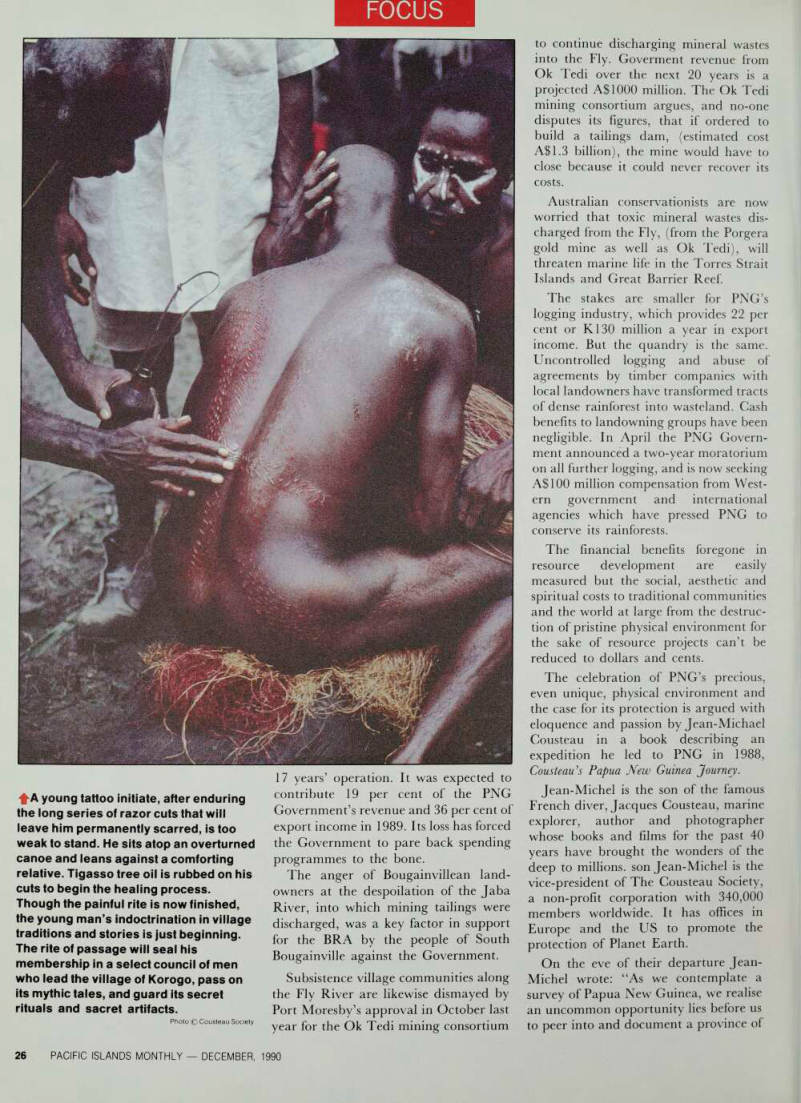
A young tattoo initiate, after enduring the long series of razor cuts that will leave him permanently scarred, is too weak to stand. He sits atop an overturned canoe and leans against a comforting relative. Tigasso tree oil is rubbed on his cuts to begin the healing process.
Though the painful rite is now finished, the young man’s indoctrination in village traditions and stories is just beginning.
The rite of passage will seal his membership in a select council of men who lead the village of Korogo, pass on its mythic tales, and guard its secret rituals and sacret artifacts.
Photo © Cousteau Society
the sea uniquely undistorted by the modern world, and a people perhaps still as intimately in touch with their natural surroundings as our earliest forebears.
“The environment, like the cultures within it, is unique. Papua New Guine is a biological crossroads, where species from Australia and Asia mingle, and where this evolutionary mixture across the aeons has produced creatures found nowhere else.”
To promote awareness of PNG’s natural assets to a worldwide television audience of hundreds of millions, The Cousteau Society is collaborating in a three-part television co-production with Turner Broadcasting Systems Inc., based in Atlanta, as part of 27-hour documen tary series, Cousteau's Rediscovery of the World.
PNG plays a key role. Why? Partly because 51-year-old Jean-Michel, in heriting his father’s passion for diving, has conducted a 15-year long-distance love affair with PNG, expressed in periodic diving expeditions. The 1988 project to film its maritime, terrestial and cultural treasures was a tribute to that affair.
The Cousteau Society doesn’t do anything by halves. The expedition involved a flotilla of two diving ships, Jacques Cousteau’s World War II con verted minesweeper, Calypso and a turbo sail windship, Alcyone ; an amphibious light plane and helicopter; several Zodiacs and two four-wheel drive vehicle trucks hired for an overland expedition to the Southern Highlands; three diving teams, film crews, scientists, air-and boat-crews, producers, planners and still photographers. Some 45 team members, mostly French and Americans, were assembled by the journey’s end, includ
ing the patron, Jacques. It must have cost squillions.
Its purpose was twofold: to celebrate the physical environment and traditional cultures of the largest South Pacific island state; and to blow the whistle on the threat to their destruction in the name of development.
“So often in our travels through developing countries we have come across the assumption that the environ ment and progress are odds and the perceived needs of the impoverished and expanding human population must take
precedence,” Jean-Michel writes. “It
invariably serves as an excuse to trade a parcel of nature evolved over millions of years, woven of organic linkages than can never be reconstructed, for quick profits.
“Sometimes the economic gains pro vide a temporary stimulus to the local standard of living, and sometimes the benefits accrue only to faraway share holders with no knowledge of their
impact.”
He feels strongly that governments seldom appeciated the true value of forests and maritime habitats. “For the villagers of Papua New Guinea, undevel
oped forests provide food, clothing,
medicines, building materials, tools and implements, boats, ornaments and other products. They also provide an invaluable sense of belonging in time and space and a spiritual fulfillment, all without money.
“Where the forest has been developed on the other hand, it provies only money.
But the money must be spent to replace the free services eliminated when the forest was cut. The independence once secured by self-sufficiency, ensured by the free goods of the forest, gives way to
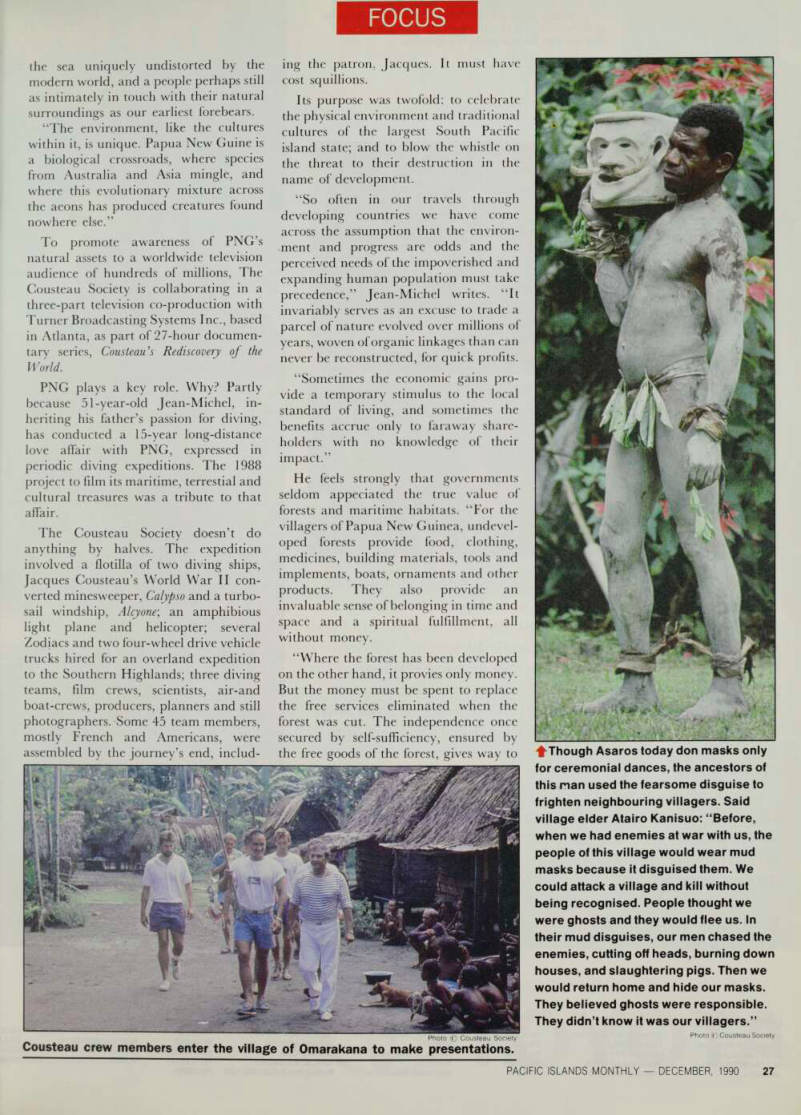
Photo © Cousteau Society Cousteau crew members enter the village of Omarakana to make presentations.
Though Asaros today don masks only for ceremonial dances, the ancestors of this man used the fearsome disguise to frighten neighbouring villagers. Said village elder Atairo Kanisuo: “Before, when we had enemies at war with us, the people of this village would wear mud masks because it disguised them. We could attack a village and kill without being recognised. People thought we were ghosts and they would flee us. In their mud disguises, our men chased the enemies, cutting off heads, burning down houses, and slaughtering pigs. Then we would return home and hide our masks.
They believed ghosts were responsible.
They didn’t know it was our villagers."
Photo [?] Cousteau Society
a new dependence on the outside world as well as spiritual, economic and family disorientation.
“When efforts to improve a society lead to destruction of the envelope of nature that has long sustained it, the society is not helped but harmed. The only legitimate paths to progress lie in developments that combine economic
enhancement with environmetal preser vation. To think the two are separate issues is to ignore the human pre dicament: we lead our lives in a womb of nature, as dependent on the health of our eco sphere around us as an unborn infant on the nurturing system of its mother’s body.”
Cousteau is part of that Western
tradition, with philosopher Jean-Jacques
Rousseau, author Robert Louis Stevenson and artist Paul Gaughin before him, for whom tribal peoples, (especially in the South Sea Isles), represent the childlike innocence of all mankind before the Fall. In Rousseau’s words, are “Noble Savages” inhabiting tropical Gardens of Eden untainted by the woes of modern man.
“We are mazed by the villagers’ encyclopaedic knowledge of the sur rounding environment,” he writes.
“Every item necessary to survival, per haps even to happiness, can be drawn from land, forest or sea. Perhaps it takes village men longer to cross an ocean strait in an outrigger canoe propelleed by a pandanus sail than it takes us in our motor vessel. But the speed of such a trip may be irrelevant in a world ungoverned by clocks, unstressed by deadlines other
Bougainville's Panguna copper mine is one of the largest man-made holes in the world. The immense pit was excavated by four-storey high shovels that can scoop 22 tons of ore. The dump trucks at the bottom of the picture can haul 150 tons of rock. There’s no indication when the mine might re-open.
Photo © Cousteau Society
Photo Cousteau Society Huts of Rossel Islanders sit at the edge of a backwater rich in organic matter from adjacent rain-forest
Melpa wigmen in the village of Kindau begin the "payback" cer emony beating the tra ditionaldrums called kundus. Their head dresses are woven of buman hair supplied by village women. By cus tom, Melpa men are costumed to create a "dark" effect, Melpa women to achieve a "bright" effect.
than those imposed by nature by rhythms of daylight and dark, by the directions of the wind, by the pulse of the seasons.” Nostalgia for Paradise Lost is frequently voiced by the so-called en lightened urban middle-class of the Western world, but it carries its own quandry. Cousteau is the executive head of a multi-million dollar conservation group. Based in Los Angeles, he jets across the world making television films, promoting the Cousteau cause on the lecture circuit, and making brief forays, supported by space-age technology, to primeval forests and uncharted reefs to
record the spiritual bonds between tribal and modern man. His own drive to improve his lot beyond that of his forebears is no different from that of the Melanesian villager.
To his credit, he admits doubts. “I think of villagers we have met on this expedition, their lives embedded in a world romantically thought of as Para dise. Surely there is no more universal human fantasy than the idea of escaping to the carefree, sun-drenched, sea refreshed life of a tropical island in the South Seas. But the people who are born to this dream, who know little else of the
In baramba, children learn at an early age to travel and play In canoes, quickly becoming so adept they can paddle while standing. Unable to raise sufficient food in the surrounding swamps, Kambaramba has sustained itself over the years with a unique barter system. In exchange for goods from other villages, Kambaramba operates Several brothels. Photo © ousteau Society
planet and who have few opportunities to travel beyond neighbouring islands: Are they “happy”? Are they fulfilled? Or do they yearn to “escape” to a faster pace and a materially richer world?”
He doesn’t try to resolve the contradic tions, but his heart is in the right place.
If the book strikes the odd jarring note it is due rather to his co-author, Mose Richards, senior producer and script writer for the Cousteau Society and apparently recipient of a swag of TV awards.
Richards echoes Cousteau’s awe at PNG’s physical beauty; at the integrity of its village culture; and his dismay at the physical and spiritual encroachment of the modern world. But his blow-by blow account of the expedition, alternat ing with Cousteau’s reflections, reveals him finally as a product of Los Angeles, shaped by the motion picture capital of the world.
We follow the Cousteau team as it criss-crosses the country by ship, plane, chopper and 4WD vehicle filming com pensation and bride-price ceremonies, shark-callers, initiation rites, mining and logging projects. PNG serves as an exotic backdrop for Richard’s central drama: the human and logistical and challenges posed by the bountry, and the triumps over them by the Cousteau team, heroes
of an adventure yarn recounted in breathless present-tense prose from start to finish.
There are errors of detail. He puts the Islander Hotel in the Port Moresby suburb of Boroko instead of Gordon/ Hohola, and muddles the contributions of Mick Leahy’s brothers Jim, Dan and Pat -in pioneering coffee-growing in the Highlands.
The name Papua, he says, derives from the Dutch word for fuzzy-haired, a legacy of its 16th century explorers. No.
It’s Malay, from Orang Papuwah (fuzzy haired man), and was first attributed to the island of New Guinea in 1526 by the Portugeuse governor of the Moluccas.
The book of the expedition is well served by its 178 colour plates. Com pared with those of many other picture books celebrating this most photogenic of countries, the best of them stand up very well indeed.
For al Cousteau’s exhortations to Papua New Guineas not to do as he does, but to do as he says, his warning against the siren call of Western consumer culture cannot be dismissed: “The young nation has inherited a vast natural fortune and must now educate itself intensely in order to manage this wealth in the wisest way.
The riches could be squandered or lost to
outsiders, or they could be husbanded and invested to sustain the nation far into the future.
“There are two enormous challenges to anyone who would try to turn these re sources into cash. The first is simply to devise ways of
extracting massive quantities
of timber or sea-life without disrupting the fragile webs of nature they help to support.
“The other is to exploit the forests and fisheries in new ways without eliminating the traditional resources of people. To proceed with
rapid exploitation before
finding solutions to these problems is to jeopardise the environmental legacy of Papua New Guinea’s future generations.” □
Shark-calling can be a perilous of obtaining food if a fisherman is not careful. Violent struggle often ensue when a shark is caught in a fisherman’s hoop. To be certain his catch will not continue its battle when pulled into the small outrigger, the captor dispatches he creature with a hardwood club. On several Papua New Guinea islands, ishermen use coconut-shell rattles to attract (“call”) sharks and vine lassoes [? ] pull them in. Photo © Cousteau Society