The new wave
pp. 20-21 · Read in the full issue
The Gulf crisis increases the need for alternative energy sources
THE South Pacific Applied Geoscience Commission (SOPAC) is now interested in seeking Nor wegian sponsorship for ocean wave energy research in the Pacific Islands. SOPAC Director Jioji Kotobalavu, sought support for the move from Pacific delegations attending the Pacific Islands 2000 Marine Energy and Mineral Resources Conference in Suva last month.
Norway, a pioneer in using ocean
waves to provide energy, has established plants in Norway and other European countries, and has been researching the feasibility for Pacific countries.
Dr Michael Lawrence, Manager of the Regional Petroleum Unit of the Forum Secretariat, said the Pacific Islands could save approximately US$4O million per year, if they switched from 97 Octane Fuel to 92 Octane Fuel, In most Pacific Island countries, 97 Octane Fuel costs US9OO per gallon, while 92 Octane Fuel costs US77£ per gallon. Lawrence, how ever, pointed out that this does not apply for diesel fuel, which is used widely in the region.
The Forum countries use approximately 25,000 barrels of oil a day; Papua New Guinea and Fiji use 21,700 barrels, and the rest use 3300 barrels. Papua New Guinea is expected to begin exporting oil in the near future, but Fiji will have to continue importing oil. The octane switch might provide Fiji
with an opportunity to reduce the importation of oil.
SOPAC’s Deputy Director, Dr James Eade, said that Fiji, Tonga, Solomon Islands, and Vanuatu, all have the potential for oil and gas finds. In fact there have been several oil “seeps” of bio grade crude oil discovered in Tonga. Dr Eade said that multi-million dollar funded exploratory programmes to search out oil in the Pacific Islands region is currently being drafted. The results of
the programme find ings will decide future explorations.
One of the most promising methods of harnessing ocean en ergy is Ocean Thermal Energy Conversion (OTEC). This taps the large percentage of so lar energy absorbed by the ocean by using the water temperature dif ferences to drive elec tricity producing tur bines for approximately 5 to 10 megawatts of power roughly what is needed by most Pa cific Islands villages.
The process also pro duces fresh water
through condensation, chilled water for air conditioning units, water for plants, and nutrient-rich water for growing algae and fish farming.
Dr Thomas Daniel, Scientific Direc tor, National Energy Laboratory of Hawaii, said OTEC can produce hydro gen (through electrolysis) which is ex pected to be a major source of energy in the future. An OTEC plant could be in operation nine months after an order is received in Hawaii, said Dr Danaiel.
However, the Project Manager of the
United Nations Energy Development
Program, Dr Peter Johnston, differed from other ocean energy experts at the meeting. He said “that new ocean energy research techniques will not provide sufficient results for Pacific countries in the near future.” He said that Pacific nations do not have the infrastructure to start new technology products and do
not have enough people to success fully operate such
technologies. He
recommended that the Pacific conserve energy by reducing demand for gener ated electricity to meet their future energy needs.
The Cook Islands is installing solar power appliances on two northern islands with funding from Tahiti and France. Cooks Deputy Prime Min ister and Minister for Energy, Intio Akaruru, said his
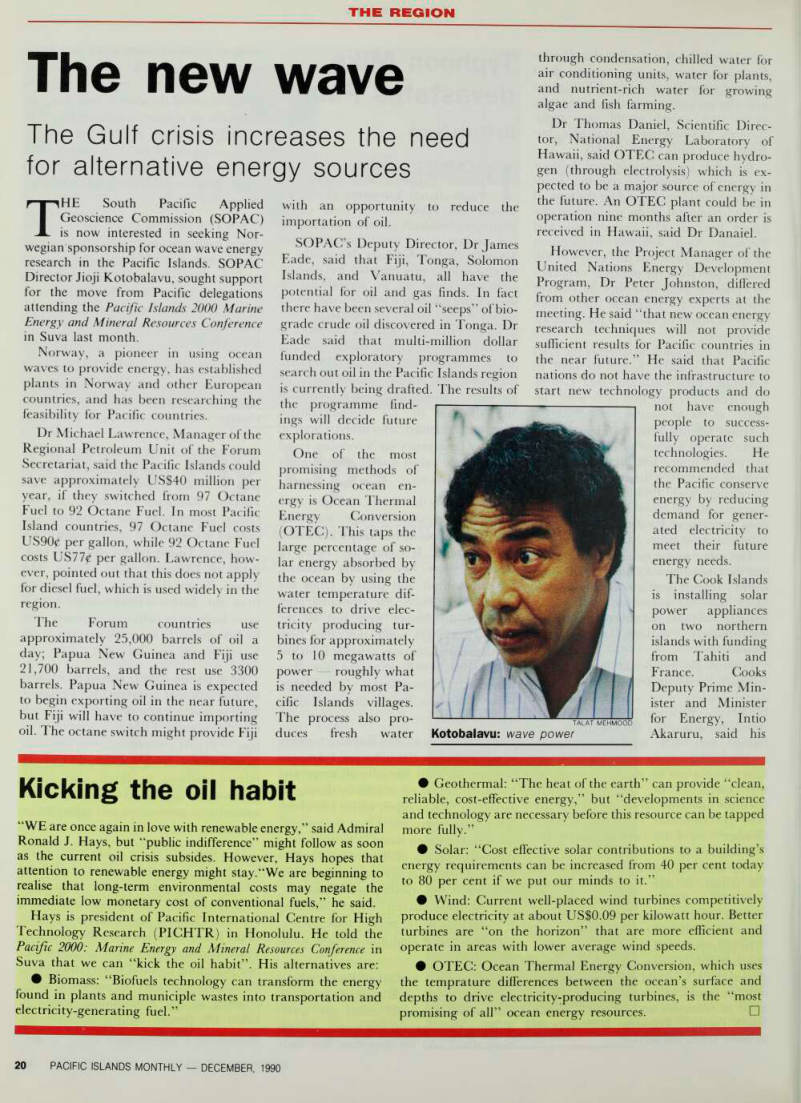
Talat Mehmood
Kotobalavu: wave power
country’s outer islands electricity costs are far greater than in Rarotonga. The Cook Islands uses profits from the Rarotonga system to subsidise electrical costs in the outer islands.
“The earning capacity in some other islands is almost nil,” he said, adding that outer islands’ electrical systems are operating at increased cost. Last year Rarotonga managed to bring in $389,950 above costs, but the outer islands tallied a $1,239,750 loss.
Nauru’s Vinci Clodumar, Minister of Health and Education, said his nation spends of most of her energy extracting moisture from phosphate, from 20 per cent to 3 per cent, before it is sold.
Kiribati’s Minister for Natural Re source Development, Taomati luta, said their major economic resources include copra, salt, fish, and foreign aid. Copra is a declining industry; salt is not selling well; fish prices are controlled by the buyers and the national fishing company is losing money because of high costs.
Foreign aid is the only profitable “re source”. Kiribati has two aid policies; • aid requested must be for pro ductive projects; and • the project must be sustainable by Kiribati over the long term.
Western Samoa’s Finance Minister, Tuilaepa Sailele, said the Middle East crisis has made energy the highest priority in his country. His country is developing hydropower and will look further at solar possibilities. He warned: “Alternative energy sources could look relatively cheap, but without proper maintenance, over the long run they could turn out more costly.”
Brown Saua, Manager of the Invest ment Corporation of the Solomon Islands, said the oil crisis “is not really a supply problem; it’s a price problem.”
He noted that oil prices have gone up at the same time as the Solomon’s currency has been going down, making price increases extra steep. There has already been some fuel rationing in the Solomon Islands and the country is proceeding with plans to develop hydropower.
Federated States of Micronesia Sena tor, Jacob Nena, ofKosrae, said fuel costs have increased from $1.25 to $2.25 per gallon since the Gulf Crisis began. This affects the transportation of food and people throughout FSM, and greatly increases government costs. Nine 9 per cent of FSM’s electricity is from diesel generators, and the government bears most of the cost. There is interest in expanding hydropower, which supplies 10 per cent of the energy needs. □