Read my Lips
pp. 18-19 · Read in the full issue
President Bush makes new commitment in significant shift of US islands policy
By Jemima Garrett
LEADERS from 11 Pacific nations were welcomed to the first US- Pacific Islands summit with much fanfare. Overhead a Black Hawke military helicopter hovered. The hills surrounding the Honolulu-based East West Centre, where the summit took place, were swarm ing with security men and, to complete the all-American scene, at least one security officer could be seen nonchalantly talking into the sieve of his pinstriped suit.
At the John F. Kennedy Centre each Pacific leader was greeted by the strains of their national anthem and personally welcomed by US President George Bush.
With only two hours set aside for formal business the summit was probably the shortest in history. Despite that it provided an opportunity for some signifi cant steps to be made particularly on the economic front.
President Bush announced five new economic and educational initiatives, some of which were things island leaders have been wanting for a number of years.
These include: • a Joint Commercial Commission
with the Island nations to meet each year at senior government level to identify and address trade opportunities and concerns. • The Overseas Private Investment Corporation (OPIC) to establish an Asian-Pacific Growth Fund and an
Environmental Invest ment Fund, to assist private sector and natural resource de velopment. OPIC will also lead a mission of American investors to Pacific Islands countries in 1991. A plan to begin negotiations to extend the US-South Pacific
Regional Fisheries
Treaty. This initiative comes in responsse to the decision by many
large US tuna canning
companies to sell only
dolphin-free tuna (fish
that has not been
caught by methods
which also kill dol
phins). • the addition ofA.I.D. private sector assistance programmes to enhance agri cultural and marine resource develop ment. • three new educational exchange programmes, including progrmmes for cabinet and sub-cabinet level officials to visit the US, and the extension of the APEC Partnership for Education initiat ive to includde Island nations.
These initiatives were welcomed by the Pacific Islands leaders. Conference spokesman, Cook Islands Prime Minister Geoffrey Henry, said the leaders were particularly enthusiastic about the future and the promise of the Commercial Commission which, he said, had been widely perceived as a forum which could eventually create a venue for the regular ministerial or even Prime Ministerial contact the leaders had sought from the summit.
One of the biggest problems for the Pacific Islands, in the past, had been translating these sort of intiatives into on going productive investment. As with previous initiatives the proof of the pudding will be in the eating.
Probably the most significant gain from the summit was simply attention to Pacific Islands concerns at the highest level. Over the past decade relations between the United States and the Island nations have not been smooth sailing. In the early eighties, a dispute over the ownership of the region’s tuna was dubbed ‘the tuna wars’ after small island nations impouded US boats for poach ing. Washington responded by imposing trade sanctions.
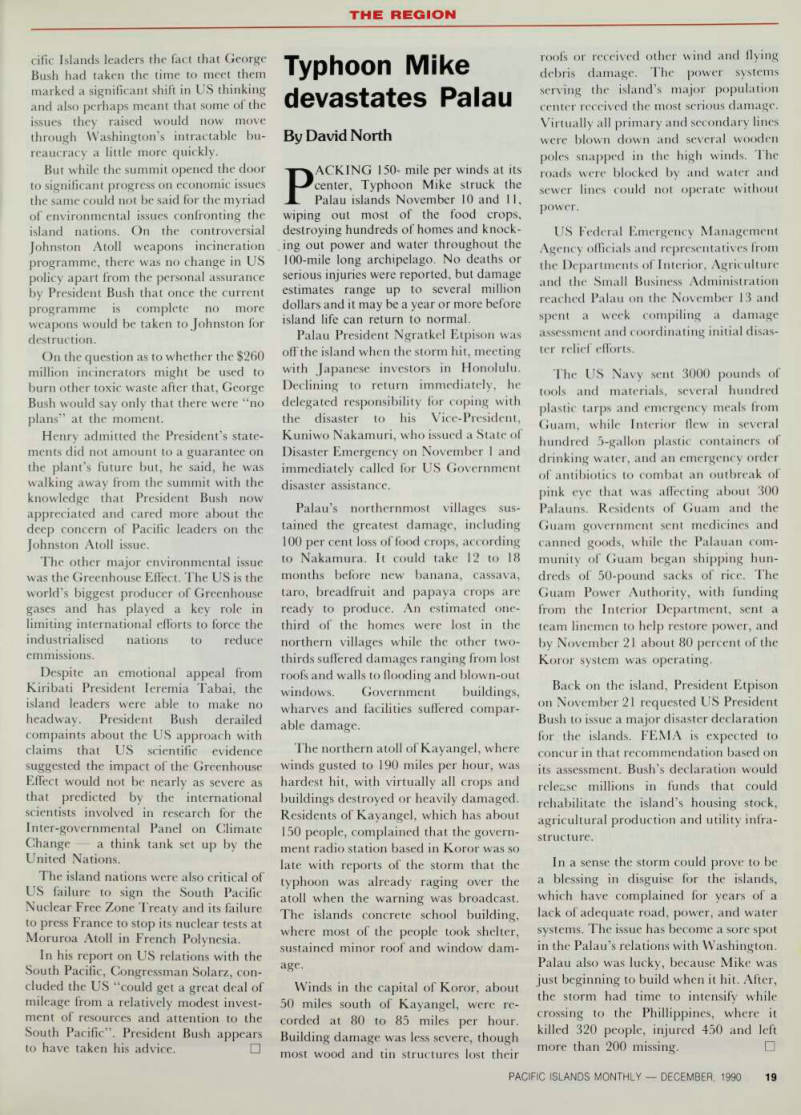
That overbear ing approach and failure to consult has again been in evidence, recently, over Washington’s plans to incinerate chemical weapons on Johnston Atoll.
A recent report on US relations with the region, by high
profile Democrat
congressman Stephen Solarz, ad mitted the goodwill towards the US left over from the Second World War, was being
rapidly drawn
down. For most Pa
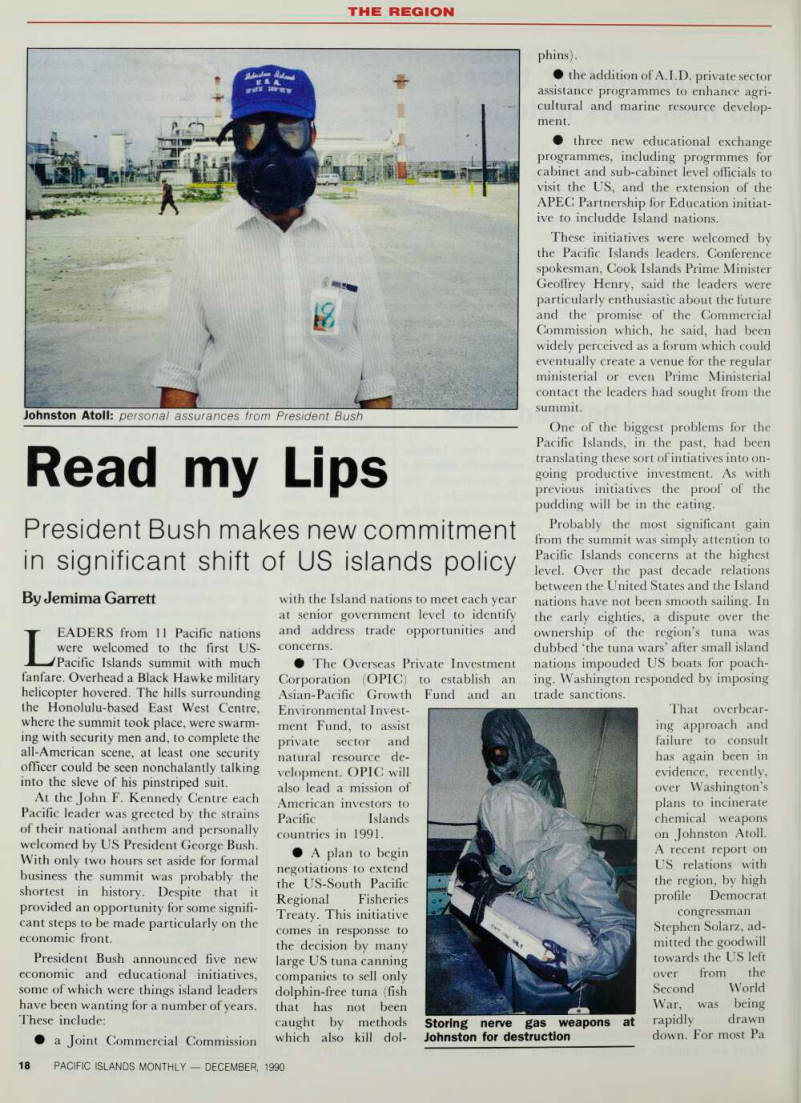
Johnston Atoll: personal assurances from President Bush
Storing nerve gas weapons at Johnston for destruction
cific Islands leaders the fact that George Bush had taken the time to meet them marked a significant shift in US thinking and also perhaps meant that some of the issues they raised would now move
through Washington’s intractable bu
reaucracy a little more quickly.
But while the summit opened the door to significant progress on economic issues the same could not be said for the myriad of environmental issues confronting the island nations. On the controversial Johnston Atoll weapons incineration programme, there was no change in US policy apart from the personal assurance by President Bush that once the current programme is complete no more weapons would be taken to Johnston for destruction.
On the question as to whether the $260 million incinerators might be used to burn other toxic waste after that, George Bush would say only that there were “no plans” at the moment.
Henry admitted the President’s state ments did not amount to a guarantee on the plant’s future but, he said, he was walking away from the summit with the knowledge that President Bush now appreciated and cared more about the deep concern of Pacific leaders on the Johnston Atoll issue.
The other major environmental issue was the Greenhouse Effect. The US is the world’s biggest producer of Greenhouse gases and has played a key role in limiting international efforts to force the industrialised nations to reduce emmissions.
Despite an emotional appeal from Kiribati President leremia Tabai, the island leaders were able to make no headway. President Bush derailed compaints about the US approach with claims that US scientific evidence suggested the impact of the Greenhouse Effect would not be nearly as severe as that predicted by the international scientists involved in research for the Inter-governmental Panel on Climate Change a think tank set up by the United Nations.
The island nations were also critical of US failure to sign the South Pacific Nuclear Free Zone Treaty and its failure to press France to stop its nuclear tests at Moruroa Atoll in French Polynesia.
In his report on US relations with the South Pacific, Congressman Solarz, con cluded the US “could get a great deal of mileage from a relatively modest invest ment of resources and attention to the South Pacific”. President Bush appears to have taken his advice. □