condemned
pp. 14-16 · Read in the full issue
Watchman condemned U.S. faces more unpopularity over controversial Palau policy
By David Robie
A CONTROVERSIAL scheme by the United States to resolve a constitutional standoff with tiny Palau, the world’s first country to adopt a nuclear-free constitution, provoked condemnation at last month’s Sixth Nuclear-Free and Independent Pacific (NFIP) movement conference in New Zealand.
The plan for a US caretaker admin istrator which also proved unpopular with many of Palau’s neighbouring states had earlier been scrapped in the face of mounting opposition. De scribed by Pacific News Bulletin as a “shocking display of arbitrary power“, the US Department of the Interior issued a secretarial order in July de signed to reimpose direct rule from
Washington.
After the initial order was dropped in September, a new one with some concessions was signed by US and Palau officials in October. Now effective con trol of the archipelago of 15,000 people the world’s last trust territory js being put in the hands of a resident
representative.
The “caretaker”, with the rank of assistant secretary in the department, could exercise sweeping executive powers over the administration of the
republic. For example, all communication and contact with the Palauan govern ment could be forced to go
through the representative.
And all Federal grants would
need his blessing.
Stressing that the new order is just a revision of the original 1979 agreement, US Interior Secretary Manuel Lujan has hailed the move as a step toward greater cooperation between the US and Palau. “Our outlook is positive,” he said, “and our actions will be cooperat ive.”
President Ngiratkel Etpison, of Palau,
said in a statement: “If faced with the choice of upholding our constitution and the trusteeship agreement or complying with the secretarial order inconsistent therewith, the leaders of Palau will have no choice but to be faithful to the people and their constitutional commitments.”
Many Palauans have condemned the move as a desperate act in retaliation for the failure of a vote to approve the so called Compact of Free Association and a call for a moratorium on further referendums.
“The secretarial order is basically the old order dressed up in diplomatic language,” says lawyer Roman Bedor, coordinator of Palau Pacific Centre. “It is a violation of the United Nations trusteeship.”
The New York-based Centre for Constitutional Rights described the order as “vague, incoherent, poorly drafted, incapable of being enforced” and the source of potential embarrass ment for the US at the United Nations.
In a controversial new book, Resisting the Serpent , by Bob Aldridge and Ched Myers, the US policies over Palau are severely condemned.
Professor Roger Clark, a New Zea land human rights law specialist at Rutgers University, notes in the fore word that nuclear control provisions in
‘The secretarial order is basically the old order ... a violation of the United Nations trusteeship’
the constitution became a sticking point between the United States and a significant part of the Palauan people.
“An attempt to amend the consti tution to set the nuclear provisions aside, at least for the purposes of the arrange ment with the US, was found illegal in the courts of Palau,” he wrote. “I must confess that I expected the United States to have found a way to finesse the affair
at least a decade ago, but it has not. The result is a standoff with the trusteeship still in force, but the nuclear-free consti tution also still intact.”
The Palau standoff was just one of many sovereignty issues discussed by 154 delegates from 26 Pacific and Asian nations and territories at the Sixth Nuclear-Free and Independent Pacific movement conference at Pawarenga in Northland from the Ist to the Bth of last month.
Delegations comprised a mixture of the region’s liberation movements, peace and land rights activists, clergy, women’s rights campaigners and parliamen tarians. They came from East Timor to French Polynesia, and the Philippines to New Zealand.
At the last conference, in Manila in 1987, delegates concentrated on the three Pacific “flashpoints” of Palau, Kanaky- New Caledonia and Fiji. However, this time Fiji and other sensitive indigenous and ethnicity issues including the future of the NFIP movement itself dominated.
Part of the conference was divided into
indigenous and non-indigenous caucuses.
Most of the sessions were barred to news media in an atmosphere of excessive secrecy that has been widely criticised by a number of delegates.
The movement, founded in Fiji 15 years ago, has nurtured many of the South Pacific’s current political and religious leaders, including Vanuatu Prime Minister Father Walter Lini and President leremia Tabai, of Kiribati. But since the 1983 conference in Port Vila, the movement has been deeply split over ethnic issues.
A recent letter by the movement’s “founding mothers” circulated among NFIP members condemned the prevail ing “indigenous agenda” which was said to be dividing and weakening the movement. Some members of the movement regard the Auckland-based Pacific Concerns Resource Centre as too dominated by one Maori activist group and want it moved to a South Pacific island nation.
The letter criticised the “failure of the
movement to raise the awareness of Pacific Islands peoples themselves (over) the People’s Charter of 1975.” It said the indigenous agenda prevented a “clear and accurate analysis of events in the islands”, such as the situation in Fiji after the two coups of 1987.
“We believe the indigenous issues are important,” said the letter’s 18 signatories. “However, the current in terpretation of these, and the way they are presented are divisive and destruc tive. Conflict between the indigenous and non-indigenous are not the issues of Pacific islanders . . . We have become the victims of this conflict.”
Fiji’s Amelia Rokotuivuna, coordi nator of the First NFIP conference, says: “Indigenousness of ethnicity is not the issue for most Pacific Islanders. It is rather justice that has been denied us by our own indigenous leaders and some aspects of our traditional systems.”
According to Pastor Elmo Manapat, the Philippines-Japan representative on the NFIP steering committee: “The indigenous issue isn’t the real issue of the Pacific. It is the issue of the English speaking indigenous people who cannot speak their own tongue fluently and have to resort to English to express their grievances. And they have the gall to tell us what to do!”
Manapat, like many other delegates, believe the real issues are perceived differently in each Pacific country. But mostly they are linked to economic independence and liberation struggles.
A greater emphasis on local develop ment through the eight regions that make up the NFIP movement and other proposals have been put forward to restructure the movement to strengthen the Pacific struggle for independence, against militarism and for more equi table development. Hilda Halkyard-
David Robie
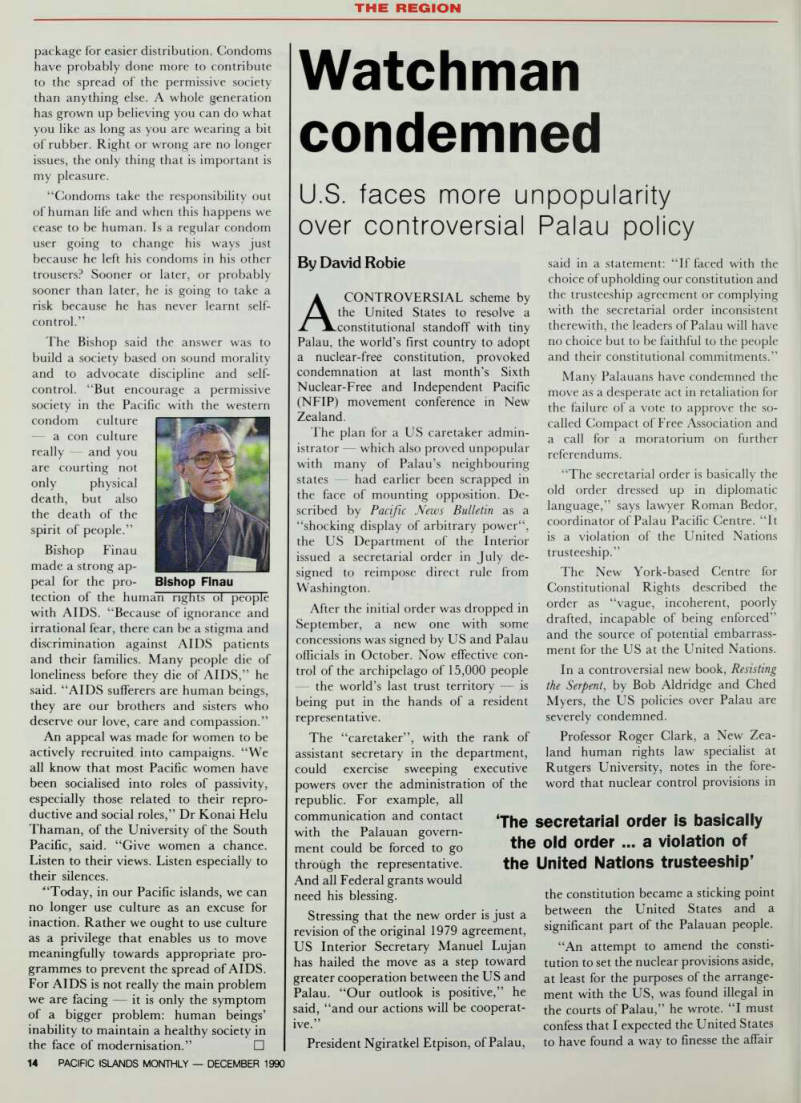
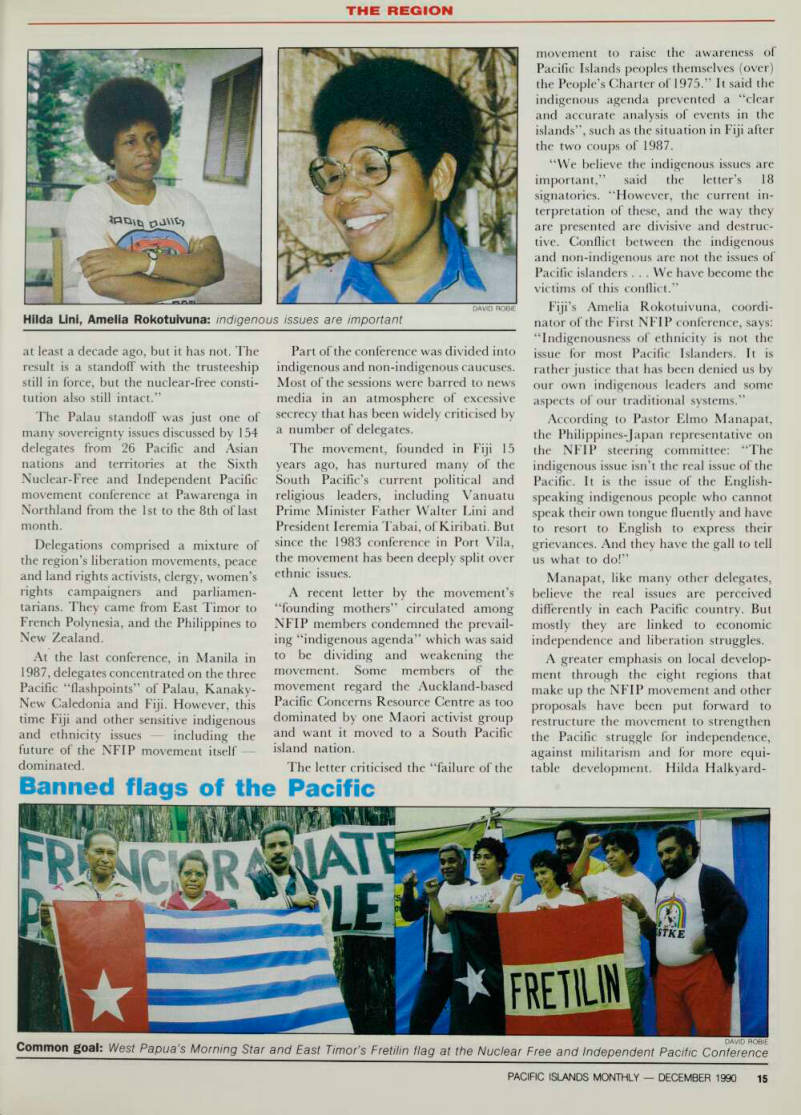
Hilda Lini, Amelia Rokotuivuna: indigenous issues are important
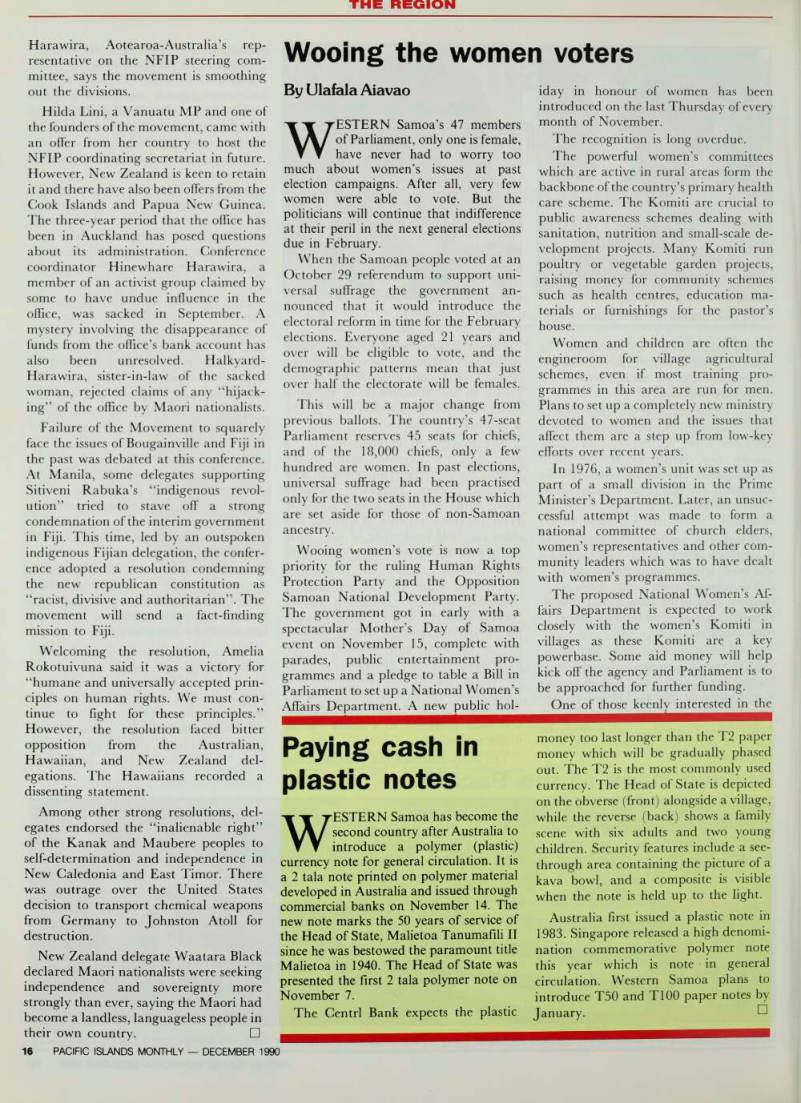
Banned flags of the Pacific
David Robie
Common goal: West Papua’s Morning Star and East Timor's Fretilin flag at the Nuclear Free and Independent Pacific Conference
Harawira, Aotearoa-Australia’s rep resentative on the NFIP steering com mittee, says the movement is smoothing out the divisions.
Hilda Lini, a Vanuatu MP and one of the founders of the movement, came with an offer from her country to host the NFIP coordinating secretariat in future.
However, New Zealand is keen to retain it and there have also been offers from the Cook Islands and Papua New Guinea.
The three-year period that the office has been in Auckland has posed questions about its administration. Conference coordinator Hinewhare Harawira, a member of an activist group claimed by some to have undue influence in the office, was sacked in September. A mystery involving the disappearance of funds from the office’s bank account has also been unresolved. Halkyard- Harawira, sister-in-law of the sacked woman, rejected claims of any “hijack ing” of the office by Maori nationalists.
Failure of the Movement to squarely face the issues of Bougainville and Fiji in the past was debated at this conference.
At Manila, some delegates supporting Sitiveni Rabuka’s “indigenous revol ution” tried to stave off a strong condemnation of the interim government in Fiji, This time, led by an outspoken indigenous Fijian delegation, the confer ence adopted a resolution condemning the new republican constitution as “racist, divisive and authoritarian”. The movement will send a fact-finding mission to Fiji.
Welcoming the resolution, Amelia Rokotuivuna said it was a victory for “humane and universally accepted prin ciples on human rights. We must con tinue to fight for these principles.”
However, the resolution faced bitter opposition from the Australian, Hawaiian, and New Zealand del egations. The Hawaiians recorded a
dissenting statement.
Among other strong resolutions, del egates endorsed the “inalienable right” of the Kanak and Maubere peoples to self-determination and independence in New Caledonia and East Timor. There was outrage over the United States decision to transport chemical weapons from Germany to Johnston Atoll for destruction.
New Zealand delegate Waatara Black declared Maori nationalists were seeking independence and sovereignty more strongly than ever, saying the Maori had become a landless, languageless people in their own country. □