Baiteke’s report card
pp. 12-13 · Read in the full issue
shows financial crisis
By Geoff Adlide
REGIONAL organisations in the South Pacific have entered a new era of co-operation, according to the Secretary-General of the South Pacific Commission. “The conflicts and competition that beset us in earlier days are now a thing of the past,” Atanraoi Baiteke told the 31st South Pacific Conference in Noumea in late October.
He said the South Pacific Organisations Co-ordinating Committee (SPOCC) which held its second meeting in March had fostered a true spirit of regional co-operation. Concrete examples were the Forum Fisheries Agency using SPC facilities in Noumea for recent meetings and SPC officials using Forum Secretariat facilities in Suva.
Baiteke’s glowing assessment of SPOCC’s progress will be welcomed by officials in Pacific governments and aid organisations as well as staff of regional organisations who have long bemoaned the organisational rivalry and duplication of services. But the Secretary-General’s annual report card on the
Geoff Adlide
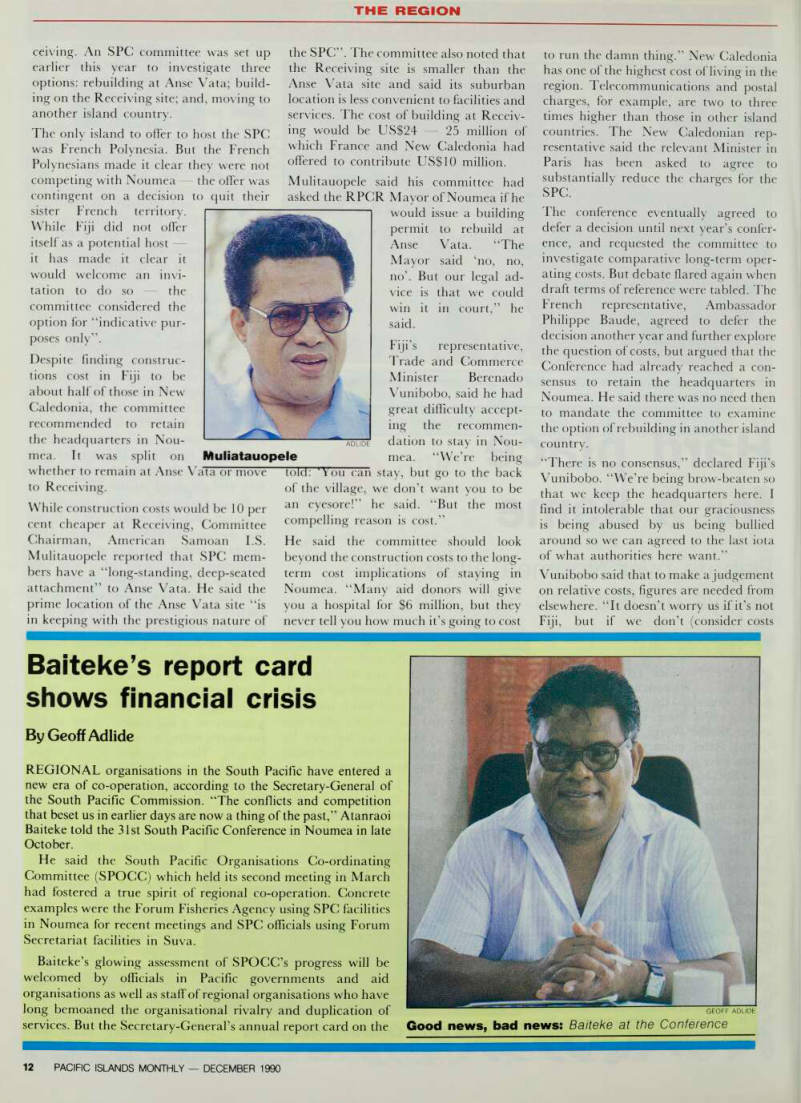
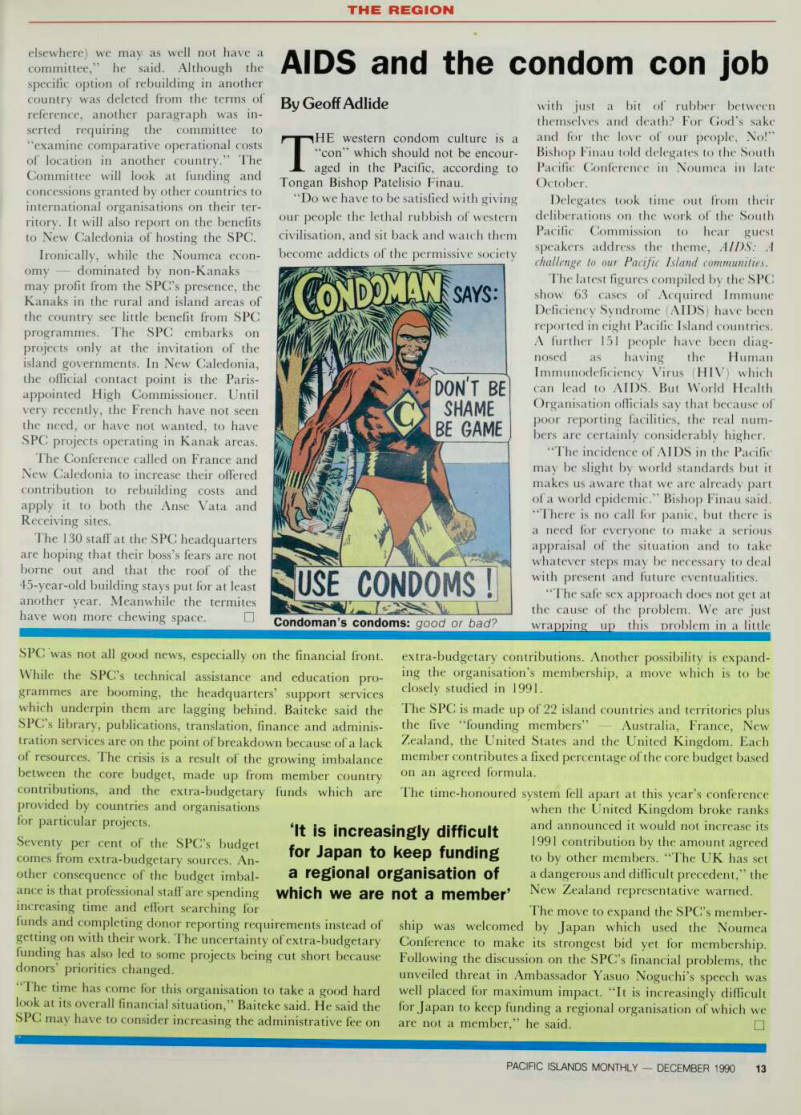
Good news, bad news: Baiteke at the Conference
SPC was not all good news, especially on the financial front.
While the SPC’s technical assistance and education pro grammes are booming, the headquarters’ support services which underpin them are lagging behind. Baiteke said the SPC’s library, publications, translation, finance and adminis tration services are on the point of breakdown because of a lack of resources. The crisis is a result of the growing imbalance between the core budget, made up from member country contributions, and the extra-budgetary funds which are
provided by countries and organisations for particular projects.
Seventy per cent of the SPC’s budget comes from extra-budgetary sources. An other consequence of the budget imbal ance is that professional staff are spending increasing time and effort searching for
funds and completing donor reporting requirements instead of getting on with their work. The uncertainty of extra-budgetary funding has also led to some projects being cut short because donors’ priorities changed.
The time has come for this organisation to take a good hard look at its overall financial situation,” Baiteke said. He said the SPC may have to consider increasing the administrative fee on
extra-budgetary contributions. Another possibility is expand ing the organisation’s membership, a move which is to be closely studied in 1991.
The SPC is made up of 22 island countries and territories plus the five “founding members” Australia, France, New Zealand, the United States and the United Kingdom. Each member contributes a fixed percentage of the core budget based on an agreed formula.
The time-honoured system fell apart at this year’s conference
‘lt is increasingly difficult for Japan to keep funding a regional organisation of which we are not a member’
when the United Kingdom broke ranks and announced it would not increase its 1991 contribution by the amount agreed to by other members. “The UK has set a dangerous and difficult precedent,” the New Zealand representative warned.
The move to expand the SPC’s member
ship was welcomed by Japan which used the Noumea Conference to make its strongest bid yet for membership.
Following the discussion on the SPC’s financial problems, the unveiled threat in Ambassador Yasuo Noguchi’s speech was well placed for maximum impact. “It is increasingly difficult for Japan to keep funding a regional organisation of which we are not a member,” he said. □