Putting your trust on wind power
p. 32 · Read in the full issue
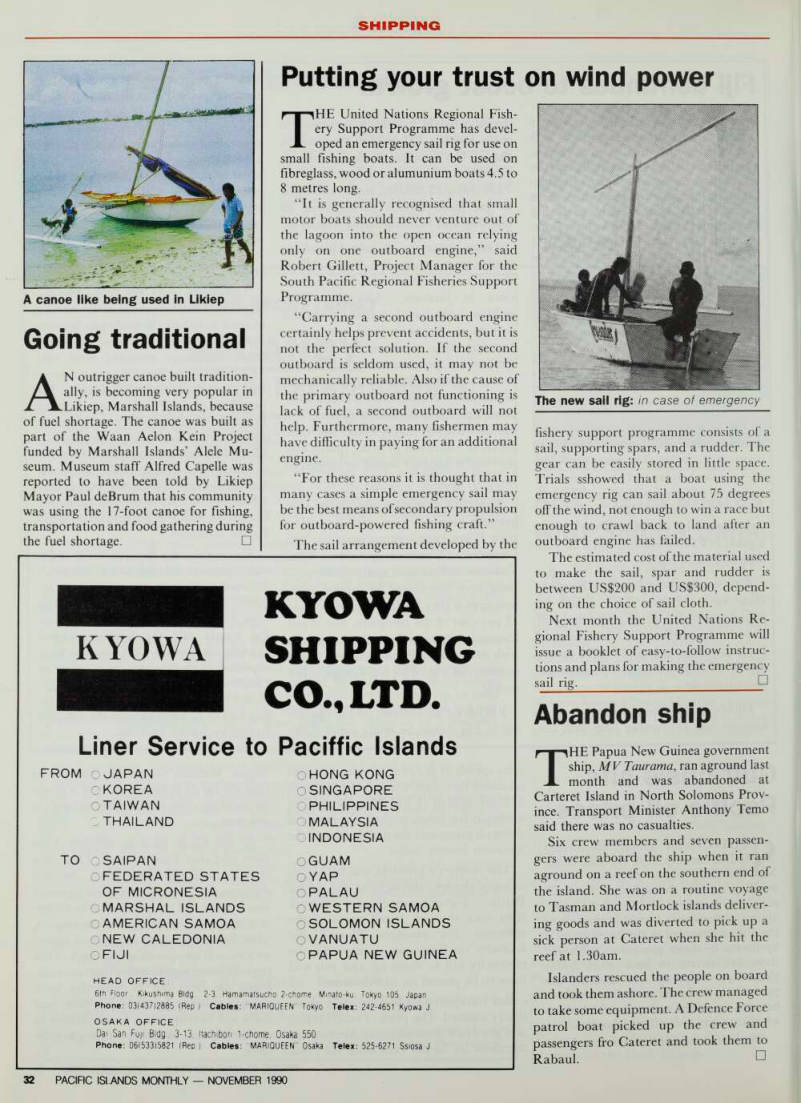
THE United Nations Regional Fish ery Support Programme has devel oped an emergency sail rig for use on small fishing boats. It can be used on fibreglass, wood or alumunium boats 4.5 to 8 metres long.
“It is generally recognised that small motor boats should never venture out of the lagoon into the open ocean relying only on one outboard engine,” said Robert Gillett, Project Manager for the South Pacific Regional Fisheries Support Programme.
“Carrying a second outboard engine certainly helps prevent accidents, but it is not the perfect solution. If the second outboard is seldom used, it may not be mechanically reliable. Also if the cause of the primary outboard not functioning is lack of fuel, a second outboard will not help. Furthermore, many fishermen may have difficulty in paying for an additional
engine.
“For these reasons it is thought that in many cases a simple emergency sail may be the best means of secondary propulsion for outboard-powered fishing craft,”
The sail arrangement developed by the
fishery support programme consists of a sail, supporting spars, and a rudder. The gear can be easily stored in little space.
Trials sshowed that a boat using the emergency rig can sail about 75 degrees off the wind, not enough to win a race but enough to crawl back to land after an outboard engine has failed.
The estimated cost of the material used to make the sail, spar and rudder is between US$2OO and US$3OO, depend ing on the choice of sail cloth.
Next month the United Nations Re gional Fishery Support Programme will issue a booklet of easy-to-follow instruc tions and plans for making the emergency sail rig. D
The new sail rig: in case of emergency