Washington post
pp. 22-23 · Read in the full issue
Western Samoa
Tofilau opens Washington post
WESTERN Samoa Prime, Tofilau Eti Alesana, opened his nation’s embassy in Washington, touched a number of important bases, and engaged in gentle, understated diplomacy on his September-October trip to the United States.
The trip included visits with Samoan communities in Hawaii and California, sessions at the annual meetings of the World Bank, a speech to the General Assembly of the United Nations, and participation in the UN-sponsored Sum mit on Children, in addition to a round of meetings with Washington officials.
One US official Tofilau did not attempt to see was President George Bush. Before leaving Apia, Tofilau released a copy of a cable he had sent to the White House, withdrawing his request for an appoint ment on the grounds of the President’s anticipated preoccupation with both the confrontation in the Middle East and America’s budget crisis. “Be assured” he wrote to Bush “that we fully support these efforts and pray for their success.”
It was just as well that the PM withdrew his request for a meeting because Bush was, in fact, up to his eyeballs with the threat of a war with Iraq and a very real (and so far quite unsuccessful) battle over the US budget which resulted, at the time of writing, in the President’s decision to shut down most of the operations of the US Government.
Further, the UN Children’s Summit attracted more than 80 heads of govern ment, making it that much harder for any of the 80 to see the embattled Bush.
While in Washington, Tofilau formally opened his country’s new embassy. One of the subtle messages conveyed at the occasion, but not spoken, was Western
Samoa, which has a resident ambassador Felix Wendt in Washington, would like the US to a resident ambassador to Apia. Western Samoa has friendly relations with the US and an ambassador in Washington, but no US ambassador in its capital. (Fiji, PNG, and, more re cently, Federated States of Micronesia and the Marshalls have resident US ambassadors; the US ambassador to New Zealand is credentialed to Apia, where a single US diplomatic officer, William P.
Francisco Hlis stationed. The State Department says that it would like a US ambassador in Apia, but funds are
lacking).
While this lingering problem may have been on Toifilau’s mind, he spoke of other things at the embassy opening, including gratitude for the work of the Peace Corps and the historical ties between the two countries that go back to a treaty signed between the chiefs of Samoa and the US in 1878. Admiral William Crowe, until recently America’s ranking military man, spoke for President Bush at the embassy opening. It was followed by a splendid party at Ambassador Wendt’s home in the Washington suburbs.
Crowe’s presence at the embassy was not the only indication of the close ties between Western Samoa and the Ameri can military. When the Prime Minister arrived at the Pentagon, his car was met at curbside by Secretary of Defense Dick Cheney and was given a full-fledged military welcome to the building. West ern Samoa and the Pentagon have reason to be happy with each other; US Navy units have been helpful following Hurri cane Ofa and other storms over the years, and Western Samoa (unlike New Zea land) has welcomed US ships without raising nuclear questions. While taking this position vis-a-vrs the US, Apia has vigorously protested French nuclear tests at Moruroa Atoll.
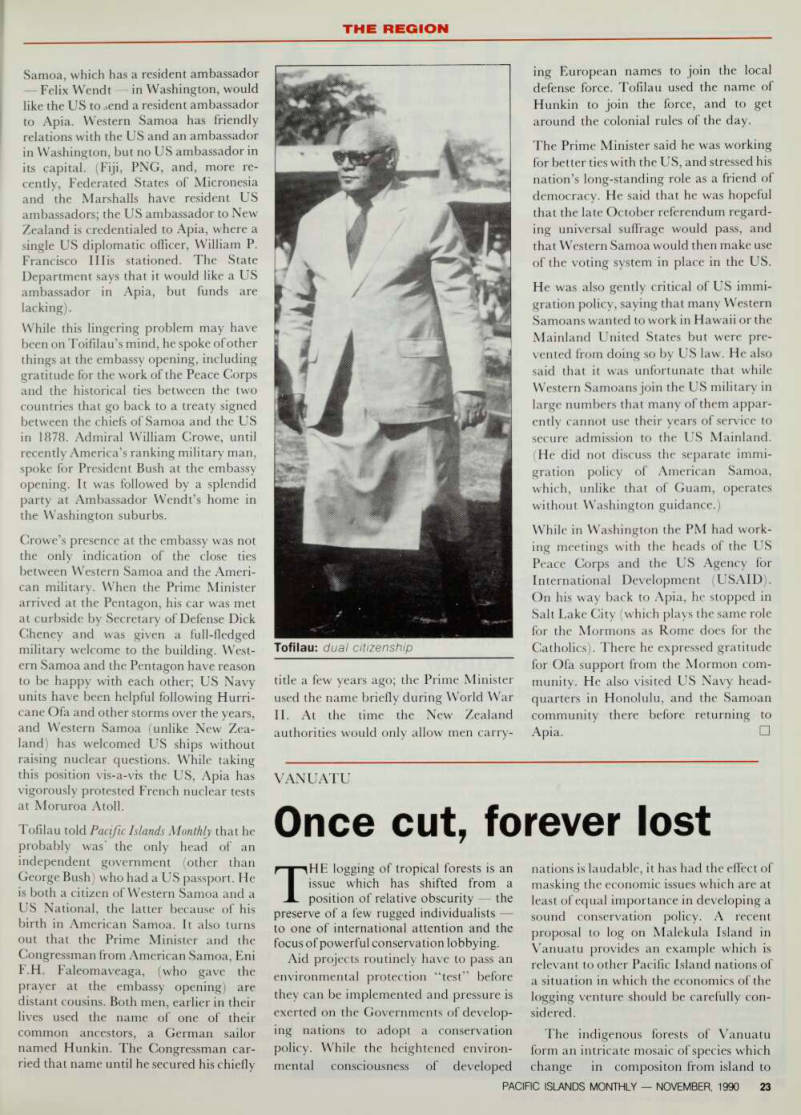
Tofilau told Pacific Islands Monthly that he probably was’ the only head of an independent government (other than George Bush) who had a US passport. He is both a citizen of Western Samoa and a US National, the latter because of his birth in American Samoa. It also turns out that the Prime Minister and the Congressman from American Samoa, Eni F.H. Faleomaveaga, (who gave the prayer at the embassy opening) are distant cousins. Both men, earlier in their lives used the name of one of their common ancestors, a German sailor named Hunkin. The Congressman car ried that name until he secured his chiefly
title a few years ago; the Prime Minister used the name briefly during World War 11. At the time the New Zealand authorities would only allow men carry
ing European names to join the local defense force. Tofilau used the name of Hunkin to join the force, and to get around the colonial rules of the day.
The Prime Minister said he was working for better ties with the US, and stressed his nation’s long-standing role as a friend of democracy. He said that he was hopeful that the late October referendum regard ing universal suffrage would pass, and that Western Samoa would then make use of the voting system in place in the US.
He was also gently critical of US immi gration policy, saying that many Western Samoans wanted to work in Hawaii or the Mainland United States but were pre vented from doing so by US law. He also said that it was unfortunate that while Western Samoans join the US military in large numbers that many of them appar ently cannot use their years of service to secure admission to the US Mainland. (He did not discuss the separate immi gration policy of American Samoa, which, unlike that of Guam, operates without Washington guidance.) While in Washington the PM had work ing meetings with the heads of the US Peace Corps and the US Agency for International Development (USAID).
On his way back to Apia, he stopped in Salt Lake City (which plays the same role for the Mormons as Rome does for the Catholics). There he expressed gratitude for Ofa support from the Mormon com munity. He also visited US Navy head quarters in Honolulu, and the Samoan community there before returning to
Apia. □
Tofilau: dual citizenship