cleanup begins
pp. 19-20 · Read in the full issue
The Region
New Zealand
Now the big cleanup begins
By Karen Mangnall
THE pain had become too great. The price of six years of monetarist Rogernomics, too high. On October 27, the New Zealand voters dumped Labour from power in the biggest political landslide since 1935.
Out went eight Cabinet Ministers, four junior Ministers, the Speaker of the House and his deputy, along with both Labour whips. Overall, Labour lost 28 seats, halving its numbers in Parliament to make it the smallest Opposition in five decades.
In came 28 hew National MPs and a new Prime Minister a 55-year-old King Country farmer, Jim Bolger New Zealand’s fourth leader in 14 months.
New Zealand’s political map is over whelmingly blue, with the exception of red Labour oases in Wellington, Christchurch and Dunedin. The rout was greatest in Auckland eight seats “down the gurgler”, as one defeated MP put it where only three years ago pre-crash yuppies voted for Labour en masse.
Yet it seems the carnage could have been greater for Labour had the party not dumped former leader Geoffrey Palmer in favour of his number three, Mike Moore.
This palace revolt, barely two months out from polling day, is being credited with saving the seats of another half-dozen Labour MPs who are now hanging on the slimmest of majorities.
Moore’s campaign focussed exclusively on leadership and distancing Labour from its cold, number-crunching image of the past. His series of “king hits” announcing employer subsidies to create 40,000 new jobs, crackdowns on tax fraud and benefit abuse, and a review of the hugely expensive ANZAC frigates deal dragged Labour up in the polls, but not enough. Hopes ofa last minute rally faded quickly on election night, and only two hours after the polls closed, Moore was heading for a telephone to concede to
Bolger.
The new PM hit the ground running, promising an action-packed 54 days to
Christmas. In that time, Bolger plans to introduce legislation to free up the labour market, tighten bail laws and provide longer sentences for rape. He has to name his Cabinet, pick a team for the final round of GATT negotiations in Brussels in December, and put together his “razor gang” to cut spending on Justice, Inland Revenue and Social Welfare.
But Bolger’s promise to “open the
books” on the nation’s finances is unlikely to reveal anything more shocking than is already known. Two days after the election, official statistics showed 208,000 unemployed, the worst level of jobless in
the country's history. National's cmploy ment spokesman John Banks predicts things will get worse before they improve.
Although inflation has been held to 5 per cent, other key economic indicators are devastating. Annual economic growth is just 0.1 per cent, compared with 5 per cent when Labour took office, and the economy contracted by 4 per cent in the June quarter. Real disposable in comes, farm incomes and retail sales are down. Manufacturing sales are down to their lowest levels since 1984, and hours worked have been cut by a quarter since June 1985.
Investment in export industries has dropped by half in the past five years. The rise in export volumes is being eroded by declining prices. In six years, the net
public debt has doubled to $43 billion, although this now includes the cost of the Think Big projects of the last National Government.
Although the Labour Government announced an $B9 million budget surplus this year, it was due mostly to fancy accounting and one-off sales of govern ment assets. Underpinning all this is an estimated overall budget deficit of more than $3 billion. The day after the election, the National Bank forecast New Zealand ers will “struggle” for the next 10 years for a decent standard of living.
In the face of such universal doomsay ing, Jim Bolgar has been indulging in some old fashioned port-barrel politics publicly promising $7OO million in good
ies while privately conceding the goodies
would have to wait. In National’s first term in office, Bolger is promising 3 per cent annual economic growth, unemploy ment halved and the budget balanced.
There will be no new taxes, no rise in the Goods and Services Tax. Cuts will be made in government spending, but not to
welfare or health in 1991. Despite this, National will put 900 more police on the streets.
Similarly, National is plan ning labour mar ket reform but Bolger denies he wants to turn New Zealand into a low-wage econ omy. Despite warnings from the Combined Trade Unions, Bolger
also says he'll dump the Growth Agree ment negotiated by Mike Moore, in which unions have promised to restrict wage claims to 2 per cent with productivity bargaining, as a way of getting the economy moving again.
There’s clear evidence Bolger and National suffer a credibility gap with much of the electorate, despite their election night win. Only 77 per cent of those eligible to vote did so, the lowest turnout since World War Two. And while Labour lost 12.9 per cent of its vote share, National only picked up 4.4 per cent.
Third parties especially NewLabour and the policy-less, leaderless Greens picked up a huge 16.8 per cent of the votes, most of it sliced from Labour.
Although the Greens failed to win an
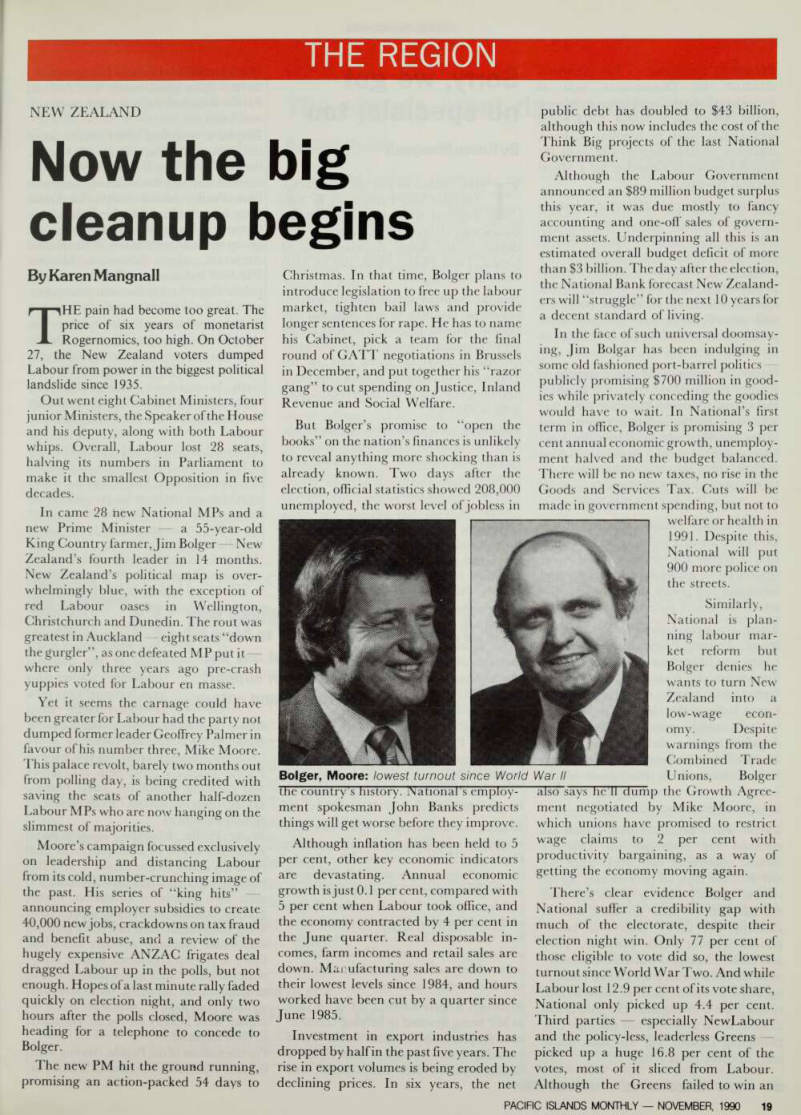
Bolger, Moore: lowest turnout since World War II
electorate, NewLabour’s Jim Anderton retained the Christchurch seat of Sydenham. And in Northern Maori, Mana Motuhake’s Matiu Rata came within 400 votes of toppling Labour, despite a widely-observed call from the Maori Council of Churches for a Maori election boycott.
The irony of October 27, is that in lashing out at Labour for its savaging of the economy, the voters have actually let themselves in for more of the same, only more so. National, too, supports privatisation and sales of state assets, foreign ownership of natural resources, and subordinating monetary and fiscal policy to the goal of 0-2 per cent inflation by 1993.
National’s Finance Minister designate, Ruth Richardson, is a hardline monetarist. Already there are signs her adherence to the inflation target could cause ructions within National’s huge 68-members caucus, many of whom believe such a target is suicidal given the Gulf crisis and rising inflation in many of New Zealand’s main trading partners.
Ousted former Finance Minister Roger Douglas is already warning that the sheer size of National’s majority could cause trouble for its leadership. Arrogance and infighting over policy, two of the faults for which the voters punished Labour.
There are signs Labour has learnt the lesson. Former Prime Minister David Lange says Labour lost because its second three-years of economic change was “more than people could cope with”.
Lange believes the electoral devastation wrought on the party is a blessing in disguise, a clean slatte allowing Mike More to “start from scratch” to reposition Labour back to its traditional ideals.
Lange says it’s something that should have been done two years ago.
Labour Party president Ruth Dyson has enchoed the comment. At Labour’s annual conference two weeks after the election, she says, all policies are “up for review”. Many Labour politicians and officials believe their downfall was in carrying out their “slash and burn” policies without public mandate. They also believe National will mistake the size of its election victory for public encour agement down the path of monetarism, rather than a cry against the pain it has caused. Ruth Dyson is not the only one predicting Labour will win back many seats in three years time. □