Comment
So much for Democracy
AS some of the Pacific Island states begin tentative moves towards more democratic systems of government they would do well to ponder the political scene in New Zealand after more than 130 years of Parliamentary democracy.
The lead-up to last month’s general ejection showed that large numbers of voters are not just disenchanted with the system but are heartily sick and tired of politicians of all colours, regarding them with the same sort ofdistaste they have for used car dealers and door-to-door salesmen.
Two months out from the poll, nearly 15 per cent of eligible voters had not registered on the electoral roll, as they are legally bound to do. More significantly, more than one in three people aged between 18 and 29 (the
student and young persons group that traditionally used to be the most politically aware segment of the population) were not enrolled.
One survey showed that 35 per cent of those not on the roll did not even know an election was due in a few weeks and nearly one-half who had enrolment forms said they were not going to fill them in.
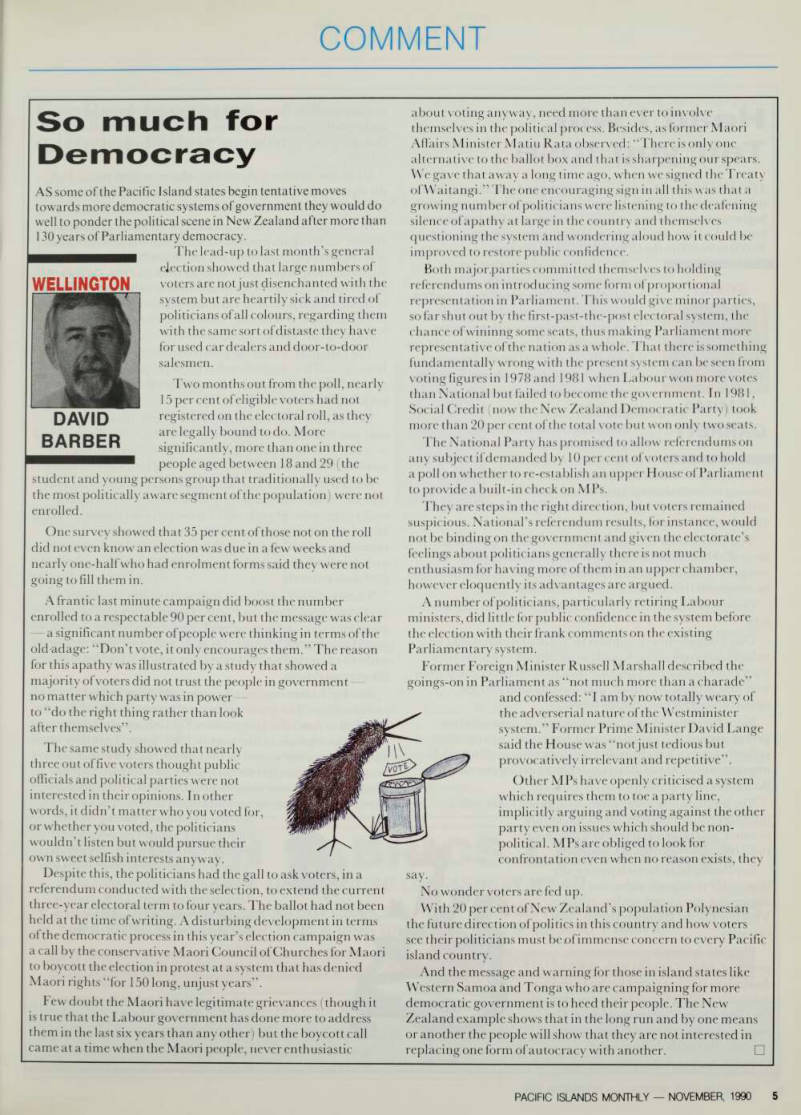
A frantic last minute campaign did boost the number enrolled to a respectable 90 per cent, but the message was clear a significant number of people were thinking in terms of the old-adage: “Don’t vote, it only encourages them.” The reason for this apathy was illustrated by a study that showed a majority of voters did not trust the people in government no matter which party was in power -
to “do the right thing rather than look after themselves”.
The same study showed that nearly three out offive voters thought public officials and political parties were not interested in their opinions. In other words, it didn’t matter who you voted for, or whether you voted, the politicians wouldn’t listen but would pursue their own sweet selfish interests anyway.
Despite this, the politicians had the gall to ask voters, in a referendum conducted with the selection, to extend the current three-year electoral term to four years. The ballot had not been held at the time of writing. A disturbing development in terms of the democratic process in this year’s election campaign was a call by the conservative Maori Council of Churches for Maori to boycott the election in protest at a system that has denied Maori rights “for 150 long, unjust years”.
Few doubt the Maori have legitimate grievances (though it is true that the Labour government has done more to address them in the last six years than any other) but the boycott call came at a time when the Maori people, never enthusiastic
about voting anyway, need more than ever to involve themselves in the political process. Besides, as former Maori Affairs Minister Matiu Rata observed; “There is only one alternative to the ballot box and that is sharpening our spears.
We gave that away a long time ago, when we signed the Treaty ofWaitangi.” The one encouraging sign in all this was that a growing number of politicians were listening to the deafening silence of apathy at large in the country and themselves questioning the system and wondering aloud how it could be improved to restore public confidence.
Both major.parties committed themselves to holding referendums on introducing some form of proportional representation in Parliament. This would give minor parties, so far shut out by the first-past-the-post electoral system, the chance ofwininng some seats, thus making Parliament more representative of the nation as a whole. That there is something fundamentally wrong with the present system can be seen from voting figures in 1978 and 1981 when Labour won more votes than National but failed to become the government. In 1981, Social Credit (now the New Zealand Democratic Party) took more than 20 per cent of the total vote but won only two seats.
The National Party has promised to allow referendums on any subject ifdemandcd by 10 per cent of voters and to hold a poll on whether to re-establish an upper House of Parliament to provide a built-in check on MPs.
They are steps in the right direction, but voters remained suspicious. National’s referendum results, for instance, would not be binding on the government and given the electorate’s feelings about politicians generally there is not much enthusiasm for having more of them in an upper chamber, however eloquently its advantages are argued.
A number of politicians, particularly retiring Labour ministers, did little for public confidence in the system before the election with their frank comments on the existing
Parliamentary system.
Former Foreign Minister Russell Marshall described the goings-on in Parliament as “not much more than a charade” and confessed: “I am by now totally weary of
the adverserial nature of the Westminister system.” Former Prime Minister David Lange said the House was “not just tedious but
provocatively irrelevant and repetitive”.
Other MPs have openly criticised a system which requires them to toe a party line, implicitly arguing and voting against the other party even on issues which should be non political. MPs are obliged to look for confrontation even when no reason exists, they
say.
No wonder voters are fed up.
With 20 per cent of New Zealand’s population Polynesian the future direction of politics in this country and how voters see their politicians must beofimmense concern to every Pacific island country.
And the message and warning for those in island states like Western Samoa and Tonga who are campaigning for more democratic government is to heed their people. The New Zealand example shows that in the long run and by one means or another the people will show that they are not interested in replacing one form of autocracy with another. □