Johnston gets
p. 40 · Read in the full issue
The Region
Johnston gets mixed reviews
By David North
TWO new sets of Washington critics have been examining the US Army’s chemical weapons destruction system on Johnston Atoll, and the reviews are mixed.
The work on Johnston has long been the subject of much attention, mostly negative, from environmentalists and from island leaders. The concern is that an accident on or near Johnston might have a massive impact on the air and water for hundreds to thousands of miles around the US-held island.
One such criticism in the latter category came recently from Juan N.
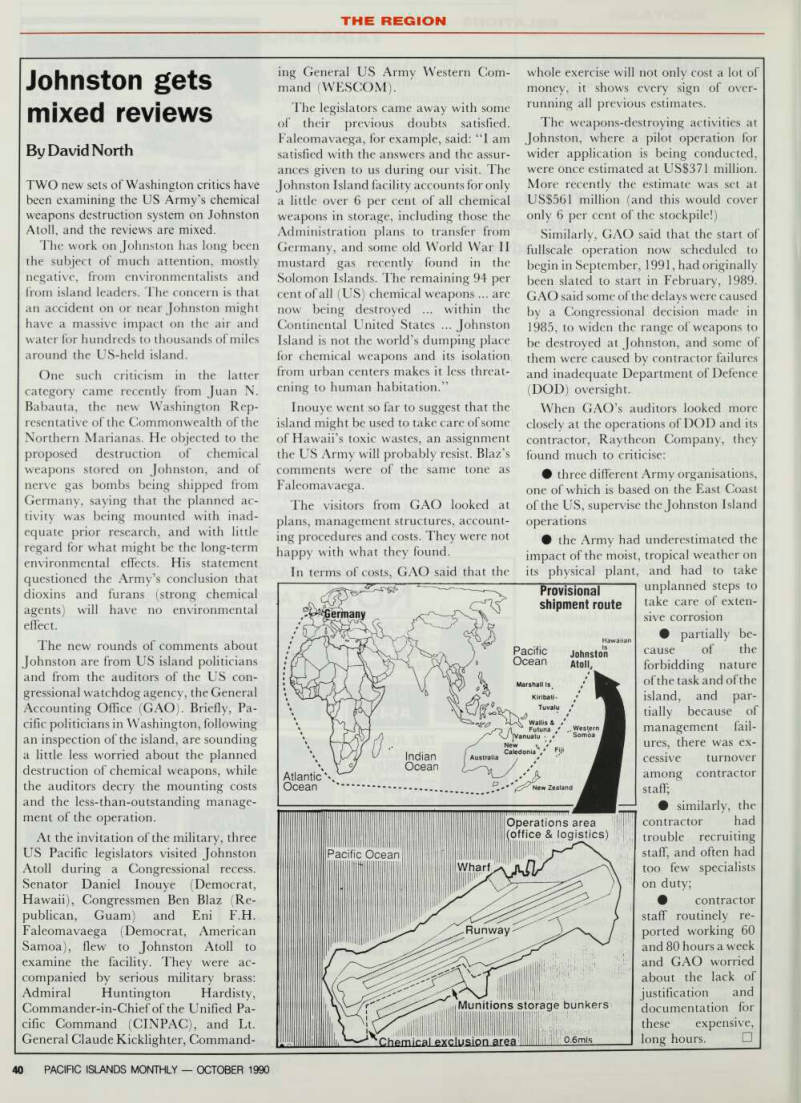
Babauta, the new Washington Rep resentative of the Commonwealth of the Northern Marianas. He objected to the proposed destruction of chemical weapons stored on Johnston, and of nerve gas bombs being shipped from Germany, saying that the planned ac tivity was being mounted with inad equate prior research, and with little regard for what might be the long-term environmental effects. His statement questioned the Army’s conclusion that dioxins and furans (strong chemical agents) will have no environmental effect.
The new rounds of comments about Johnston are from US island politicians and from the auditors of the US con gressional watchdog agency, the General
Accounting Office (GAO). Briefly, Pa
cific politicians in Washington, following an inspection of the island, are sounding a little less worried about the planned destruction of chemical weapons, while the auditors decry the mounting costs and the less-than-outstanding manage ment of the operation.
At the invitation of the military, three US Pacific legislators visited Johnston Atoll during a Congressional recess.
Senator Daniel Inouye (Democrat, Hawaii), Congressmen Ben Blaz (Re publican, Guam) and Eni F.H.
Faleomavaega (Democrat, American Samoa), flew to Johnston Atoll to examine the facility. They were ac
companied by serious military brass:
Admiral Huntington Hardisty, Commander-in-Chief of the Unified Pa cific Command (CINPAC), and Lt.
General Claude Kicklighter, Command
ing General US Army Western Com mand (WESCOM).
The legislators came away with some of their previous doubts satisfied.
Faleomavaega, for example, said: “I am satisfied with the answers and the assur ances given to us during our visit. The Johnston Island facility accounts for only a little over 6 per cent of all chemical weapons in storage, including those the Administration plans to transfer from Germany, and some old World War II mustard gas recently found in the Solomon Islands. The remaining 94 per cent of all (US) chemical weapons ... are now being destroyed ... within the Continental United States ... Johnston Island is not the world’s dumping place for chemical weapons and its isolation from urban centers makes it less threat ening to human habitation.”
Inouye went so far to suggest that the island might be used to take care of some of Hawaii’s toxic wastes, an assignment the US Army will probably resist. Blaz’s comments were of the same tone as Faleomavaega.
The visitors from GAO looked at plans, management structures, account ing procedures and costs. They were not happy with what they found.
In terms of costs, GAO said that the
whole exercise will not only cost a lot of money, it shows every sign of over running all previous estimates.
The weapons-destroying activities at Johnston, where a pilot operation for wider application is being conducted, were once estimated at USS37I million.
More recently the estimate was set at USSS6I million (and this would cover only 6 per cent of the stockpile!) Similarly, GAO said that the start of fullscale operation now scheduled to begin in September, 1991, had originally been slated to start in February, 1989.
GAO said some of the delays were caused by a Congressional decision made in 1985, to widen the range of weapons to be destroyed at Johnston, and some of them were caused by contractor failures and inadequate Department of Defence (DOD) oversight.
When GAO’s auditors looked more closely at the operations of DOD and its contractor, Raytheon Company, they found much to criticise: • three different Army organisations, one of which is based on the East Coast of the US, supervise the Johnston Island
operations
the Army had underestimated the impact of the moist, tropical weather on its physical plant, and had to take
unplanned steps to take care of exten sive corrosion partially be cause of the forbidding nature of the task and of the island, and par tially because of management fail ures, there was ex cessive turnover among contractor staff; similarly, the contractor had trouble recruiting staff, and often had too few specialists on duty; contractor staff routinely re ported working 60 and 80 hours a week and GAO worried about the lack of
justification and
documentation for
these expensive,
long hours. □