PNG restricts funding
pp. 27-30 · Read in the full issue


Crop crisis worsens as PNG restricts funding
IT was the last thing that the growers of Papua New Guinea wanted to hear. The country s Agriculture and Livestock Minister Tom Paias predicted that the
1991 Budget to be delivered soon will contain even less funds for the seriously wounded agricultural sector than the current year. He blamed the Bougainville mine closure, but also in the back of the Government’s mind is the thought that they are going to have to cut their cloth according to their means, especially after Australian Prime Minister Bob Hawke made it clear on his recent visit that the former colonial power would not always be able to patch up the financial cracks.
Up until now, the crisis in the coffee, palm oil, cocoa and copra industries has been assuaged by bounty payments and some savings for better years. But there is no question that the crunch has come: at least 5000 plantation workers in Western Highlands Province alone are in danger of losing their jobs if coffee growers are forced out of business by continuing low prices and the inability of the stabilisation fund to keep their operations in the back.
There is a bitter irony in this for Papua New Guinea. The country has, to some extent, neglected some areas of the economy while its successive governments since Independence have thrown their energies into building up the agricultural
sector. Crops are extremely important
export items (and still are, despite the low prices), and the buoyancy of the rural economy has always been seen as ensuring both political stability and at least stemming what would otherwise be a flood of people moving to the towns looking for jobs. Meanwhile, secondary
industry and deep sea fishing have been left largely in limbo, the towns are swelling with unemployment and now large sections of the countryside face straitened circumstances. Efforts to get industries going, but it is unlikely to have more than a marginal effect on the very
serious unemployment problem.
If Agriculture Minister Pais is right, the consequences for the rural sector and for law and order in the towns as more unemployed arrive looking for work are worrying.
In his recent statement, Pais said Papua New Guinea had borrowed from international agencies to assist the agri cultural industry on condition that price support for major commodities should be phased out. But he said the Government would continue to provide whatever support it could and was now looking at assistance packages for the major commodities aimed at achieving greater efficiency and higher productivity. But he said that agricultural groups and com modity boards had to realise that the Government could not afford to support commodity prices for the next decade, and the 1991 Budget may contain less funds for the sector.
Earlier, Prime Minister Rabbie Namaliu asked all commercial banks in the country to consider rescheduling loan repayments from farmers and plan tations, and the Government was still looking for an overseas lender to help refinance the loans. The Prime Minister said the rural industries had already been helped by the devaluation of the kina, the lifting of the 2.5 per cent tax on tree crop commodities, reduction of import duties for goods needed by the agriculture sector.
The large plantation companies have been badly hit not just by the price collapses, but many of them owned plantations in the North Solomons Prov ince, which is now under the control of the Bougainville Revolutionary Army.
One of Papua New Guinea’s largest plantation companies is on the verge of closing down. New Guinea Plantations Ltd, with heaquarters in Rabaul, and which owns large cocoa and coconut plantations in North Solomons, New Ireland, East and West New Britain provinces, was Papua New Guinea’s largest cocoa producer until its Bougainville plantations were forced to close and 2000 workers laid off. Share holders of the company have been advised by their managers, Kina Gilbanks & Co Ltd, that the operation is running out of money. Another 1000 workers face the
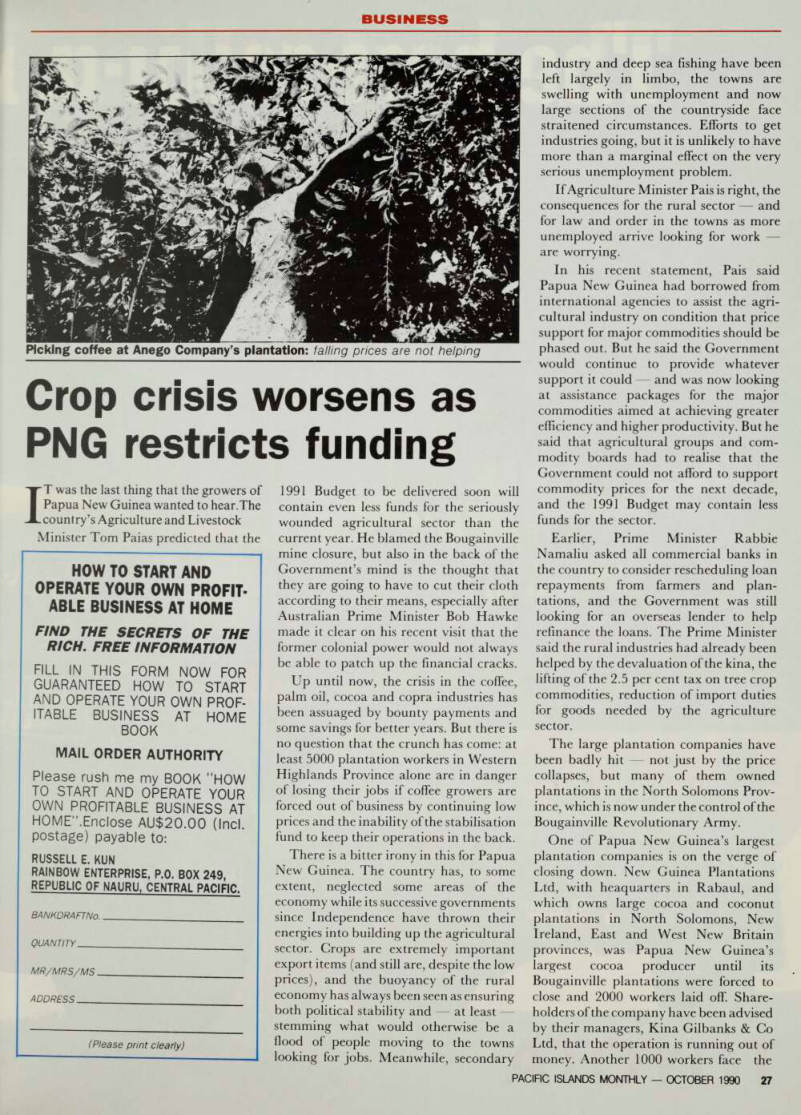
Picking coffee at Anego Company’s plantation: falling prices are not helping
sack if the other plantations close, too.
The company needed K 200,000 (USS 188,000) to keep it going until the end of 1990. New Guinea Plantations owes KlO million in outstanding loans.
Now the National Provident Fund
(NPF) is threaten ing to foreclose on New Guinea Plan tations Ltd which owes it KBOO,OOO, and also to take the same action against the simi larly named New Guinea Plan tations Holdings Ltd (for K 1.75 million),
Waimetke Ltd (K 250,000) and New Guinea Islands Produce Co Ltd (K 300,000). All these loans were made for plantation improvements in North Solomons, East and West New Britain.
NFP managers told Prliament’s Public Accounts Committee they were going to wind up these investments before the end of the year.
But committee members were angered to hear that former NFP attorney and now Member of Parliament Peter Garong had advised the fund against investing in plantations on the grounds that such a move was too risky. He also told the NFP board such investments would be illegal.
Auditor-General’s officials told the Public Accounts Committee that the money should instead have been placed in interest-bearing deposits where it would have been safe and at the same time earning income for the fund.
But the big question which remains unanswered is where the Government will find the money it needs to prevent the tree crop industries going bust.
Coffee Industry Board chairman Dekot Koki said the Coffee Stabilisation Board alone needed a KlO million injection. He expressed “grave concern and dismay” at the Government’s inability to help coffee growers, especially as it had recently handed K 4.5 million to copra growers (although the point should be made that the Copra Stabilisation Fund had run dry, while the coffee fund has enough to keep it going until the end of the year).
The coffee fund has Kl 4 million left, but
The low coffee prices and the current economic crisis are having a devastating impact on the economy’
that is being eked out by the recent halving of the bounty to growers, Koki has joined those who are warning of civil unrest, rampant unemployment and increasing crime if the industry which indirectly provides a million jobs
and is the third largest foreign exchange earner after copper and gold was neglected. “The low coffee prices and the current economic crisis are having a devastat
ing impact on the
economy of the country and, in
particular, on the economy of the High lands where 86 per cent of the crop is grown,” he said.
But he warned that the stabilisation fund could not support the coffee industry for much longer. While the International Coffee Organisation quota system was in limbo there was little prospect of a recovery in prices.
And Koki said most coffee plantations
and projects were not being managed
properly because managers were being squeezed by the Agriculture Bank’s strict lending policy and the high interest rates charged by the commercial banks. He warned that unless money was made available to keep the stabilisation fund going during 1991, many people now involved in the industry would be forced to earn a living illegally.
Joining the chorus of warning was the Plantations Management Agency. One of its officials, Philip Bobby, said that between 4000 and 5000 labourers in Western Highlands were in danger of losing their jobs if palntations closed, a prediction which confirms fears among provincial leaders that there will be major civil unrest if these people are suddenly
left without jobs.
Bobby said that under the current bounty of 35 toea per kilogram, it was impossible for coffee growers to recover expenses incurred in growing and har vesting the coffee beans. He urged a 15t increase to, at least, help growers break even. But the Planters’ Association stressed that all the major tree crops are facing a battle for survival as viable industries. The association said the situ ation was worst in East New Britain Province, where the cocoa and copra areas had been badly hit.
Executive Director David Loh said many plantations in that province had already closed the economic sitution being exacerbated by criminals having terrorised workers and managers on the plantations and this had in turn led to a business downturn in Rabaul. Loh estimated that 10,000 workers had been laid off, and this has resulted in “almost daily” criminal acts such as rape, armed hold-ups, harassment and intimidation.
“This is a desperate situation,” he said.
“People have decided to leave their plantations, the law and order situation is bad with managers and labourers being attacked every day.” He said he was getting depressed at all the problems in the industry, and he estimated the banks were owed about K4O million by plan tations which, despite losing money, were being asked to service these loans at high interest rates. He said the Government could help by reducing fuel prices, place a moratorium on loan repayments and help keep stabilisation funds at accept able levels.
Certainly, the Government in Port Moresby will come under increasing pressure to do something, even though its hands are tied financially. Typical of what Namaliu and his ministers will hear is the suggestion from Wapenamenda MP Masket langalio, who wants the Govern ment to seek soft loans from the World Bank and Asian Development Bank.D