The chase is on
pp. 19-21 · Read in the full issue
American territories face fierce elections in the race for the top jobs
By David North
MANY hot election contests are coming on November 6 in Guam, American Samoa and Hawaii.
Two governorships, and possibly the con trol of the United States Senate, are among the prizes at stake.
In addition to the usual contests between the ins and the outs, the Democrats and the Republicans, and the young and the old, there may be some breakthroughs on gender and ethnic lines: A woman may represent Hawaii in the State, and another may become Governor of Guam — each a first; andH
• a Samoan man may become the first of his background to secure a voting seat in the House of Representa tives.
The race getting the most Main
land attention is that between sitting Democratic U.S. Senator, Daniel Akaka, and his assertive Republican opponent, Congresswoman Pat Saiki. If she wins, and she is leading by a bit in the polls, and if several other Republican challengers on the Mainland beat their Democratic opponents, the Democrats could lose their current control of the Senate. Among the by-products of such a change would be a weakened position for long-term Senator Daniel Inouye (Democrat, Hawaii), the dean of the Pacific delegation in Congress.
His prowess within the senatorial struc ture would be lessened were he to be a member of the minority,
Guam
Madeleine versus Ada There is a tight contested race for Governor, with each of the candidates seeking to break island tradition. The Republican Governor, Joseph Ada,
would like to be the first Governor in island history to be re-elected to a second, consecutive term. His Democratic op ponent, Senator Madeleine Z. Bordallo, widow of ex-Governor Ricky Bordallo who killed himself earlier this year rather than report to a federal prison, would like to be the first woman elected to the job.
The polls show him slightly ahead. The rival candidates have much in common.
Both supported the territory’s ban on abortion and the tax rebate programmes.
Both advocate a strong position on Commonwealth status. Senator Bordallo, however, takes a more populist position
thanthe Governor, and is more critical of
governmental con
trol on develop ment. She was
nominated by the Democrats in a con tested primary in early September, beat ing one of her late husband’s Lt.
Governors, Rudy Sablan, by a 60-40 per cent margin. Governor Ada was unopposed for the Republican nomi nation.
Whie Governors serve four-year terms, the job of delegate to the Congress comes with a two-year term, and the Republi can incumbent, Ben Blaz is, as he was in 1988, facing a tough fight with Democrat Ben Pangelinan, once a key appointee of the late Governor Bordallo. This year, as in 1988, both men won their nominations without opposition, but while Blaz got 1000 more votes in the 1988 primary election round than his opponent, that
Matsunga’s death and the ambitions of many politicians have set off a complex array of electoral contests
margin shrunk to 591 this year. In turn, Blaz’s margin of victory in the general election of 1988 was smaller than his margin in 1986.
Blaz, a retired Marine Corps general, is running on his record in office, and on his close ties with the Bush Adminis tration; his younger, somewhat more animated opponent argues that the voters should “send the right Ben to Washington,” promising more vigorous representation for the island.
The Guam Legislature, currently con trolled by the Democrats by a 13 to 8 margin, is likely to show few changes. Of the 21 incumbents, 19 are running again this year and all 19 were renominated by their parties. A likely newcomer this year, who outpolled several sitting Democratic senators in the primary, is Marilyn Won Pat, daughter of the late Guam Congressman Antonio Won Pat. In re
cent years women have
played a
large
role in the
Legis
lature; there are seven of
“them in the
sitting
body, six of whom are running for re-election.
(Senator Bordallo had to give up her seat to run for Governor.) Senators Doris Brooks and Pilar Lujan were the ranking votegetters among the Republican and Democratic female candidates, respect ively, in the primary.
Hawaii
Saiki versus Akaka The death of longtime United States Senator Spark Matsunaga (Democrat, Hawaii) earlier this year, and the am bitions of numerous politicians, have set off a complex array of electoral contests.
Governor John D. Waihee 111, a Democrat, appointed then Congressman Daniel Kahikina Akaka (Democrat, Hawaii) to replace
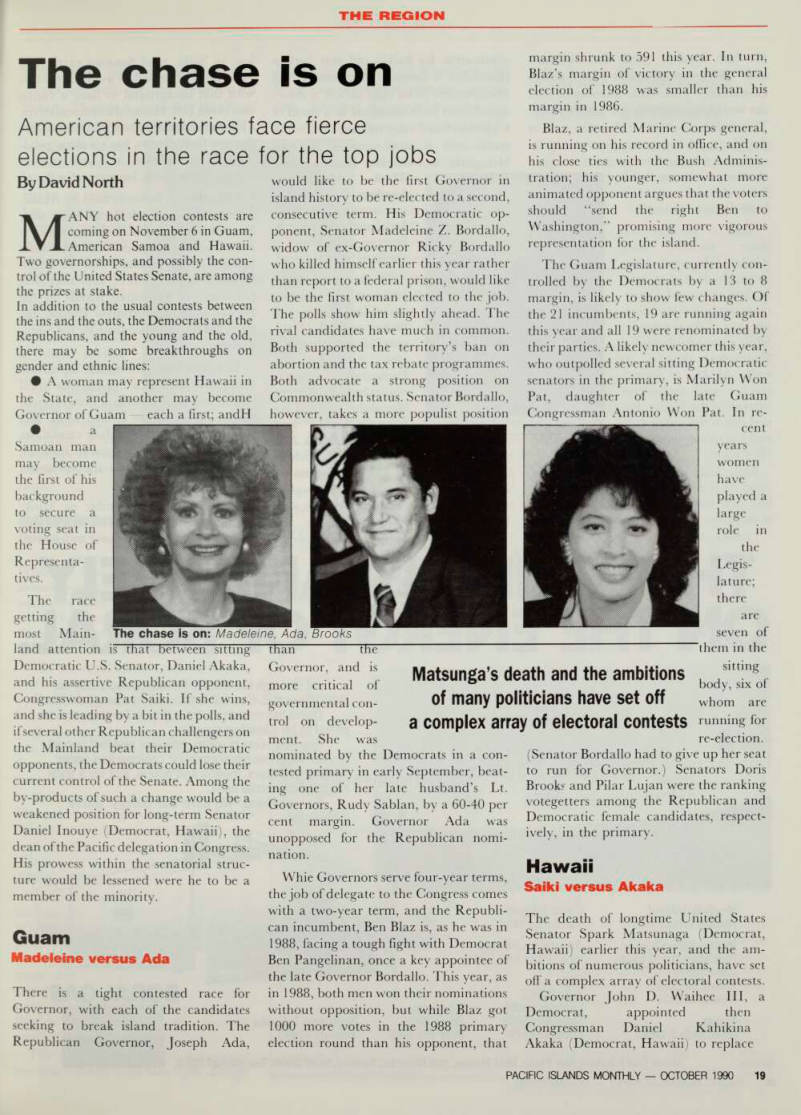
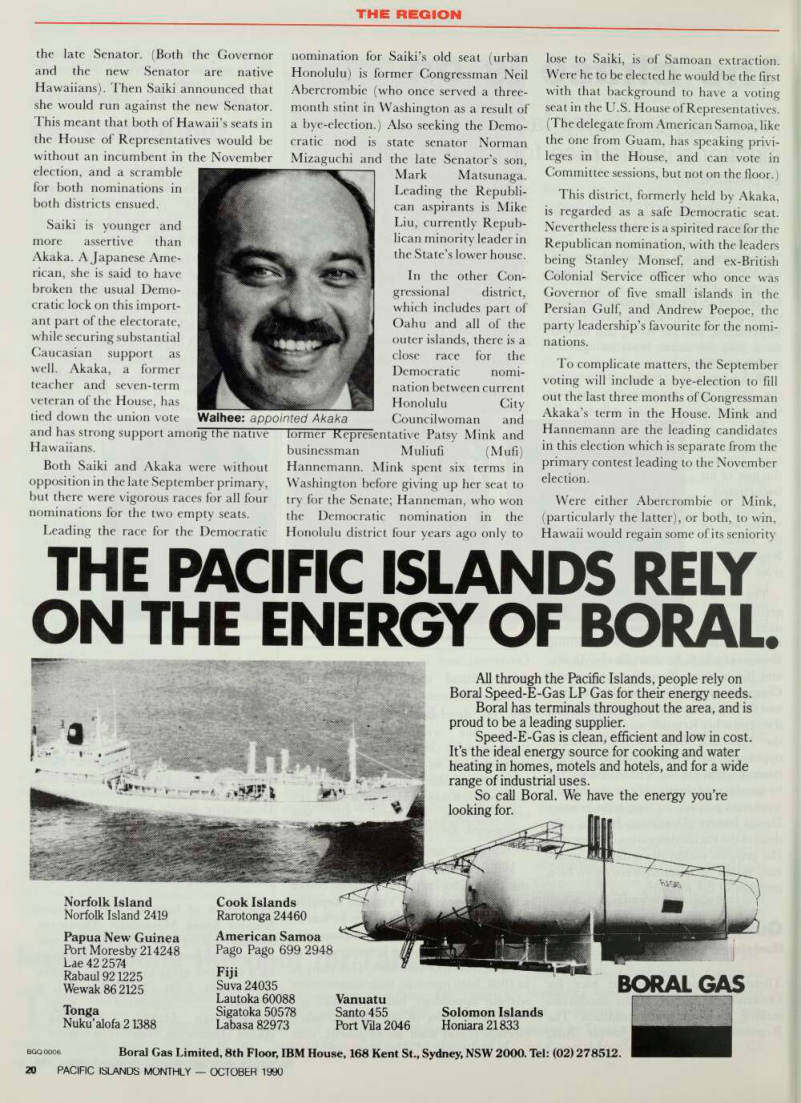
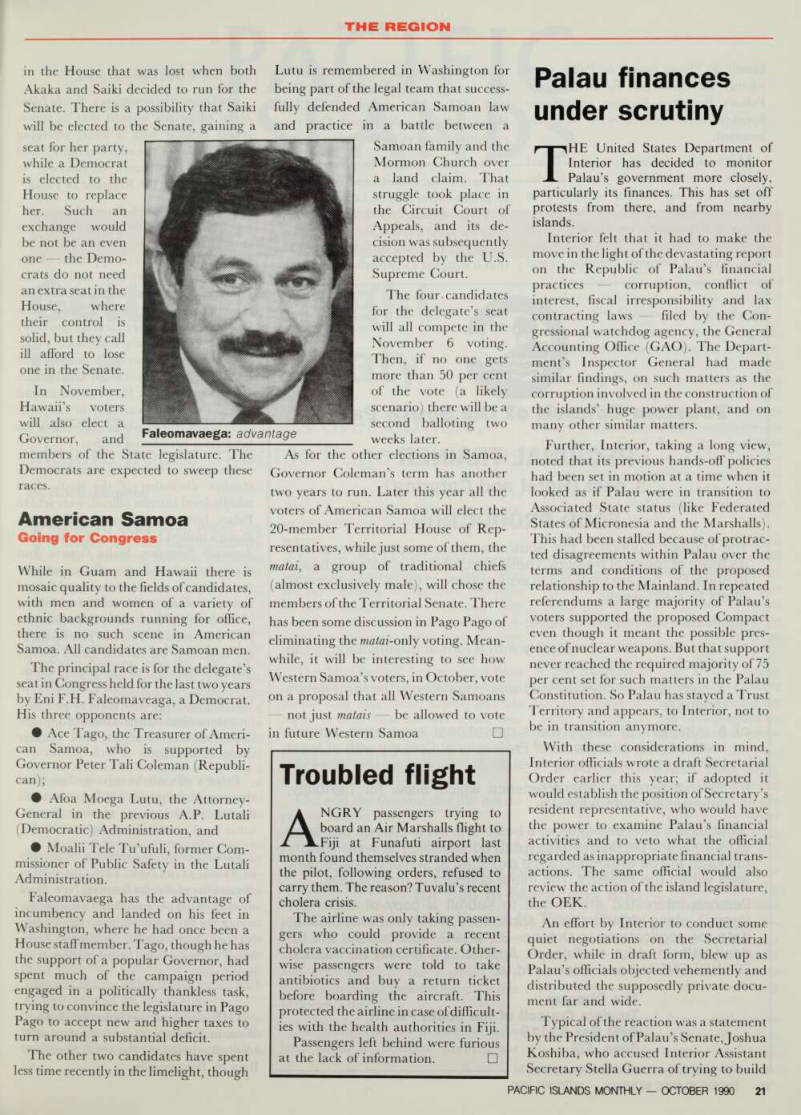
The chase is on: Madeleine, Ada, Brooks
the late Senator. (Both the Governor and the new Senator are native Hawaiians). Then Saiki announced that she would run against the new Senator.
This meant that both of Hawaii’s seats in the House of Representatives would be without an incumbent in the November
election, and a scramble for both nominations in both districts ensued.
Saiki is younger and more assertive than Akaka. A Japanese Ame rican, she is said to have broken the usual Demo cratic lock on this import ant part of the electorate, while securing substantial Caucasian support as well. Akaka, a former teacher and seven-term veteran of the House, has tied down the union vote
and has strong support among the native Hawaiians.
Both Saiki and Akaka were without opposition in the late September primary, but there were vigorous races for all four nominations for the two empty seats.
Leading the race for the Democratic
nomination for Saiki’s old seat (urban Honolulu) is former Congressman Neil Abercrombie (who once served a three month stint in Washington as a result of a bye-election.) Also seeking the Demo cratic nod is state senator Norman Mizaguchi and the late Senator’s son.
Mark Matsunaga.
Leading the Republi
can aspirants is Mike Liu, currently Repub lican minority leader in the State’s lower house.
In the other Con
gressional district,
which includes part of Oahu and all of the outer islands, there is a close race for the Democratic nomi nation between current
Honolulu City
Councilwoman and
lormer Kepresentative Patsy Mink and businessman Muliufi (Mufl) Hannemann. Mink spent six terms in Washington before giving up her seat to try for the Senate; Hanneman, who won the Democratic nomination in the Honolulu district four years ago only to
lose to Saiki, is of Samoan extraction.
Were he to be elected he would be the first with that background to have a voting seat in the U.S. House of Representatives. (The delegate from American Samoa, like the one from Guam, has speaking privi leges in the House, and can vote in Committee sessions, but not on the floor.) This district, formerly held by Akaka, is regarded as a safe Democratic seat.
Nevertheless there is a spirited race for the Republican nomination, with the leaders being Stanley Monsef, and ex-British Colonial Service officer who once was Governor of five small islands in the Persian Gulf, and Andrew Poepoe, the party leadership’s favourite for the nomi nations.
To complicate matters, the September voting will include a bye-election to fill out the last three months of Congressman Akaka’s term in the House. Mink and Hannemann are the leading candidates in this election which is separate from the primary contest leading to the November election.
Were either Abercrombie or Mink, (particularly the latter), or both, to win, Hawaii would regain some of its seniority
Waihee: appointed Akaka
in the House that was lost when both Akaka and Saiki decided to run for the Senate. There is a possibility that Saiki will be elected to the Senate, gaining a
seat for her party, while a Democrat is elected to the House to replace her. Such an exchange would be not be an even one the Demo crats do not need an extra seat in the House, where their control is solid, but they call ill afford to lose one in the Senate.
In November, Hawaii’s voters will also elect a Governor, and
members of the State legislature. The Democrats are expected to sweep these races.
American Samoa
Going for Congress While in Guam and Hawaii there is mosaic quality to the fields of candidates, with men and women of a variety of ethnic backgrounds running for office, there is no such scene in American Samoa. All candidates are Samoan men.
The principal race is for the delegate’s seat in Congress held for the last two years by Eni F.H. Faleomaveaga, a Democrat.
His three opponents are: • Ace Tago, the Treasurer of Ameri can Samoa, who is supported by Governor Peter Tali Coleman (Republi can); • Afoa Moega Lutu, the Attorney- General in the previous A.P. Lutali (Democratic) Administration, and • Moalii Tele Tu’ufuli, former Com missioner of Public Safety in the Lutali Administration.
Faleomavaega has the advantage of incumbency and landed on his feet in Washington, where he had once been a House staff member. T ago, though he has the support of a popular Governor, had spent much of the campaign period engaged in a politically thankless task, trying to convince the legislature in Pago Pago to accept new and higher taxes to turn around a substantial deficit.
The other two candidates have spent less time recently in the limelight, though
Lutu is remembered in Washington for being part of the legal team that success fully defended American Samoan law and practice in a battle between a
Samoan family and the Mormon Church over a land claim. That struggle took place in the Circuit Court of Appeals, and its de cision was subsequently accepted by the U.S.
Supreme Court.
The four.candidates for the delegate’s seat will all compete in the November 6 voting.
Then, if no one gets more than 50 per cent of the vote (a likely scenario) there will be a second balloting two weeks later.
As for the other elections in Samoa, Governor Coleman’s term has another two years to run. Later this year all the voters of American Samoa will elect the 20-member Territorial House of Rep resentatives, while just some of them, the matai , a group of traditional chiefs
(almost exclusively male), will chose the
members of the Territorial Senate. There has been some discussion in Pago Pago of eliminating the matai- only voting. Mean while, it will be interesting to see how Western Samoa’s voters, in October, vote on a proposal that all Western Samoans not just matais be allowed to vote in future Western Samoa □
Faleomavaega: advantage